
Durability Testing for Recycled Polyester Woven Labels
Durability testing for recycled polyester woven labels is the single biggest concern I hear from procurement managers considering the switch from virgin polyester. The worry is understandable — if your labels crack, fade, or fray after a few washes, you're staring at returns, failed retailer audits, and brand damage. The good news: the right testing protocol can give you a definitive answer before you commit a single production run.
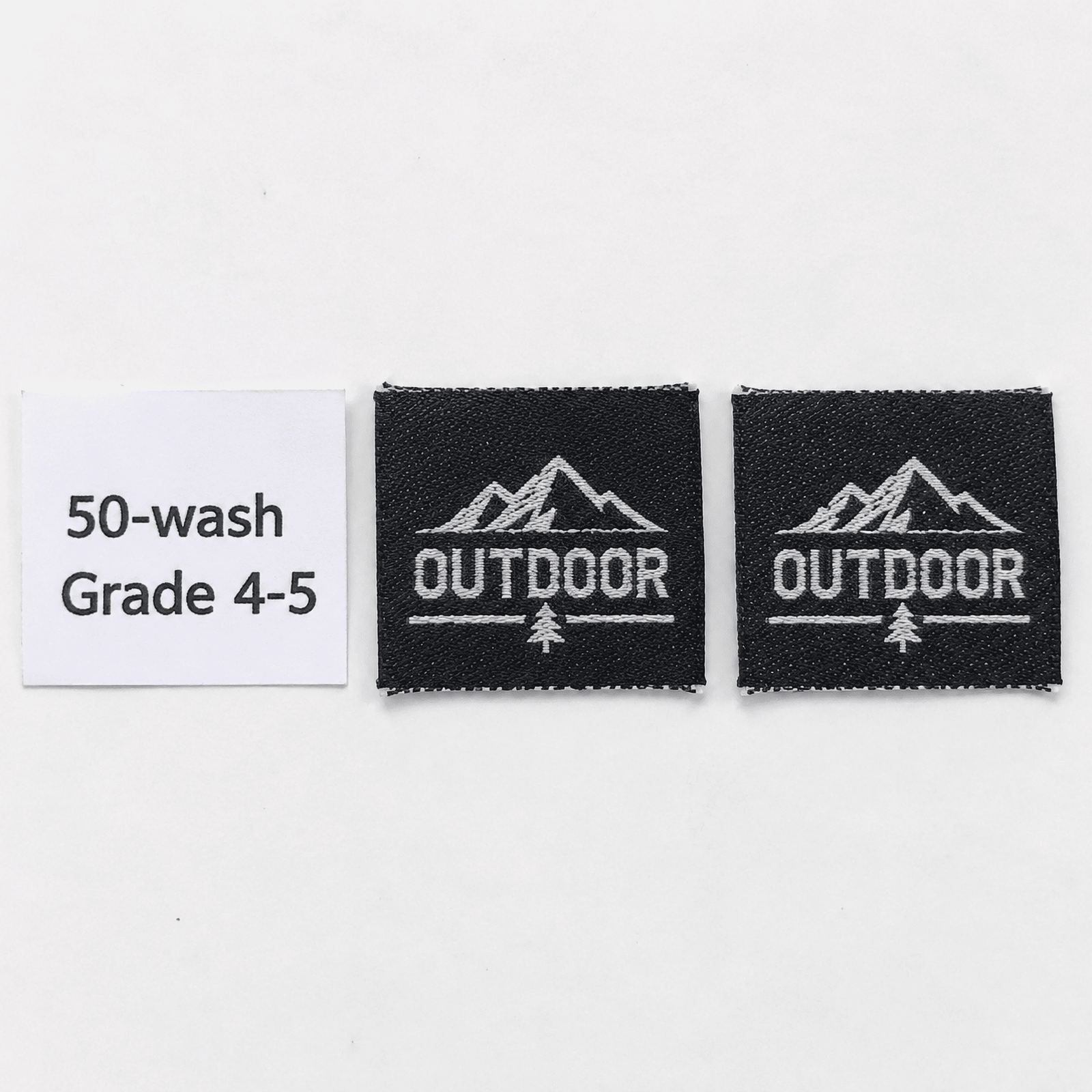
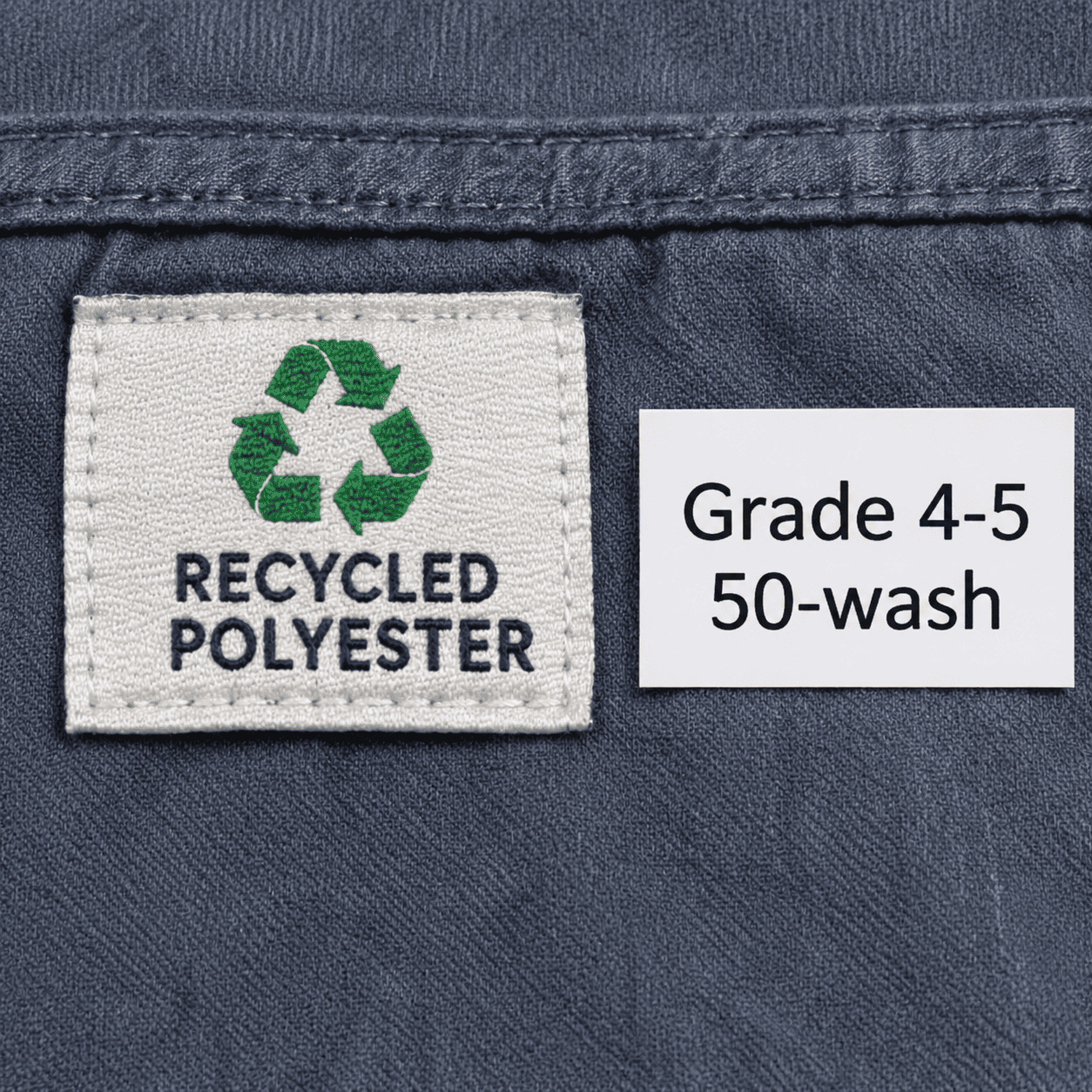
Recycled polyester woven labels can match the wash durability and colorfastness of virgin polyester labels under standard garment care conditions (machine wash ≤60°C). In our internal 50-wash comparison testing, recycled polyester labels achieved colorfastness ratings of Grade 4–5 — on par with virgin polyester benchmarks. However, performance under high-temperature industrial laundering or prolonged UV exposure requires separate verification for your specific end-use scenario.
But a single data point from one manufacturer shouldn't be the end of your evaluation. Below, I'll walk you through the specific tests you should request, the numbers that constitute a "pass," the honest limitations of recycled polyester labels, and — critically — how to verify that the test reports your supplier hands you are real.
What Does Our Internal Testing Reveal About Recycled vs. Virgin Polyester Labels?
Procurement teams often hesitate at the recycled polyester switch because they assume "recycled" means "weaker." Without head-to-head data, that assumption hardens into policy. The result? Brands miss sustainability targets they've publicly committed to.
Our internal testing data shows that recycled polyester woven labels perform comparably to virgin polyester under standard consumer laundering conditions. Across a controlled 50-wash cycle comparison at ≤60°C, both materials maintained structural integrity, and colorfastness scored Grade 4–5 on the grey scale — the range most retailers accept as passing1.
How We Structured the Comparison
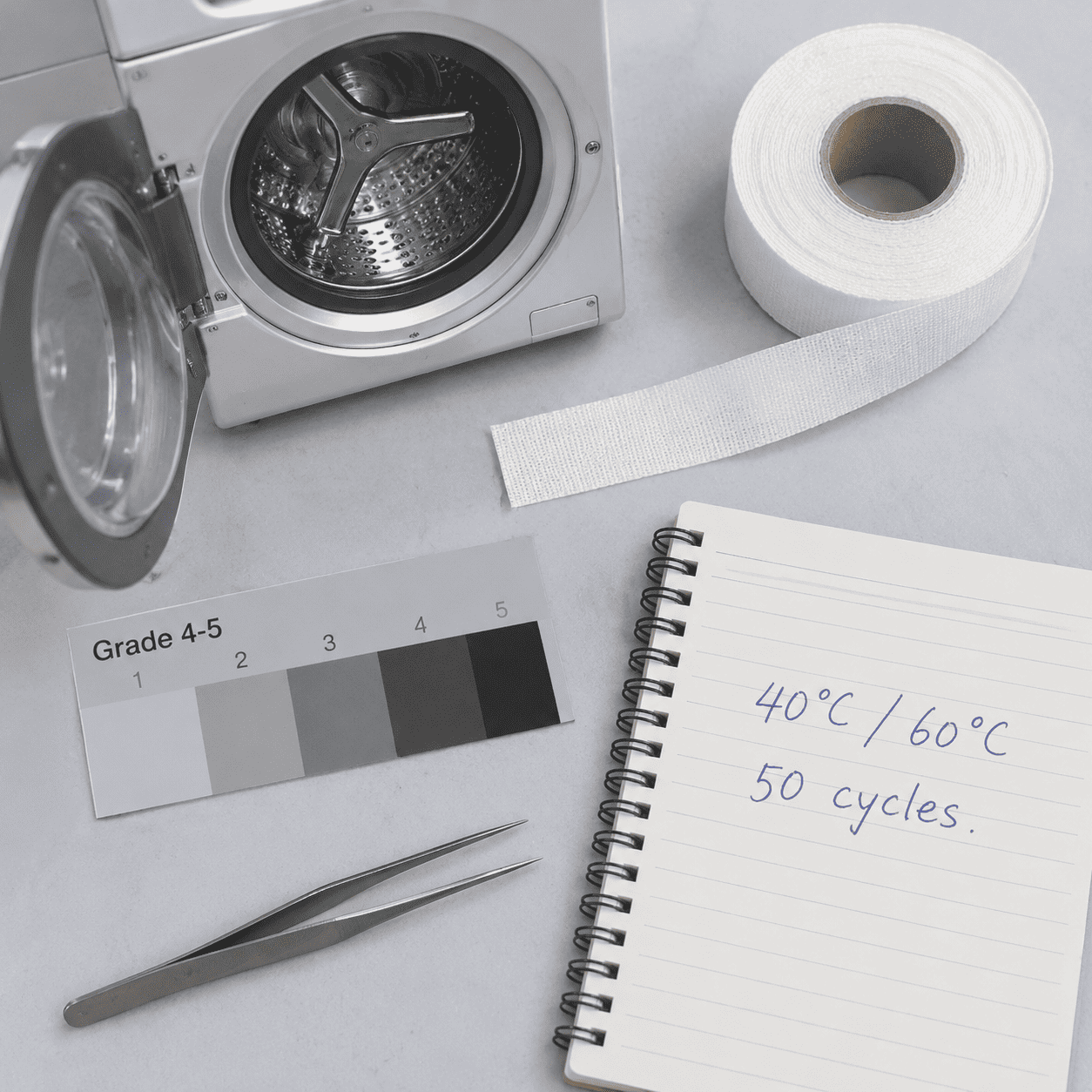
We manufacture recycled polyester woven labels in-house, which gives us direct access to production-batch materials for testing. Here's what we controlled for:
- Material source: Post-consumer recycled polyester yarn (GRS-traceable)2 vs. standard virgin polyester yarn, both in the same denier range
- Weave construction: Identical damask weave density, thread count, and label dimensions
- Wash protocol: Home laundering simulation at 40°C and 60°C, with standard detergent, tumble dried at medium heat
- Cycle count: 50 consecutive wash-dry cycles per sample set
- Evaluation criteria: Colorfastness to washing (grey scale rating), edge fraying, text legibility, dimensional stability
The Results in Numbers
| Test Parameter | Recycled Polyester | Virgin Polyester |
|---|---|---|
| Colorfastness (grey scale) after 50 washes at 40°C | Grade 4–5 | Grade 4–5 |
| Colorfastness (grey scale) after 50 washes at 60°C | Grade 4 | Grade 4–5 |
| Edge fraying | Minimal, comparable | Minimal |
| Text legibility after 50 washes | Fully legible | Fully legible |
| Dimensional change | <1% shrinkage | <1% shrinkage |
A few important caveats. These are internal production-floor tests, not ISO-accredited laboratory results. The data reflects specific yarn batches, specific weave constructions, and specific wash conditions. I share them because they dissolve the reflexive assumption that recycled means inferior — but I do not present them as universal proof. Your end-use conditions may differ, and I'd always recommend confirming with third-party lab testing on your actual production samples.
Also note the slight colorfastness dip at 60°C for recycled polyester. At 50 washes, we consistently saw Grade 4 rather than 4–5. For most consumer apparel, this difference is negligible. For applications requiring repeated high-temperature laundering, it's a flag worth investigating further.
Where Do Recycled Polyester Woven Labels Actually Fall Short?
Here's where most supplier content goes wrong: they bury the limitations at the bottom of the page, or they skip them entirely. If you're a procurement manager spending six or seven figures annually on trims, you already know that every material has boundaries. What you need is specificity — not reassurance.
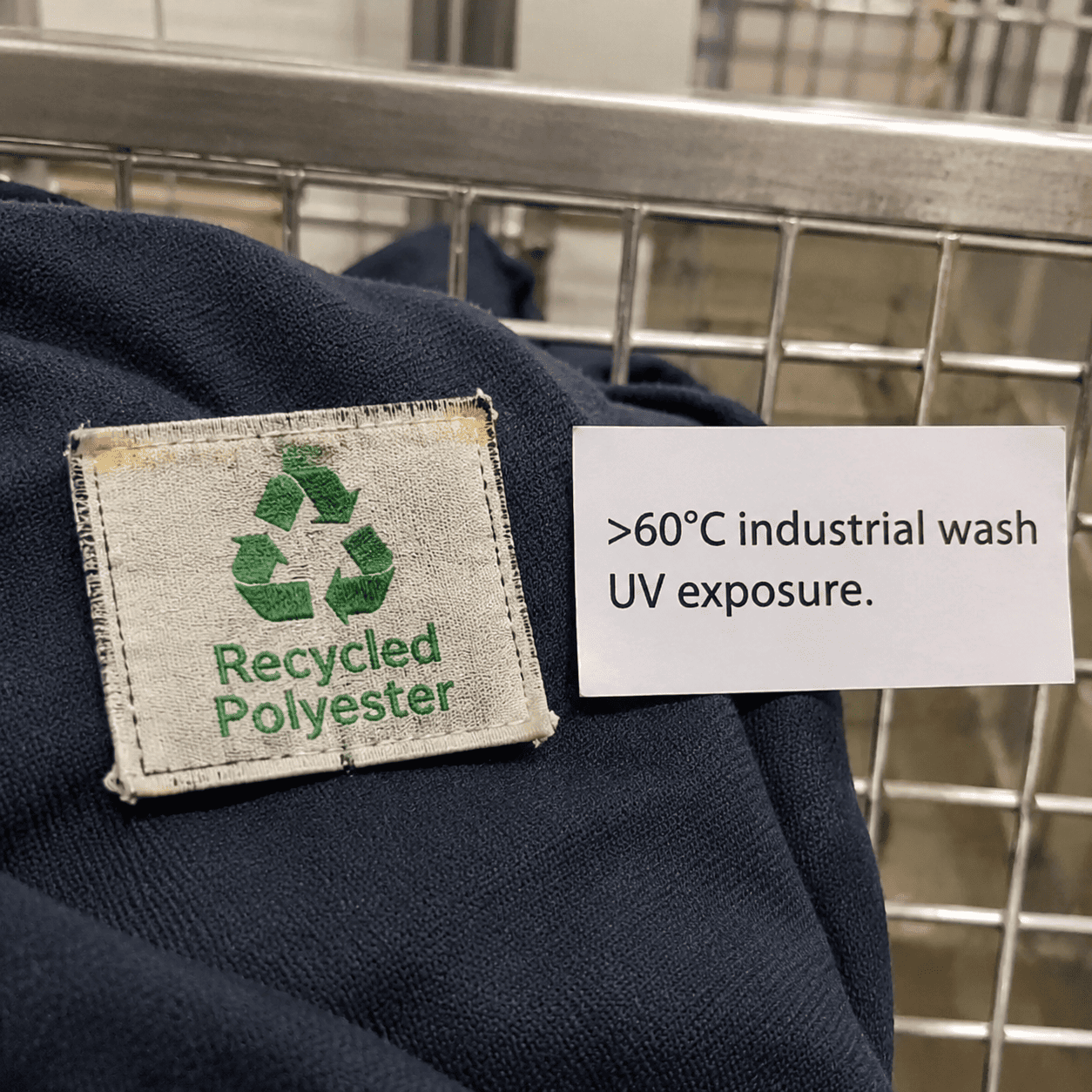
Recycled polyester woven labels have three known performance boundaries: high-temperature industrial laundering above 60°C, prolonged direct UV exposure, and extreme mechanical abrasion. These limits don't disqualify the material — they define where additional testing or alternative materials are warranted.
High-Temperature Industrial Laundering (>60°C)
This is the most commercially relevant limitation. Hospitality uniforms, healthcare garments, and industrial workwear often undergo repeated laundering at 70–85°C with aggressive detergents3. In our internal testing, we observed measurable colorfastness degradation and increased edge fraying when recycled polyester labels were subjected to repeated cycles above 60°C.
If your labels will face industrial wash protocols, do not rely on consumer-wash test data. Request testing specifically under ISO 15797 (industrial laundering) or the relevant protocol your end customer specifies. This is a scenario where recycled polyester may not be a drop-in substitute without reformulation of yarn chemistry or weave construction.
Prolonged UV Exposure
Outdoor apparel, swimwear displayed on retail racks under strong lighting, or garments stored in sunny warehouse environments can expose labels to sustained UV. Recycled polyester dyes may exhibit slightly faster fading under prolonged UV compared to virgin polyester4, particularly in lighter colorways.
The relevant test standard is ISO 105-B02 (colorfastness to artificial light). If your product category involves outdoor exposure, request lightfastness testing at a minimum rating of Grade 4 on the blue wool scale.
Extreme Abrasion Scenarios
Labels positioned at high-friction contact points — such as waistbands on activewear or collar labels on workwear — experience repeated mechanical abrasion. While our standard woven labels handle normal abrasion well through 50+ wash cycles, extreme abrasion environments (think industrial safety garments) should be tested under ISO 12947 (Martindale abrasion)5 or ASTM D4966 to establish a wear cycle threshold.
Bottom line for procurement teams: If your garments are consumer-laundered at ≤60°C, recycled polyester woven labels are a strong candidate. If your application involves industrial washing, heavy UV, or extreme abrasion, treat these as "verify before committing" scenarios — not automatic disqualifiers, but areas where you need application-specific test data.
Which Durability Test Standards Should You Require From Any Supplier?
Most buyers I work with know they need "test reports." Far fewer know which specific tests to request or what a passing score actually looks like. This gap is where bad sourcing decisions happen — a supplier hands over a generic certificate, and nobody on the buying side knows whether it covers the right parameters.
The four most commonly required durability test standards for woven labels in the apparel industry are AATCC 61, ISO 105-C06, ISO 105-X12, and ISO 105-B02. Each tests a different failure mode, and each has a specific pass/fail threshold your retail and brand customers will reference.
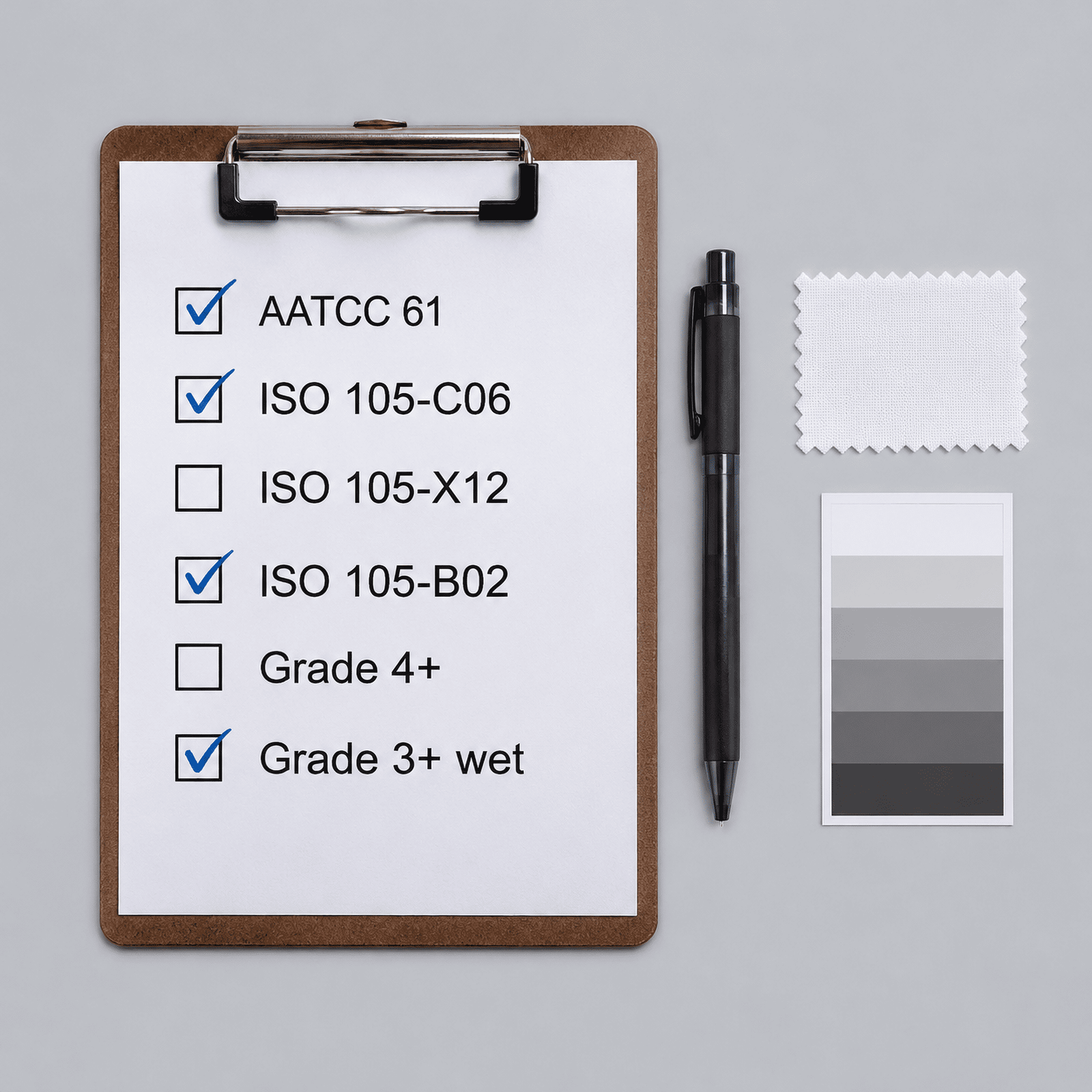
Your Durability Testing Checklist
Here's the testing matrix I recommend procurement managers use when evaluating any woven label supplier — whether they're offering recycled or virgin polyester:
| Test Standard | What It Measures | Pass Threshold (Typical Retail Requirement) | When to Require It |
|---|---|---|---|
| AATCC 61 (Colorfastness to Laundering) | Color change and staining after simulated washing | Grade 4 minimum on grey scale | All consumer apparel |
| ISO 105-C06 (Colorfastness to Domestic/Commercial Laundering) | Color change under various wash temperatures and detergent conditions | Grade 4 minimum on grey scale | EU/UK market compliance, international brands |
| ISO 105-X12 (Colorfastness to Rubbing) | Color transfer under dry and wet rubbing | Grade 3–4 dry, Grade 3 wet (minimum) | High-friction label placements, activewear |
| ISO 105-B02 (Colorfastness to Artificial Light) | Fading under simulated sunlight | Grade 4 on blue wool scale | Outdoor apparel, swimwear, retail-displayed goods |
How to Read the Grey Scale
The grey scale runs from Grade 1 (severe change) to Grade 5 (no change). Most major retailers — including Amazon private label programs, big-box chains, and European fashion retailers — set their minimum at Grade 4. Some premium brands require Grade 4–5.
If your supplier provides a test report showing Grade 3 or below on any of the above, that's a fail for most commercial applications. Don't accept "close enough" — retailer compliance audits use these numbers as hard cutoffs.
AATCC vs. ISO: Which Framework Should You Use?
This depends on your market:
- North American retailers typically reference AATCC standards
- European and international brands more commonly reference ISO standards
- Many global brands accept either, but specify one in their vendor manual
If you sell into both markets, request testing under both AATCC 61 and ISO 105-C06. The protocols differ slightly in wash temperature, detergent composition, and mechanical action — a label that passes one may not automatically pass the other.
A Printable Checklist for Your Next Supplier Conversation
I've seen too many procurement teams accept a single page of test results without checking whether it covers the right standards. Here's what to ask for:
- [ ] Colorfastness to laundering (AATCC 61 or ISO 105-C066) — Grade 4+ on grey scale
- [ ] Colorfastness to rubbing (ISO 105-X12) — Grade 3+ wet, Grade 4+ dry
- [ ] Colorfastness to light (ISO 105-B02) — Grade 4+ on blue wool scale (if applicable)
- [ ] Dimensional stability after washing — <2% change
- [ ] Test conducted on production-representative samples, not pre-production prototypes
- [ ] Report issued by an accredited third-party lab (not supplier's internal QC only)
How Can You Verify That Supplier Test Reports Are Authentic?
This is the section I wish more articles included. In our experience serving procurement managers across 30+ countries, fake or misleading test certificates are a real and recurring problem. One of the most common pain points I hear from buyers — especially those managing $1M+ annual trim budgets — is discovering after delivery that a supplier's "certified" test report doesn't hold up under scrutiny.
Verifying the authenticity of durability test reports is a three-step process: check the lab's accreditation, cross-reference the report number, and request independent re-testing on delivered goods. Skipping any of these steps leaves a gap that unreliable suppliers can exploit.
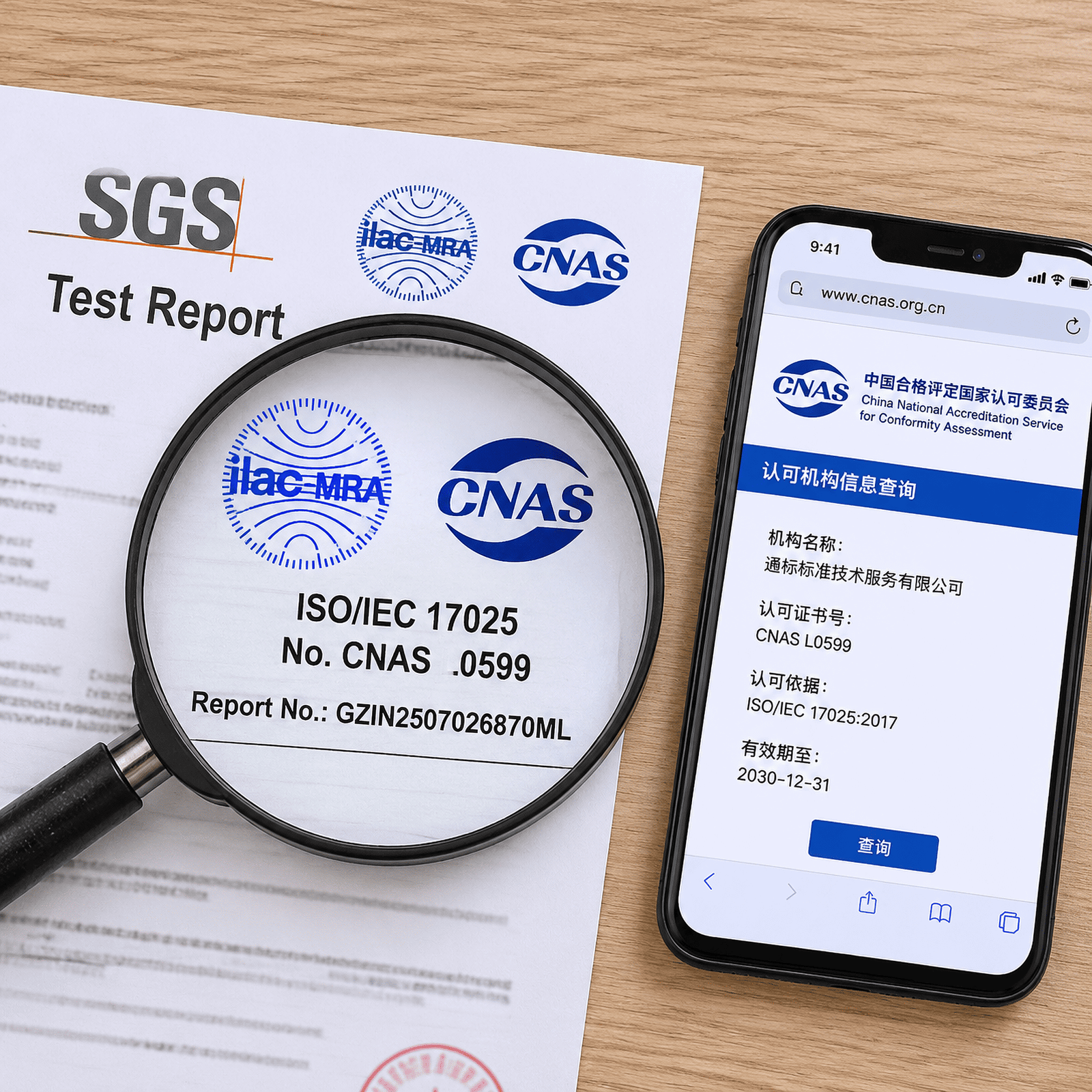
Step 1: Check the Lab's Accreditation
A legitimate test report should come from a laboratory accredited under ISO/IEC 17025 — the international standard for testing and calibration laboratory competence. Major accredited labs in the textile space include SGS, Intertek, Bureau Veritas, and TÜV, among regional players.
How to verify:
- Look for the accreditation body's logo and accreditation number on the report
- Cross-check the lab's accreditation status on the accreditation body's public database (e.g., CNAS in China, UKAS in the UK, A2LA in the US)
- If the report lists an unfamiliar lab, search for it in the ILAC Mutual Recognition Arrangement7 database
Red flag: A test report with no accreditation number, no lab contact information, or a lab name that returns zero search results online.
Step 2: Cross-Reference the Report Number
Every legitimate test report has a unique report number. Contact the issuing laboratory directly — by phone or email using contact information from the lab's official website, not from the supplier's forwarded email — and ask them to confirm:
- The report number exists in their system
- The test date and product description match what the supplier provided
- The report has not been altered or reissued
This takes 10 minutes and can save you from a six-figure sourcing mistake.
Step 3: Request Re-Testing on Delivered Goods
The most robust verification method is to pull samples from actual delivered goods and submit them to an independent accredited lab for re-testing. This catches two common problems:
- Bait-and-switch: The supplier tested a premium sample but ships lower-grade production material
- Report recycling: The supplier uses a valid old report but has since changed yarn sources or weave specifications
I recommend building re-testing into your quality control workflow, especially for initial orders from new suppliers or when switching from virgin to recycled polyester. The cost of a single colorfastness test at an accredited lab typically runs $50–$150 — negligible compared to the cost of a failed compliance audit or a batch of returns.
What About Sustainability Certifications?
A common confusion I want to address: sustainability certifications are not durability certifications. Here's how they differ:
| Certification | What It Proves | What It Does NOT Prove |
|---|---|---|
| GRS (Global Recycled Standard) | Recycled content traceability, chain of custody | Wash durability, colorfastness, physical performance |
| OEKO-TEX® STANDARD 100 | Absence of harmful chemicals, product safety | Wash durability, colorfastness, dimensional stability |
| AATCC/ISO test reports | Specific performance under tested conditions | Recycled content, chemical safety, environmental impact |
As a manufacturer holding OEKO-TEX® STANDARD 100 certification8, I value what it represents — it's a meaningful trust signal for chemical safety. But I would never present it as evidence that our labels survive 50 wash cycles. Those are different questions requiring different documentation. Any supplier who conflates the two is either confused or hoping you won't notice.
How Should You Structure a Supplier Evaluation for Recycled Polyester Woven Labels?
Switching to recycled polyester woven labels involves more variables than a simple material swap. If you treat it like a one-line procurement change, you risk discovering problems at the worst possible moment — during a retailer audit or after customer complaints spike.
A structured supplier evaluation for recycled polyester woven labels should cover four pillars: material traceability, durability test coverage, production consistency, and ongoing verification. Evaluating all four reduces the risk of post-purchase surprises.
Pillar 1: Material Traceability
Request documentation proving the recycled content claim. GRS (Global Recycled Standard) certification or equivalent third-party verification of the recycled polyester yarn supply chain is the industry benchmark. Ask for:
- GRS Transaction Certificate for the specific yarn lot
- Supplier's scope certificate confirming they're authorized to process GRS-certified materials
- Yarn supplier identification (you don't need trade secrets — just confirmation that the supply chain is auditable)
Pillar 2: Durability Test Coverage
Use the testing checklist from the section above. Additionally:
- Confirm tests were conducted on the same weave construction and colorway you're ordering, not a generic sample
- Ask whether tests reflect recycled polyester specifically, not virgin polyester results applied to recycled product
- Request test reports dated within the last 12 months — old reports may not reflect current yarn batches
Pillar 3: Production Consistency
Durability data from one sample batch is a starting point, not a guarantee. Evaluate:
- Does the supplier have documented incoming material inspection procedures?
- Do they conduct in-process quality checks (weave density, color matching against approved standards)?
- Can they provide batch-to-batch colorfastness records over multiple production runs?
- What is their defect rate on woven labels, and how do they handle nonconforming product?
Pillar 4: Ongoing Verification
Build verification into your purchasing agreement:
- First-article inspection: Test the first production batch against approved samples before releasing the full order
- Skip-lot testing: Periodically submit delivered labels to an independent lab (every 3rd or 5th order, for example)
- Annual re-certification review: Confirm that the supplier's GRS, OEKO-TEX, or other certifications remain valid and current
Pro tip for high-volume buyers: Negotiate the right to conduct unannounced quality audits or pull random samples from shipments for independent testing. Suppliers confident in their quality will agree to this. Suppliers who resist may be signaling a problem.
Frequently Asked Questions
Are recycled polyester woven labels as durable as virgin polyester labels?
Under standard consumer laundering conditions (≤60°C), recycled polyester woven labels perform comparably to virgin polyester in both colorfastness and structural integrity. Based on our internal 50-wash cycle testing, both materials scored Grade 4–5 on the grey scale. For high-temperature industrial applications, verify durability with application-specific testing.
What colorfastness rating should I require for woven labels?
Most major retailers require a minimum of Grade 4 on the grey scale for colorfastness to laundering. For premium brands, Grade 4–5 is often specified. Always confirm the specific requirement in your retail partner's vendor compliance manual before setting your supplier specification.
Does GRS certification prove my recycled polyester labels are durable?
No. GRS (Global Recycled Standard) certifies the traceability and percentage of recycled content in the material. It does not test or certify wash durability, colorfastness, or physical performance. You need separate AATCC or ISO test reports to verify durability.
How can I tell if a supplier's test report is fake?
Check three things: (1) the issuing lab's ISO/IEC 17025 accreditation status on the accreditation body's public database, (2) cross-reference the report number directly with the lab, and (3) submit samples from delivered goods to an independent lab for re-testing. This three-step process catches the most common forms of certificate fraud.
Can recycled polyester labels handle outdoor or UV-exposed applications?
Recycled polyester labels may show faster fading under prolonged UV exposure compared to virgin polyester, particularly in lighter colors. If your product category involves outdoor use, request lightfastness testing under ISO 105-B02 and confirm a minimum Grade 4 on the blue wool scale before committing to production.
Conclusion
Durability testing for recycled polyester woven labels doesn't have to be a guessing game. The data we've gathered from internal testing — 50-wash cycles, Grade 4–5 colorfastness, structural integrity on par with virgin polyester under consumer wash conditions — demonstrates that the material is commercially viable for the vast majority of apparel applications. But data only protects you if you know which tests to require, what scores constitute a pass, and how to verify that supplier reports are legitimate.
Know the boundaries: high-temperature industrial laundering, prolonged UV, and extreme abrasion are scenarios that demand additional, application-specific verification. Don't accept blanket claims from any supplier — including us. Request accredited third-party test reports, cross-reference them, and build re-testing into your quality control workflow.
If you're evaluating recycled polyester woven labels for your brand or distribution business and want to review our internal test data, request free samples, or discuss your specific application requirements, contact our team for a consultation. We provide technical specification sheets and can arrange samples within 3–7 days so you can conduct your own independent verification before committing to production.
"Grey Scale (Gray Scale) in Textile Colour Fastness", https://tetrainspection.com/grayscale/. Industry guidance from organizations such as AATCC and published retailer vendor manuals indicate that a grey scale rating of Grade 4 (corresponding to slight color change) is widely adopted as the minimum acceptable threshold for colorfastness to laundering in commercial apparel. Evidence role: general_support; source type: institution. Supports: Major apparel retailers commonly specify a minimum grey scale rating of Grade 4 for colorfastness to laundering in their vendor compliance manuals.. Scope note: Specific retailer thresholds vary by brand and product category; no single public source comprehensively catalogs all retailer requirements. ↩
"Global Recycled Standard (GRS)", https://textileexchange.org/knowledge-center/materials/global-recycled-standard-grs/. The Global Recycled Standard (GRS), managed by Textile Exchange, is an international, voluntary product standard that sets requirements for third-party certification of recycled content, chain of custody, social and environmental practices, and chemical restrictions. Evidence role: definition; source type: institution. Supports: The Global Recycled Standard, administered by Textile Exchange, provides chain-of-custody certification for products containing recycled content, including post-consumer recycled polyester.. Scope note: GRS documentation describes the standard's scope but does not independently verify any specific supplier's compliance claims. ↩
"G. Laundry and Bedding | Infection Control", https://www.cdc.gov/infection-control/hcp/environmental-control/laundry-bedding.html. ISO 15797:2017 specifies industrial laundering and finishing procedures for testing workwear textiles, with wash cycles typically conducted at temperatures ranging from 60°C to 92°C depending on the disinfection and soil removal requirements of the application. Evidence role: general_support; source type: research. Supports: Industrial laundering protocols for healthcare and hospitality textiles commonly specify wash temperatures of 70–85°C to achieve thermal disinfection requirements.. Scope note: Exact temperature protocols vary by facility, country regulations, and specific hygiene requirements; 70–85°C is representative but not universal. ↩
"A comprehensive review of ultraviolet radiation and functionally modified ...", https://pmc.ncbi.nlm.nih.gov/articles/PMC11605348/. Research on recycled PET fibers indicates that the mechanical recycling process can introduce chain scission, reduced molecular weight, and trace contaminants that may affect dye-fiber interactions and photostability, potentially leading to reduced lightfastness under prolonged UV exposure compared to virgin PET fibers. Evidence role: mechanism; source type: paper. Supports: Recycled polyester fibers may contain residual contaminants or structural irregularities from the recycling process that can affect dye uptake uniformity and UV stability compared to virgin polyester.. Scope note: Published studies vary in recycling process type, fiber grade, and dye chemistry; results may not generalize to all recycled polyester yarn sources used in woven label production. ↩
"Martindale (unit)", https://en.wikipedia.org/wiki/Martindale_(unit). ISO 12947, comprising multiple parts, specifies methods for determining the resistance to abrasion of textile fabrics using the Martindale apparatus, measuring either mass loss, specimen breakdown, or appearance change under controlled abrasive action. Evidence role: definition; source type: institution. Supports: ISO 12947 specifies the Martindale method for determining the abrasion resistance of textile fabrics.. Scope note: The standard is designed for fabric testing generally; its direct applicability to small-format woven labels may require adaptation of specimen preparation procedures. ↩
"Colour Fastness Test Protocols: ISO 105 and AATCC", https://www.karcem.com.tr/en/colour-fastness-iso-aatcc.html. AATCC Test Method 61, published by the American Association of Textile Chemists and Colorists, and ISO 105-C06, published by the International Organization for Standardization, both assess textile colorfastness to laundering but employ different test conditions including detergent type, temperature options, steel ball inclusion, and agitation parameters, meaning results are not directly interchangeable. Evidence role: general_support; source type: institution. Supports: AATCC Test Method 61 and ISO 105-C06 both evaluate colorfastness to laundering but differ in wash conditions, detergent formulations, and mechanical action parameters.. Scope note: Detailed protocol differences require access to the full standard documents; summary comparisons may not capture all test condition variations relevant to specific label constructions. ↩
"Scope and Obligations", https://www.nist.gov/document/ilacp5062022. The International Laboratory Accreditation Cooperation (ILAC) operates a Mutual Recognition Arrangement (MRA) among its member accreditation bodies, which facilitates international acceptance of test and calibration results from laboratories accredited by MRA signatories. Evidence role: definition; source type: institution. Supports: The International Laboratory Accreditation Cooperation (ILAC) maintains a Mutual Recognition Arrangement among accreditation bodies worldwide, enabling cross-border recognition of accredited test results.. Scope note: The ILAC MRA database confirms accreditation body membership, but individual laboratory accreditation status must be verified through the specific national accreditation body's registry. ↩
"Oeko-Tex", https://en.wikipedia.org/wiki/Oeko-Tex. OEKO-TEX® STANDARD 100, administered by the International Association for Research and Testing in the Field of Textile and Leather Ecology, is an independent testing and certification system for textile raw materials, intermediate, and end products at all stages of production, focused on testing for harmful substances according to defined limit values. Evidence role: definition; source type: institution. Supports: OEKO-TEX® STANDARD 100 is a product safety certification that tests for harmful substances in textiles, not a performance or durability certification.. ↩
0 Comments
Ask a question or share your garment accessories sourcing experience.