

Dyeing Requirements for Recycled Polyester Used in Apparel Trims
Switching your apparel trims to recycled polyester sounds straightforward—until the first bulk shipment arrives two shades off your Pantone reference. Dyeing requirements for recycled polyester trims are fundamentally different from those for virgin PET, and most procurement teams discover this the hard way: through failed color-fastness tests, batch-to-batch shade variation, and costly re-dye requests.
Recycled polyester (rPET) does not dye like virgin polyester. The fiber's inconsistent crystallinity and residual contaminants from the recycling process alter dye uptake rates, making trim categories like woven labels, elastic bands, and embroidered patches especially prone to color deviation. Buyers switching to rPET trims must adjust their color tolerance windows, fastness specifications, and sampling protocols upfront—not after bulk production begins.
The real question is not whether recycled polyester can be dyed. It absolutely can. The question is which trim types carry the highest dyeing risk when you make the switch—and what you should specify in your purchase order to avoid batch failures. Below, I break down the specific dyeing challenges across trim categories, the fastness gaps you should anticipate, and the procurement language that protects your production timeline.
Why Does Recycled Polyester Dye Differently Than Virgin Polyester?
If you have been sourcing virgin PET trims for years, your first rPET order may feel like a rude awakening. The same dye recipe, the same disperse dye class, the same temperature curve—and yet the color comes out noticeably different. Understanding why is the first step toward specifying correctly.
Recycled polyester fibers have a different internal structure than virgin fibers. The recycling process—especially the dominant bottle-to-fiber route1—introduces variability in crystallinity, intrinsic viscosity (IV), and surface contaminants that directly affect how dye molecules penetrate and bond with the fiber.
Inconsistent Crystallinity and Dye Uptake
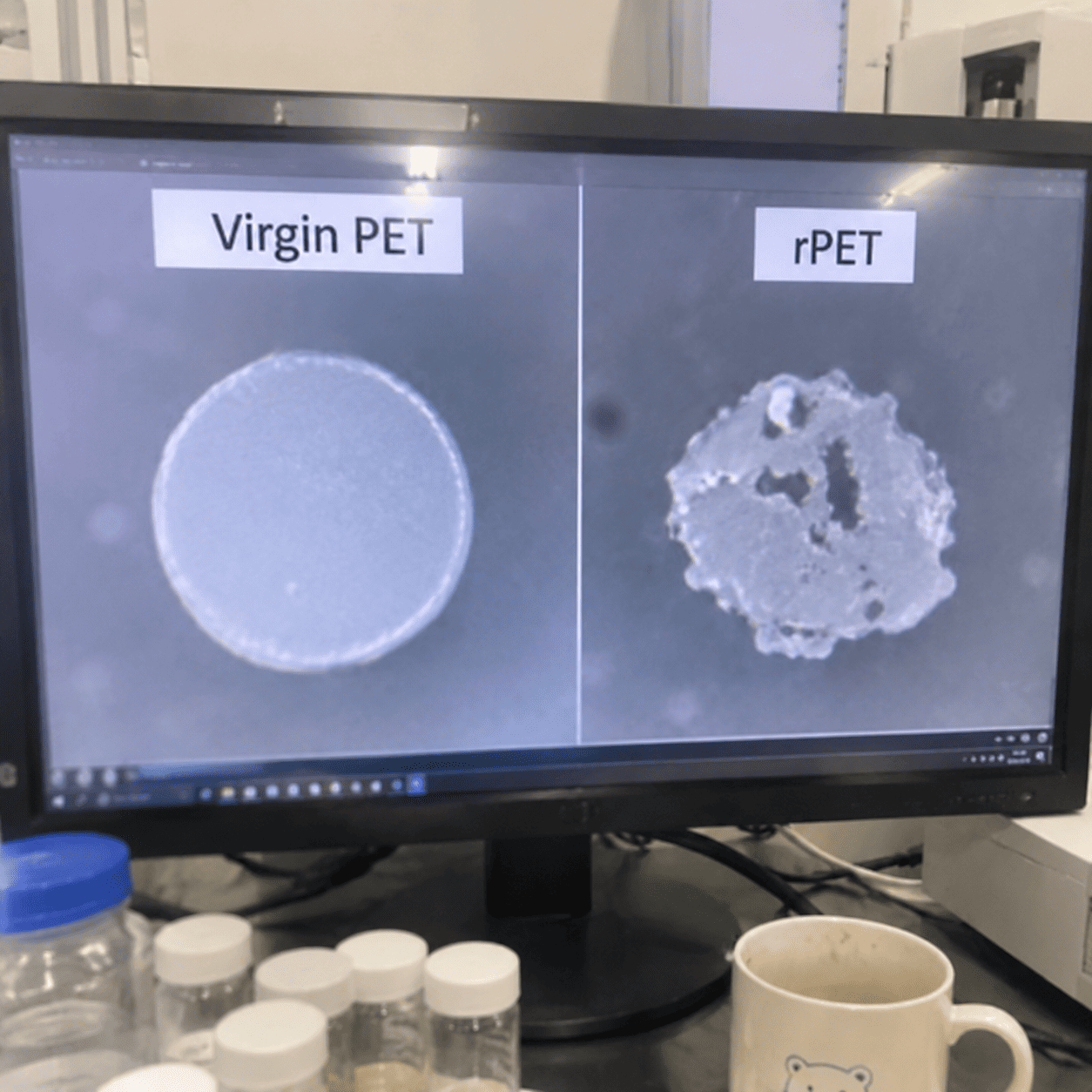
In our experience producing woven labels with rPET yarn, the most persistent issue is uneven dye uptake. Virgin polyester has a relatively uniform crystalline structure, which means disperse dyes penetrate at a predictable rate2. Recycled polyester, by contrast, has been through thermal degradation during its previous life cycle and again during reprocessing. This creates zones of varying crystallinity within the same fiber3—some regions are more amorphous (absorb dye readily), others are more crystalline (resist dye penetration).
The practical result? A deep navy that should read as a consistent tone across a woven label may show subtle streaking or a "washed out" appearance in certain areas. Multiply that across a 5,000-meter production run and you have a measurable color deviation problem.
Residual Contaminants
Bottle-grade rPET can carry trace residues from:
- Adhesive compounds from original bottle labels
- Colorants from the original PET bottles (especially green and blue tints)
- Surface coatings and UV stabilizers
These contaminants may be invisible to the naked eye in raw fiber form, but they interact with disperse dyes during the high-temperature exhaust dyeing process (typically 125–135 °C for polyester)4. The result is a color shift—sometimes only 0.5–1.0 ΔE on a spectrophotometer, but enough to fail a strict brand approval.
Variable Feedstock, Variable Results
Here is what many buyers do not realize: virgin polyester comes from a controlled petrochemical process with tight specifications. Recycled polyester comes from collected post-consumer bottles—and the composition of that collection changes. Different bottle sources mean different IV values, different levels of degradation, and different trace contaminant profiles.
| Factor | Virgin Polyester | Recycled Polyester (rPET) |
|---|---|---|
| Crystallinity | Uniform, controlled | Variable, process-dependent |
| Intrinsic Viscosity (IV) | Consistent batch to batch | Fluctuates with feedstock source |
| Surface Contaminants | Minimal | Trace adhesives, colorants, coatings |
| Dye Uptake Predictability | High | Moderate to low |
| Color Reproducibility | Tight tolerance achievable | Wider tolerance required |
Key takeaway for procurement: The dyeing requirements for recycled polyester demand that you treat color matching as a risk management exercise, not a one-and-done approval.
Which Apparel Trim Types Carry the Highest Dyeing Risk with rPET?
Not all trims are equally affected. Some trim constructions magnify the dyeing variability inherent in recycled polyester, while others are more forgiving. If you are planning a phased transition to rPET trims, understanding which categories to approach cautiously can save you significant rework costs.
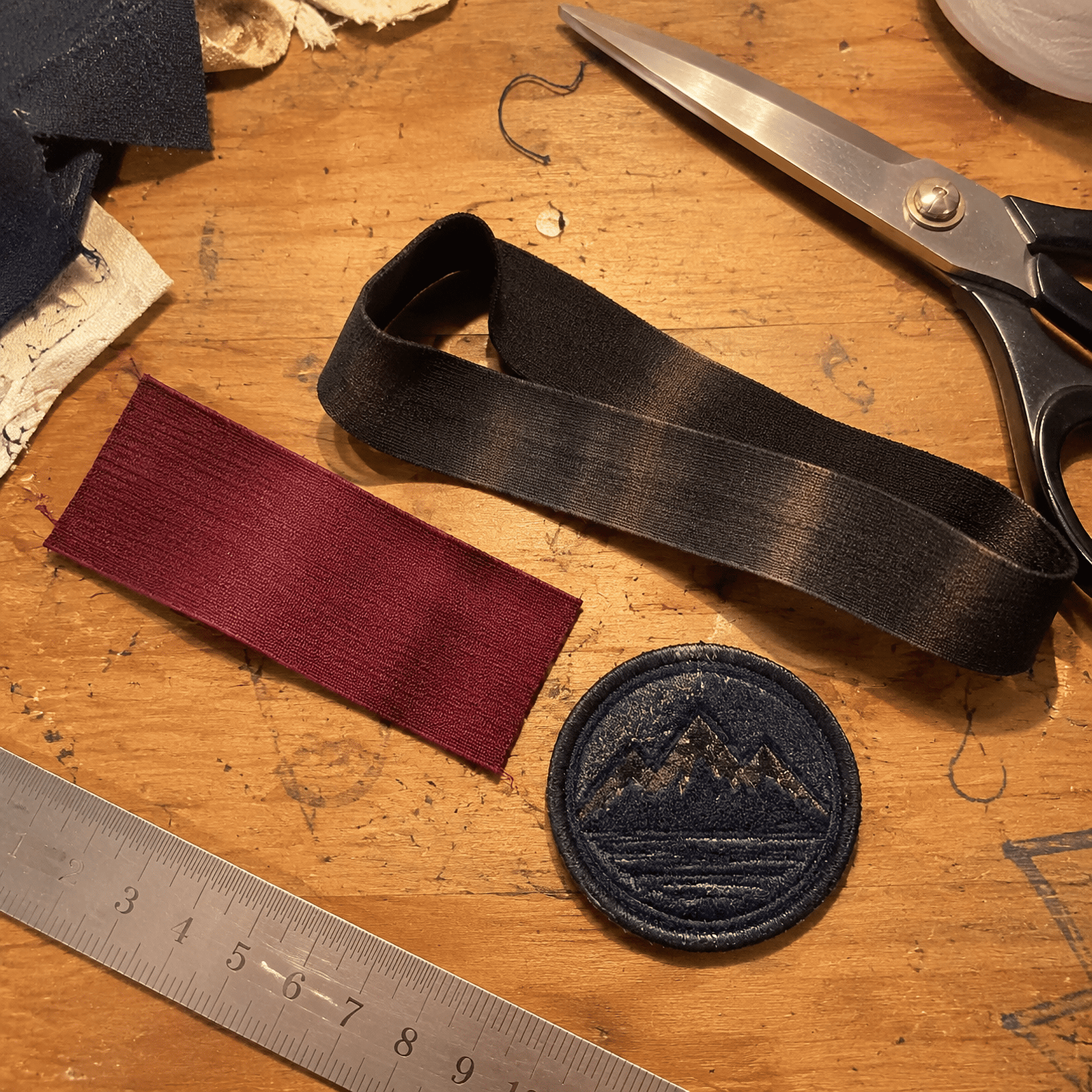
The highest-risk categories are woven labels, elastic bands, and drawcords—each for different reasons. Care labels and embroidered patches fall into a moderate-risk tier, depending on construction and end-use washing frequency.
Woven Labels: High Dye Density on a Small Canvas
Woven labels are the most unforgiving trim type for rPET dyeing issues. Here is why: a woven label packs extremely high thread density into a surface area of just a few square centimeters. Any inconsistency in dye uptake between individual yarns is immediately visible. There is nowhere for the variation to hide.
In our production, we have observed that deep, saturated colors—blacks, navies, burgundies—are where woven labels with rPET yarn struggle most. Light and medium tones are more forgiving because minor uptake variation is less perceptible to the human eye.
What to specify:
- Request a dye lot sample from bulk yarn, not from a separate sample yarn lot
- Approve with a spectrophotometer reading, not just a visual check under D65 light
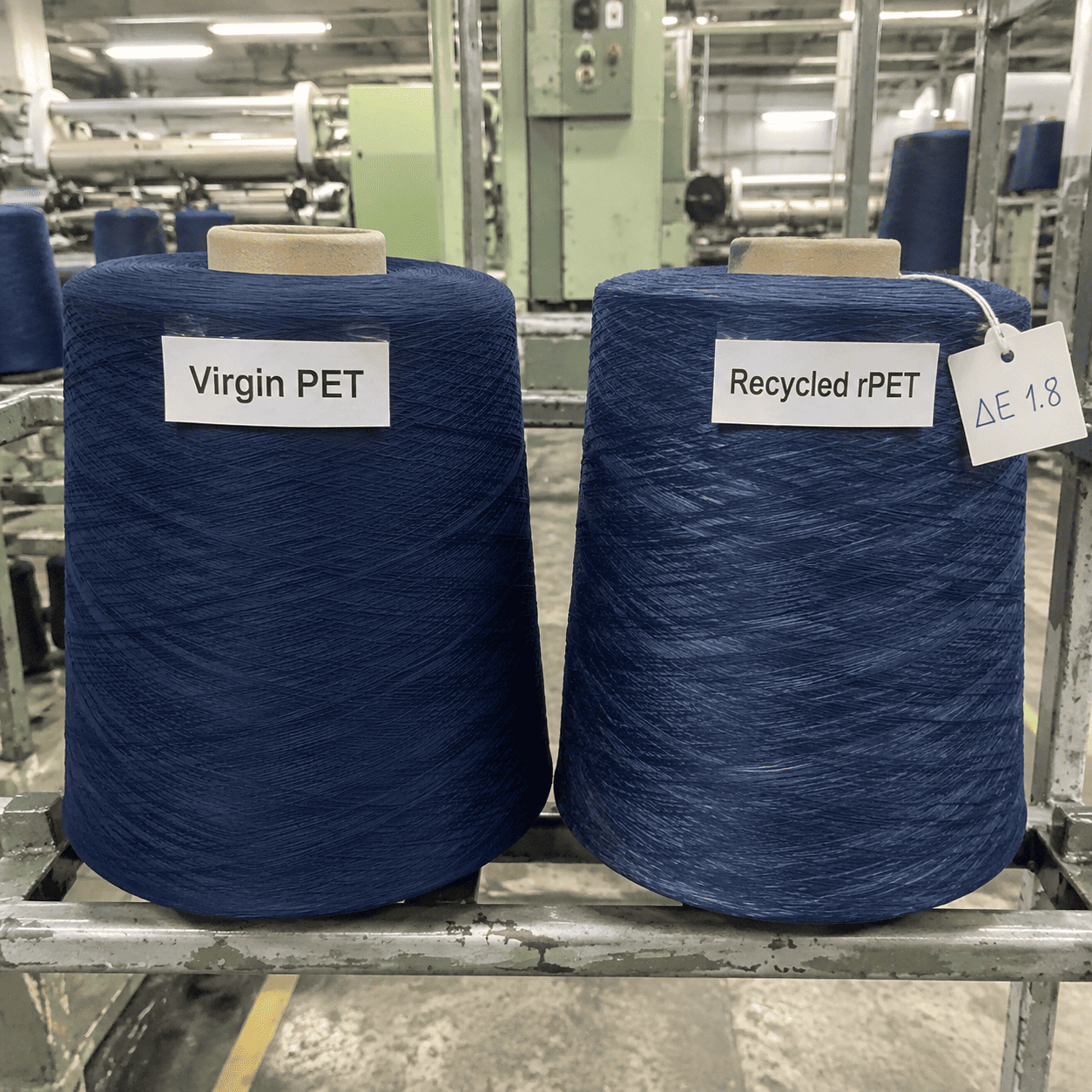
- Build a ΔE tolerance of 1.5–2.0 for rPET woven labels (versus 1.0 or tighter for virgin PET)
Elastic Bands and Drawcords: The Blended Construction Problem
Elastic bands and drawcords combine multiple fiber types—typically polyester with spandex (elastane) or nylon. When you switch the polyester component to rPET, you introduce a differential dye uptake problem. The rPET absorbs disperse dyes at a different rate than the spandex or nylon components. The result is visible color unevenness—sections that appear lighter or darker depending on the fiber composition at that point.
This is not a defect in workmanship. It is a material-inherent behavior that must be communicated clearly during sampling. I have managed multiple situations where a buyer rejected a bulk elastic band shipment for "uneven dyeing" that was, in fact, a predictable result of the blended rPET construction they approved at the sample stage.
What to specify:
- Request stretch-state color evaluation, not just relaxed-state
- Document the acceptable variation range between fiber zones at sampling
- Confirm whether the spandex/nylon component is solution-dyed or piece-dyed, as this affects the interaction
Embroidered Patches and Care Labels: Moderate Risk
Embroidered patches use thread that is typically dyed before embroidery (yarn-dyed or pre-dyed thread), so the dyeing risk shifts to the thread manufacturer. If you are sourcing rPET embroidery thread, request the thread supplier's shade consistency data across recent production lots.
Care labels washed frequently carry moderate risk because color fastness to repeated laundering is where rPET underperforms most noticeably—a topic I address in detail in the next section.
How Does Color Fastness Differ on Recycled Polyester Trims?
Color fastness is the hidden cost of switching to rPET trims. The trim arrives looking acceptable, passes the initial visual approval, and then fails after real-world use—washing, rubbing, light exposure. This is where post-delivery claims originate, and it is where the dyeing requirements for recycled polyester demand the most careful upfront specification.
Wash fastness, rubbing (crock) fastness, and light fastness all tend to underperform on rPET trims compared to virgin equivalents. The gap is not dramatic in most cases, but it is consistent enough that buyers who do not adjust their test protocols risk surprises.
Wash Fastness
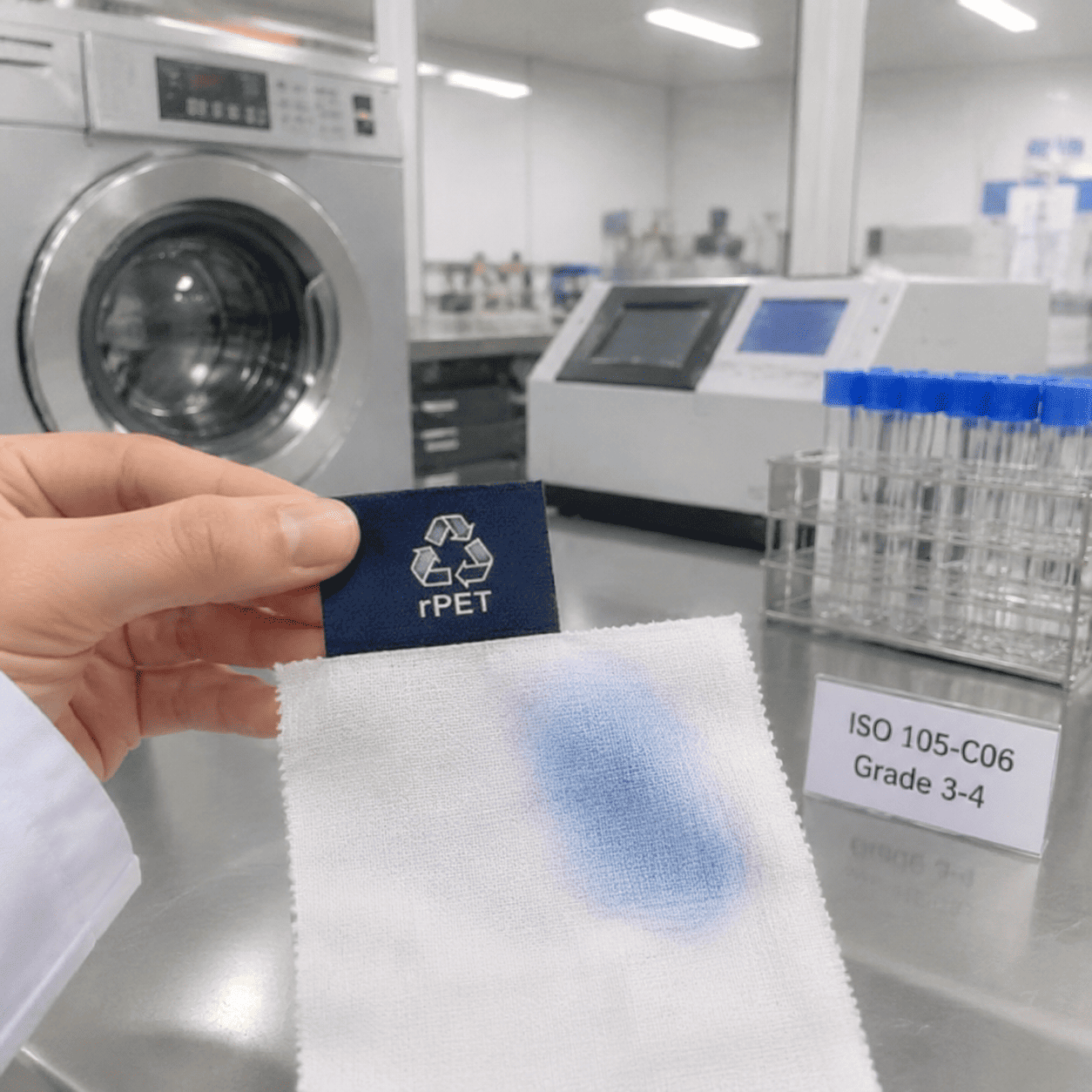
The most common issue we see is a half-grade to one-grade drop in wash fastness ratings on rPET woven labels compared to identical designs produced with virgin polyester yarn. (This is a typical industry observation—verify with your supplier's specific test reports for the yarn lot in question.)
The mechanism is straightforward: the variable crystallinity of rPET means that some dye molecules are trapped in amorphous zones that swell more readily during washing, releasing dye. On a woven label sewn into the neckline of a white T-shirt, even a minor fastness drop can produce visible staining on the garment.
Rubbing (Crock) Fastness
Rubbing fastness tends to be more problematic on elastic bands and drawcords than on woven labels, because the mechanical stretch during wear exposes fresh fiber surface and unfixed dye. For rPET blends, we typically recommend that buyers:
- Specify dry rubbing ≥ Grade 4 and wet rubbing ≥ Grade 3–4 as minimum acceptance criteria
- Request test reports conducted on the production yarn lot, not on a reference standard
Light Fastness
Light fastness is relevant primarily for externally visible trims—branded elastic waistbands, exposed drawcords, and decorative patches. rPET trims exposed to prolonged UV light may fade faster than virgin PET equivalents, particularly in pastel shades. If your trim is an external-facing brand element, discuss light fastness requirements explicitly during the specification stage.
The Certification Distinction Buyers Must Understand
Here is a critical point that I see buyers confuse regularly: OEKO-TEX® STANDARD 100 and GRS (Global Recycled Standard) certifications address material origin and chemical safety—they say nothing about dyeing performance or color fastness5. A trim can be fully GRS-certified and OEKO-TEX compliant while still failing your brand's wash fastness requirement.
Certifications verify that the recycled content claim is legitimate and that restricted chemical limits are met. They do not guarantee that the navy blue on your woven label will survive 50 wash cycles without fading. These are separate requirements, and they must be specified separately in your purchase order.
Bottom line: Always request supplier test reports for color fastness (ISO 105 or AATCC methods) in addition to environmental certifications. They answer different questions.
How Should Buyers Manage Sample-to-Bulk Color Shift with rPET Trims?
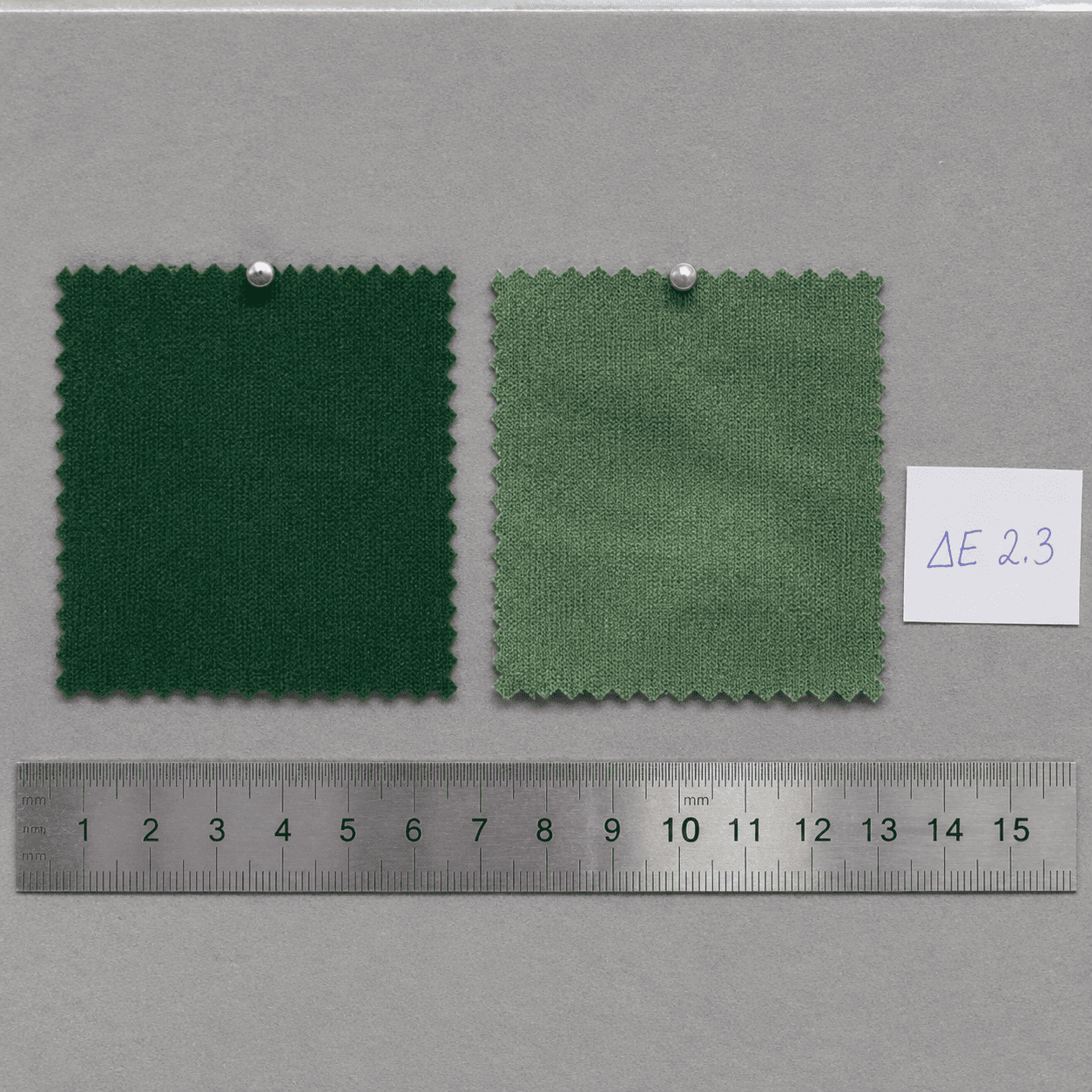
If you have worked with virgin polyester trims for any length of time, you are accustomed to a relatively tight sample-to-bulk color correlation. With recycled polyester, that correlation is structurally wider, and this is the single biggest source of frustration I encounter in customer communications.
The color achieved in a 50-meter sample run may not hold in a 5,000-meter production run—not because of carelessness, but because the recycled feedstock itself varies from one procurement batch to the next.
Why the Shift Is Wider
In a virgin polyester supply chain, the chip manufacturer controls the polymer specification tightly. In an rPET supply chain, the fiber is derived from post-consumer bottles aggregated from multiple collection sources. The IV value (intrinsic viscosity) of the incoming flake can swing by 0.02–0.05 dl/g between batches. This may sound negligible, but it directly affects melt spinning conditions, fiber morphology, and ultimately dye uptake.
When we produce a 50-meter woven label sample, we are using yarn from one specific rPET yarn lot. When we scale to 5,000 meters, we may need yarn from a different lot—or even multiple lots. Each lot carries slightly different dye affinity.
What to Specify in Your Approval Process
Here is the procurement language I recommend building into your rPET trim orders:
-
Wider ΔE tolerance at approval stage. For rPET trims, consider accepting ΔE 1.5–2.0 instead of the typical 1.0. This is not lowering your standards—it is matching your tolerance to the material's realistic behavior.
-
Bulk-lot yarn confirmation before dyeing. Ask your supplier to confirm whether the bulk production will use the same yarn lot as the approved sample. If not, request a lab dip on the actual bulk yarn lot before full production proceeds.
-
Re-approval trigger. Specify that any yarn lot change requires a new lab dip approval—do not leave this implicit.
-
Color continuity clause. For multi-delivery orders, include a clause requiring shade continuity reports between shipments.
| Specification Element | Virgin PET Standard | Recommended rPET Adjustment |
|---|---|---|
| ΔE Tolerance | 0.8–1.0 | 1.5–2.0 |
| Lab Dip Requirement | Once at sampling | Per yarn lot change |
| Shade Continuity Check | Optional | Mandatory for multi-delivery |
| Fastness Test Timing | On sample | On sample AND first bulk meter |
| Yarn Lot Traceability | Recommended | Required |
The Cost Equation
Wider tolerances and additional lab dips add process steps, but they are far cheaper than the alternative: rejecting a bulk shipment, re-dyeing 5,000 meters of woven labels, and missing your production deadline. In my experience, one round of re-dyeing typically costs 15–25% of the original order value—and delays delivery by 7–14 days6. For seasonal product launches, that delay can mean missing the sales window entirely.
What Should Your Purchase Order Include for rPET Trim Dyeing?
Procurement managers often tell me they "want sustainable trims" but their purchase orders still use the same specifications they wrote for virgin polyester. This gap between intention and documentation is where most rPET dyeing disputes originate.
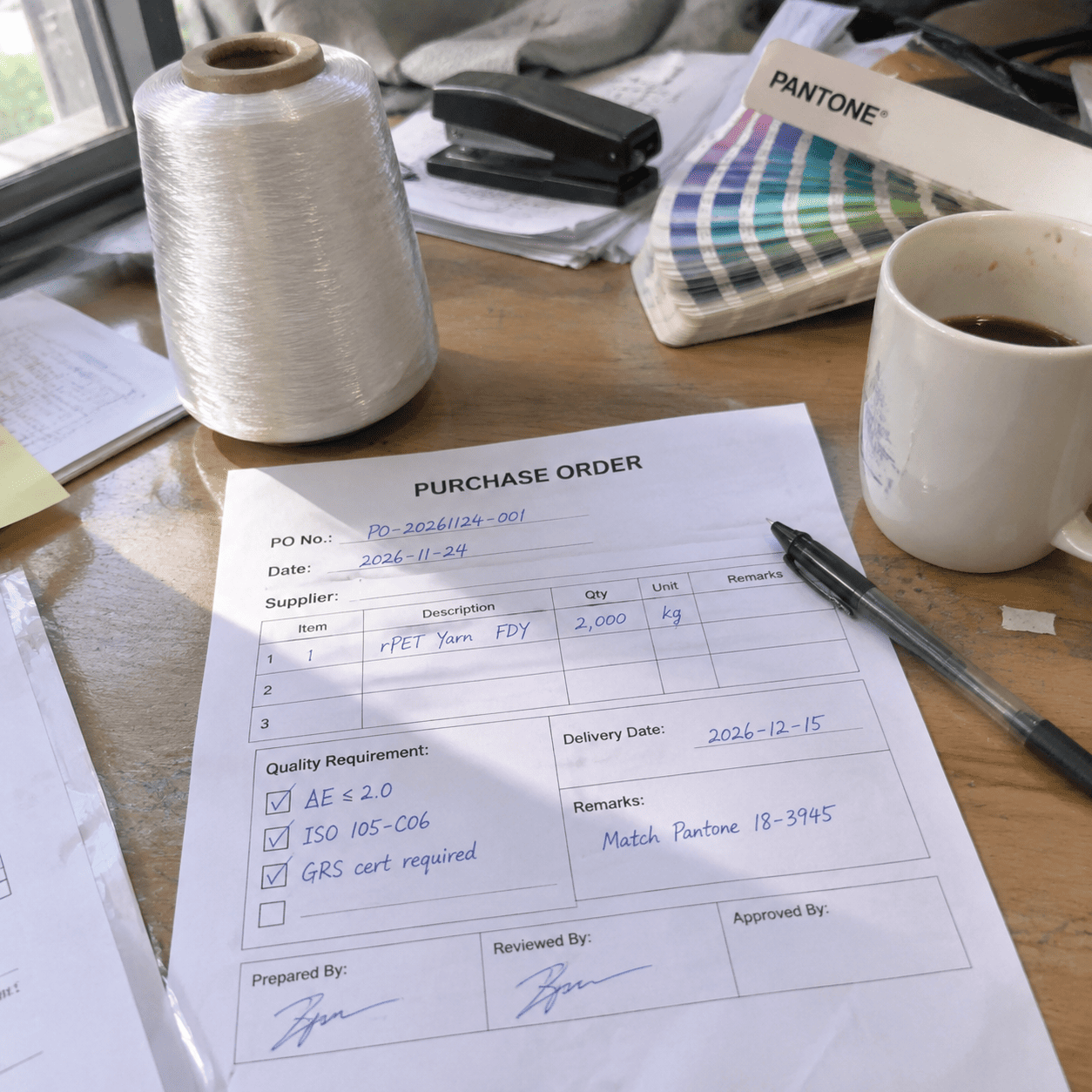
Your purchase order is a contract document. If the dyeing requirements for recycled polyester trims are not explicitly stated, you have no leverage when the color deviates. Here is what I recommend including.
Essential PO Specifications for rPET Trims
- Material declaration: Specify "recycled polyester (rPET)" with the target recycled content percentage (e.g., 100% rPET or 50/50 rPET-virgin blend)
- Color reference: Pantone number, plus a physical swatch from the approved lab dip
- ΔE tolerance: State the numeric tolerance explicitly (e.g., "ΔE ≤ 2.0 under D65 illuminant")
- Fastness requirements: Cite the specific test method (ISO 105-C06 for wash, ISO 105-X12 for rubbing7) and the minimum grade
- Certification requirements: List certifications (GRS, OEKO-TEX) separately from performance requirements—make clear these are in addition to, not substitutes for, fastness standards
- Sample approval process: Define how many lab dip rounds are included, and what triggers a re-approval
- Yarn lot traceability: Require the supplier to disclose the rPET yarn source and lot number
A Note on Communication
One of the biggest pain points I hear from buyers—especially those sourcing from overseas—is that communication about dyeing expectations breaks down between the brand, the sourcing agent, and the trim manufacturer. I strongly recommend that the person writing the PO also participates in the sample approval call. Specifications that seem clear on paper can be interpreted differently across languages and production cultures. A ten-minute video call during lab dip review prevents weeks of dispute resolution later.
Frequently Asked Questions
Can recycled polyester trims match the exact same Pantone color as virgin polyester trims?
rPET trims can target the same Pantone reference, but achieving an identical visual match is more difficult due to the fiber's variable dye uptake. Expect a slightly wider tolerance range. Always approve color based on a lab dip made with the actual rPET yarn lot, not by referencing a virgin PET sample.
Does GRS certification guarantee color-fastness on rPET trims?
No. GRS (Global Recycled Standard) certifies that the recycled content claim is verified and that environmental and social criteria are met in production. It does not test or certify dyeing performance or color fastness. You must request separate fastness test reports from your supplier.
Are light colors safer than dark colors when dyeing rPET trims?
Generally, yes. Light and medium shades are more forgiving because minor dye uptake variation is less visible. Deep, saturated colors—especially black, navy, and burgundy—amplify any inconsistency. If you are new to rPET trims, starting with lighter colorways reduces your risk during the learning curve.
How much does re-dyeing rPET trims cost compared to getting the spec right upfront?
Re-dyeing typically adds 15–25% to the original order cost and delays delivery by 7–14 days, based on typical industry experience. Building the correct specifications—wider ΔE tolerances, per-lot lab dips, explicit fastness requirements—into your purchase order upfront is significantly cheaper and protects your production timeline.
Should I request a physical sample or rely on digital color files for rPET trim approvals?
Always request a physical sample dyed on the actual rPET yarn lot. Digital color files and on-screen Pantone references cannot capture the texture-dependent color behavior of recycled polyester. A physical swatch under controlled lighting (D65 light box) is the only reliable approval method for rPET trims.
Conclusion
The dyeing requirements for recycled polyester trims are not a barrier to sustainability—they are simply different from what you have been specifying for virgin polyester. The fiber's variable crystallinity, residual contaminants, and batch-to-batch feedstock changes all create a wider window of color variation that must be managed through deliberate specification, not absorbed through post-production complaints. The highest-risk trim categories—woven labels, elastic bands, and drawcords—demand the most attention during sampling and PO drafting. Color fastness must be verified independently of environmental certifications. And the sample-to-bulk gap is structurally wider, making per-lot lab dips and explicit ΔE tolerances essential rather than optional.
If you are evaluating a switch to rPET trims and want to get the specifications right before your first order, reach out to our team at Guangzhou Zhunming. We work with procurement managers daily to navigate exactly these material transitions—providing fast sampling, transparent test reporting, and the production-floor expertise that keeps your trim quality consistent while meeting your sustainability commitments.
"Textiles: Material-Specific Data | US EPA", https://www.epa.gov/facts-and-figures-about-materials-waste-and-recycling/textiles-material-specific-data. According to Textile Exchange's annual Preferred Fiber and Materials Market Report, post-consumer PET bottles remain the dominant feedstock for recycled polyester fiber production, accounting for the vast majority of rPET used in textiles globally. Evidence role: statistic; source type: research. Supports: Post-consumer PET bottles are the primary feedstock for recycled polyester fiber production in the textile industry.. Scope note: Market share figures may vary by year and region; the dominance of bottle-to-fiber may shift as fiber-to-fiber recycling technologies scale. ↩
"Mechanism of Accelerant on Disperse Dyeing for PET Fiber in the Silicone ...", https://pmc.ncbi.nlm.nih.gov/articles/PMC6473690/. Standard textile chemistry references establish that disperse dyes penetrate polyester fibers by diffusing into amorphous regions at elevated temperatures, where the polymer chains have sufficient mobility to allow dye molecule entry; uniform crystallinity in virgin PET results in consistent dye uptake across the fiber (see, e.g., Broadbent, 'Basic Principles of Textile Coloration,' SDC, 2001). Evidence role: mechanism; source type: education. Supports: Disperse dyes diffuse into polyester fibers primarily through amorphous regions, and the uniformity of crystalline-amorphous distribution determines the predictability of dye uptake.. ↩
"Crystallinity of Recycled PET Fibers from Chemical and Mechanical ...", https://par.nsf.gov/servlets/purl/10411543. Studies in polymer science have demonstrated that mechanical recycling of PET leads to increased crystallinity heterogeneity and reduced amorphous fraction uniformity, attributed to thermal degradation and chain scission during reprocessing (see, e.g., Awaja & Pavel, 'Recycling of PET,' European Polymer Journal, 2005). Evidence role: mechanism; source type: paper. Supports: Mechanical recycling of PET introduces heterogeneous crystallinity in the resulting fibers due to repeated thermal processing and chain scission.. Scope note: Most published research examines bulk PET resin properties rather than individual fiber-level crystallinity mapping relevant to trim-scale dyeing. ↩
"Dyeing of Polyester with Disperse Dyes: Part 2. Synthesis and ... - PMC", https://pmc.ncbi.nlm.nih.gov/articles/PMC6274409/. Textile dyeing references, including those from institutions such as NCSU College of Textiles, confirm that disperse dyeing of polyester via the high-temperature exhaust method is typically carried out at 125–135 °C to achieve adequate dye diffusion into the fiber's semi-crystalline structure. Evidence role: definition; source type: education. Supports: Standard high-temperature exhaust dyeing of polyester with disperse dyes is conducted at temperatures in the range of 125–135 °C.. ↩
"Global Recycled Standard (GRS) Certification", https://www.scsglobalservices.com/services/global-recycled-standard. The Global Recycled Standard (administered by Textile Exchange) verifies recycled content, chain of custody, and social/environmental practices, while OEKO-TEX Standard 100 (administered by the OEKO-TEX Association) certifies that textiles meet limits for harmful substances; neither certification framework includes color fastness performance testing within its scope. Evidence role: definition; source type: institution. Supports: GRS certifies recycled content claims and environmental/social production criteria, while OEKO-TEX Standard 100 tests for harmful substances; neither standard includes color fastness performance requirements.. Scope note: OEKO-TEX does test for certain extractable substances that may indirectly relate to dye chemistry, but this is distinct from color fastness grading. ↩
"The Journey of Dyes: From Factories to Our Rivers", https://extension.psu.edu/the-journey-of-dyes-from-factories-to-our-rivers. Industry analyses of textile supply chain inefficiencies indicate that color-related rework, including re-dyeing, represents a significant cost burden, with estimates ranging from 10–30% of original production costs depending on order size and complexity, alongside lead time extensions of one to two weeks. Evidence role: case_reference; source type: research. Supports: Re-dyeing and rework in textile trim production incurs significant additional cost and lead time, typically estimated at a substantial fraction of original order value.. Scope note: Exact percentages vary widely by supplier, order volume, and geographic location; the 15–25% figure cited in the article likely reflects the author's specific production context rather than a universal benchmark. ↩
"ISO 105-C06", https://cdn.standards.iteh.ai/samples/51276/bb37ae4124174869ac303511b7cc742f/ISO-105-C06-2010.pdf. ISO 105-C06 ('Textiles — Tests for colour fastness — Part C06: Colour fastness to domestic and commercial laundering') and ISO 105-X12 ('Textiles — Tests for colour fastness — Part X12: Colour fastness to rubbing') are internationally recognized standards published by the International Organization for Standardization for evaluating textile color fastness performance. Evidence role: definition; source type: institution. Supports: ISO 105-C06 specifies methods for determining color fastness to domestic and commercial laundering, and ISO 105-X12 specifies methods for determining color fastness to rubbing.. ↩
0 Comments
Ask a question or share your garment accessories sourcing experience.