
Recycled Polyester Yarn for Woven Labels: Pros, Cons and Sourcing Tips
Recycled polyester yarn for woven labels is on nearly every sustainability-minded brand's procurement checklist — but the transition is rarely as simple as swapping one spool for another. Without the right evaluation framework, buyers risk visual inconsistencies, greenwashing exposure, or paying premium prices for unverifiable claims. The key is knowing which label SKUs can switch and which ones cannot.
Recycled polyester yarn is a viable material for many woven label types — especially low-density care labels and basic brand tabs — but it is not a universal drop-in replacement for virgin polyester. Subtle differences in luster, hand-feel, and batch-to-batch color consistency mean that high-detail damask weaves may not perform to spec. A successful switch also requires verifiable GRS chain-of-custody certification, not just a supplier's verbal assurance.
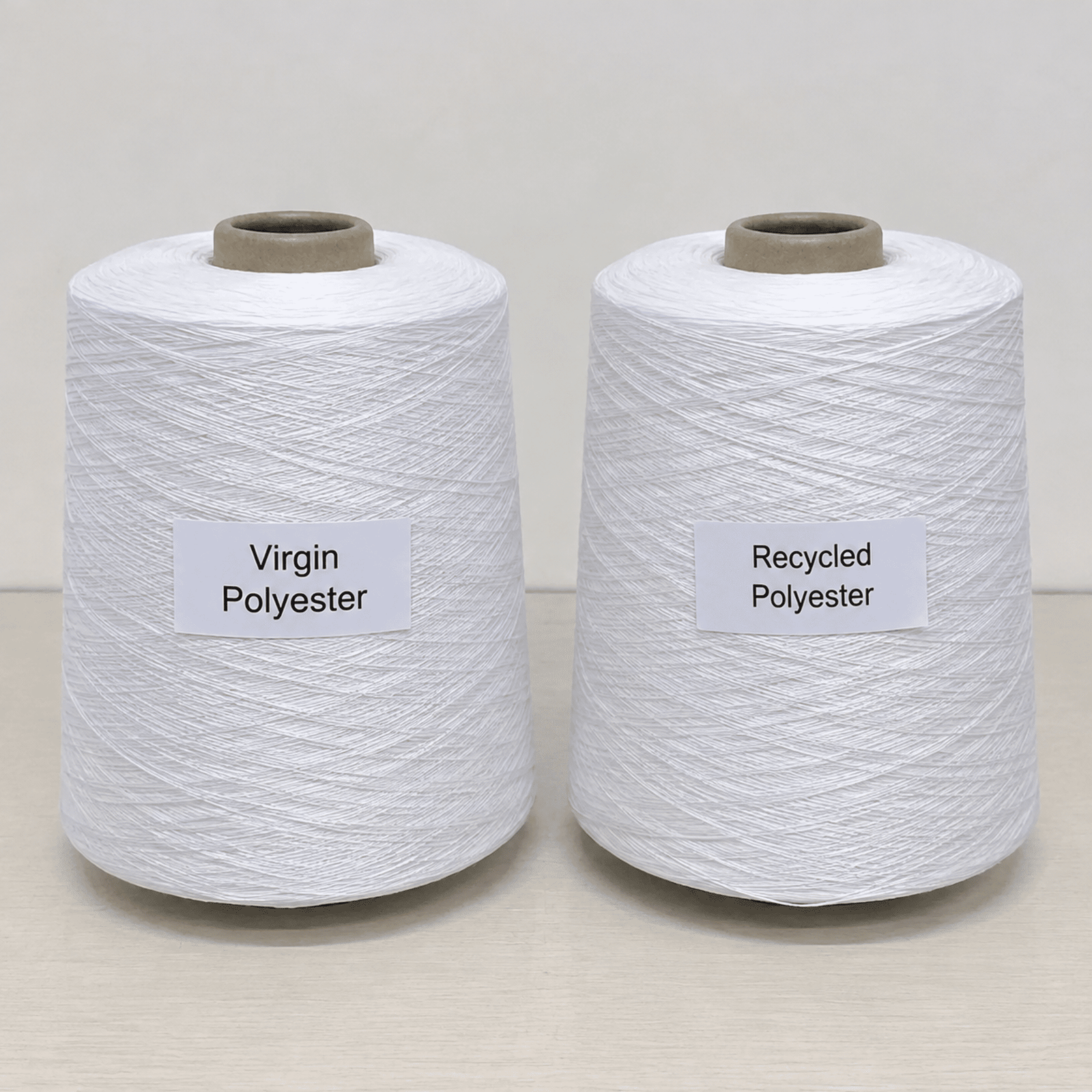
The real question is not "Should I use recycled polyester yarn?" It is "Which of my label SKUs can switch without compromising appearance, compliance, or cost — and which cannot?" Below, I walk through the visual and tactile differences, the certification requirements most buyers underestimate, and the sampling protocols that protect you from quality drift and certificate fraud.
How Does Recycled Polyester Yarn Actually Differ from Virgin Yarn in Woven Labels?
The difference between recycled and virgin polyester yarn is easy to dismiss on a spec sheet but harder to ignore once woven into a detailed label. If your brand relies on crisp fine-line artwork or gradient effects, this matters.
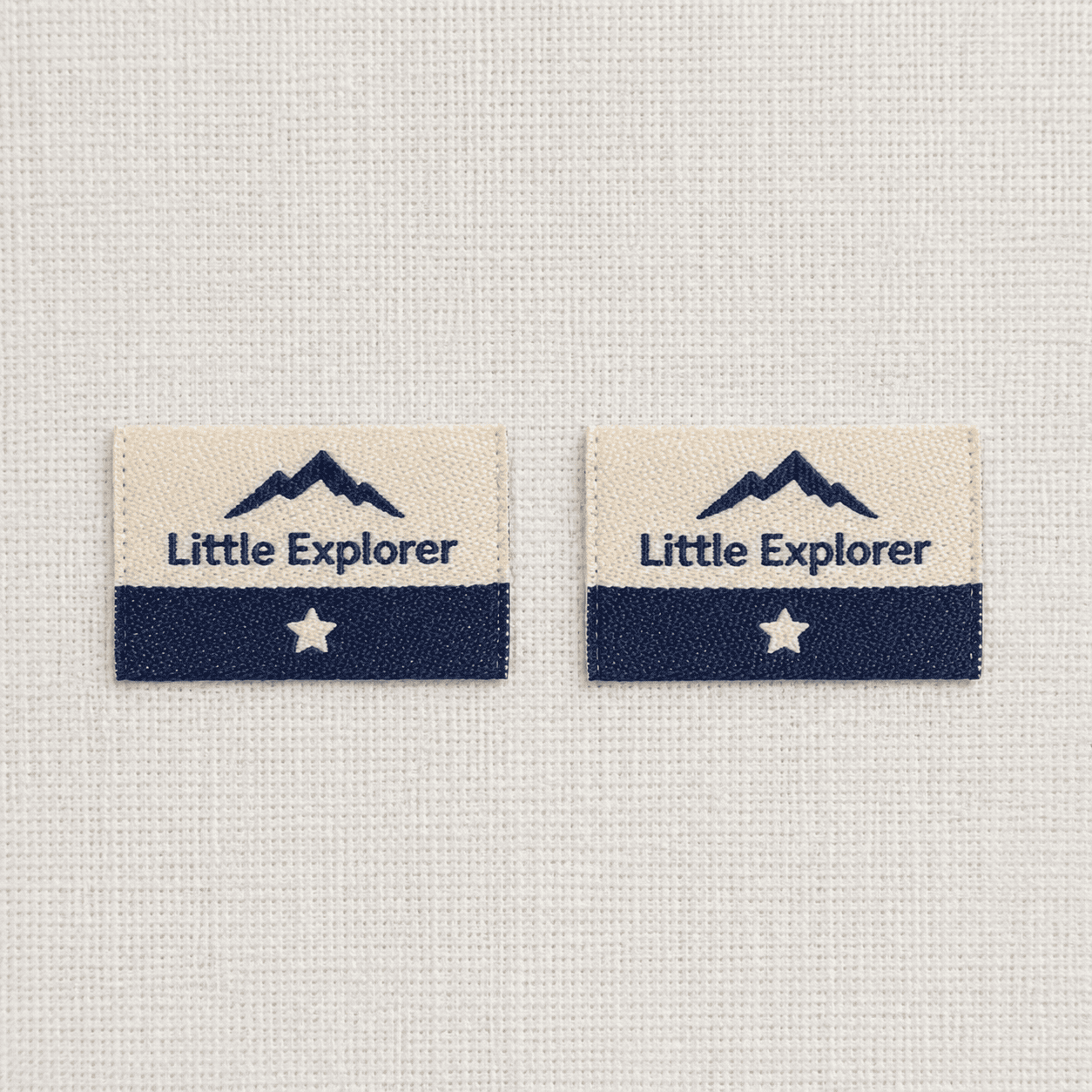
Recycled polyester yarn typically exhibits slightly lower luster and a marginally different hand-feel compared to virgin yarn. In our production, we've noticed the difference is negligible on simple, low-density labels but becomes visible on high-detail damask weaves with fine text or tonal gradients.
Why Does the Luster Differ?
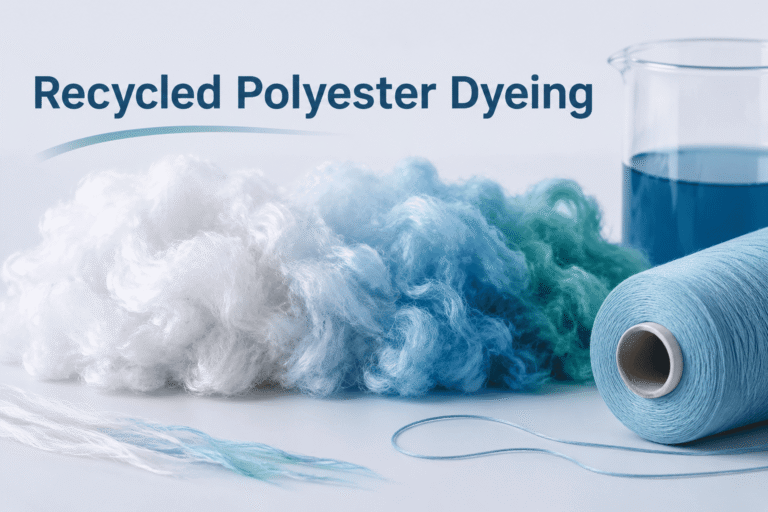
Recycled polyester is derived from post-consumer PET — most commonly plastic bottles — that has been cleaned, flaked, re-melted, and re-extruded into filament1. Each reprocessing cycle can subtly alter the polymer's molecular structure and the uniformity of the filament surface2. The result is a fiber that reflects light slightly differently than virgin polyester, which is extruded from uniform PET resin in a single controlled pass.
In our experience with the yarn sources we use, the luster reduction is slight — perhaps not noticeable to a consumer handling a single garment. But when our QC team lines up a recycled-yarn label next to its virgin-yarn counterpart under studio lighting, the difference is there. For a basic fold-end brand tab or a care/content label, this is commercially irrelevant. For a high-density damask main label carrying your brand's logo in metallic thread with gradient shading, it can affect perceived quality.
The "Safe to Switch / Test First / Not Recommended" Framework
Based on our daily production experience weaving labels in both materials, here is a practical starting framework:
| Label Type | Recycled Yarn Suitability | Notes |
|---|---|---|
| Care / content labels | ✅ Safe to switch | Simple text, low density — differences invisible |
| Basic woven brand tabs (1–2 colors) | ✅ Safe to switch | Flat weave, limited detail — minimal visual impact |
| Woven size labels | ✅ Safe to switch | Small format, utilitarian purpose |
| Mid-density woven main labels (3–4 colors) | ⚠️ Test first | Request pre-production samples; evaluate luster and color fidelity under your packaging conditions |
| High-density damask labels (5+ colors, fine text, gradients) | ❌ Not recommended without thorough testing | Luster and hand-feel differences most apparent; color-lot consistency harder to maintain |
| Metallic or specialty-thread blends | ❌ Not recommended without thorough testing | Interaction between recycled base yarn and metallic threads may affect final appearance unpredictably |
Key takeaway: Most brands have a mix of label SKUs. In our experience, 60–70% of a typical label lineup3 (care labels, size labels, simple tabs) can transition to recycled polyester yarn with minimal risk. The remaining high-complexity labels deserve dedicated sampling before any commitment.
Hand-Feel Considerations
Beyond visual luster, hand-feel — what the textile industry calls hand — also shifts slightly. Recycled polyester yarn can feel marginally stiffer or less silky than its virgin counterpart, depending on the specific yarn supplier's processing methods. For labels sewn into a garment's neckline or waistband, this is worth evaluating. I always recommend requesting a sew-in mock-up rather than judging the label alone on a desk. The feel of a label against fabric — and against skin — is the test that matters.
Does Using Recycled Yarn Automatically Make Your Labels "Eco-Friendly"?
This is one of the most dangerous assumptions in sustainable sourcing. Many procurement managers believe that specifying recycled polyester yarn on a purchase order entitles their brand to market the finished label — or even the garment — as "eco-friendly." It does not. Without the proper certification chain, that marketing claim is a greenwashing risk.
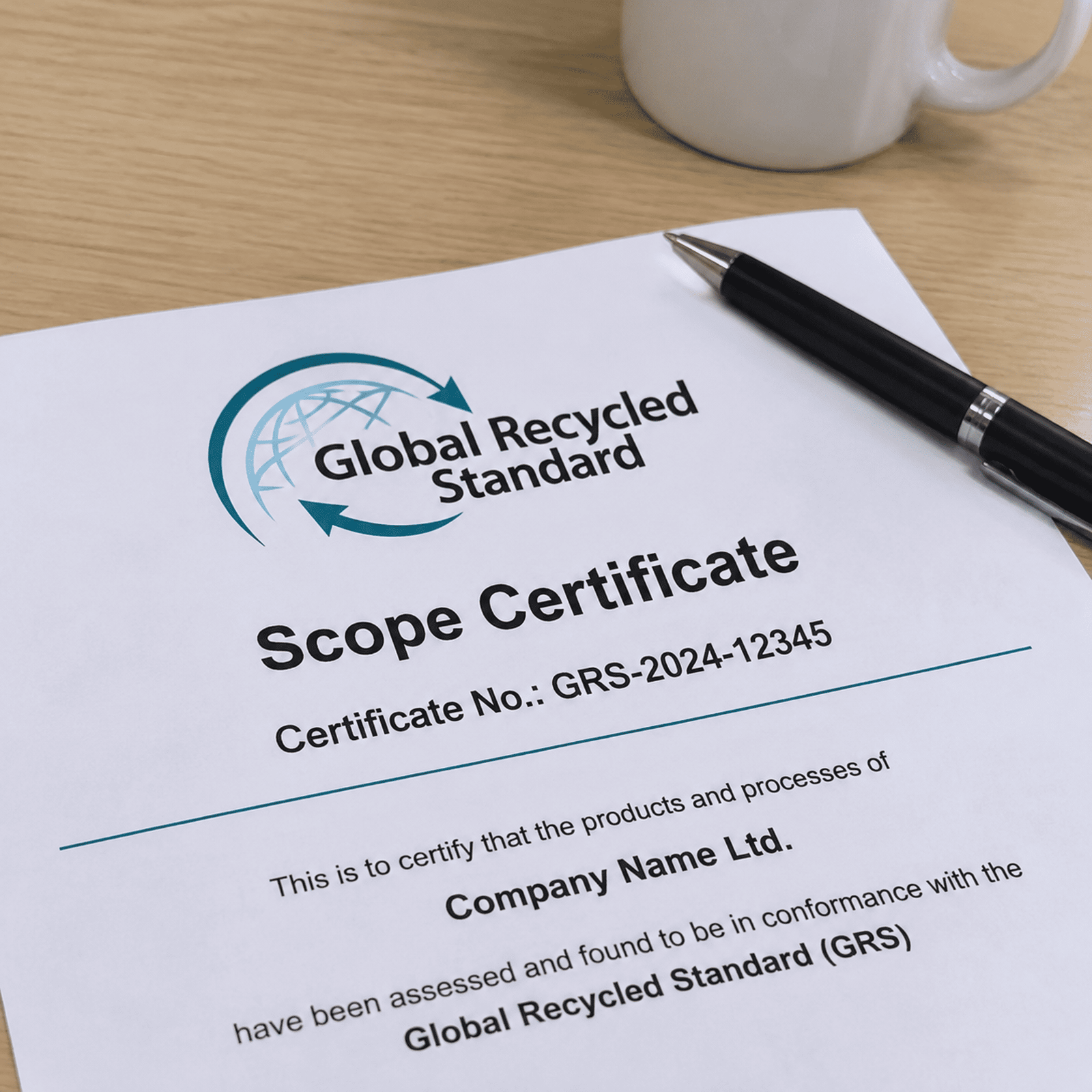
Using recycled yarn is a material choice, not a compliance achievement. A credible sustainability claim requires GRS (Global Recycled Standard) chain-of-custody certification at every link in the supply chain, traceable recycled-content percentages, and carefully worded consumer-facing language that matches verified facts.
The Chain-of-Custody Requirement
The Global Recycled Standard (GRS), administered by Textile Exchange4, does not certify a material in isolation. It certifies a transaction chain. This means:
- The yarn supplier must hold a valid GRS scope certificate.
- The label manufacturer (the weaving facility) must also hold a valid GRS scope certificate.
- Each shipment of certified product must be accompanied by a Transaction Certificate (TC) issued by the certifying body — not just a letter from the supplier.
- Segregated inventory must be maintained at every stage so that certified material is never commingled with non-certified material in an uncontrolled way.
If any single link in this chain is missing, the final product cannot carry a legitimate GRS claim. Period.
What Happens When the Chain Breaks?
I have seen buyers receive labels made from genuinely recycled yarn — but because the label manufacturer did not hold its own GRS scope certificate, the buyer could not legally reference GRS on their garment hangtag, packaging, or website. The yarn was recycled. The claim was not certifiable. That is a frustrating but common scenario.
Worse, some suppliers in the market present forged or expired GRS certificates. This is a real risk our customers have flagged to us. If a buyer unknowingly uses a fraudulently certified product and makes public sustainability claims, they face:
- Regulatory risk (FTC Green Guides in the US, EU Green Claims Directive5)
- Reputational damage if audited by a retail partner or exposed by media
- Financial liability in markets with active enforcement
Minimum Steps for a Defensible Claim
If you plan to tell your end customers that your labels (or garments) use certified recycled content, here is the minimum pathway:
| Step | What You Need | How to Verify |
|---|---|---|
| 1. Yarn sourcing | GRS scope certificate from yarn supplier | Check certificate number on the Textile Exchange certificate database |
| 2. Label manufacturing | GRS scope certificate from label manufacturer | Same database check; confirm your product category is within the scope |
| 3. Per-shipment proof | Transaction Certificate (TC) for each order | Request TC before or upon shipment; confirm quantities match your PO |
| 4. Marketing language | Wording aligned to GRS labeling guidelines | Refer to GRS Communication Guide; avoid vague terms like "eco-friendly" or "green" without specifics |
My advice: Before you draft any sustainability messaging, ask your legal team or compliance consultant to review the wording against the documentation you actually hold. "Made with GRS-certified recycled polyester" backed by a valid TC is defensible. "Eco-friendly label" with no paperwork trail is not.
What Does GRS Certification Actually Cost and Demand from a Label Supplier?
Many buyers treat GRS certification as a logo — something a supplier either has or doesn't. But GRS is an operational commitment with real costs, process requirements, and ongoing audit obligations. Understanding what it demands helps you evaluate whether a supplier's claim is genuine.
GRS certification requires annual third-party audits, segregated inventory management, full transaction-level documentation, and a scope certificate that is renewed (not just issued once). For a woven label manufacturer, this means dedicating staff time, warehouse space, and administrative systems to maintain compliance year-round.
The Real Operational Burden
Having gone through the GRS certification process ourselves, I can share what it actually involves on the production floor:
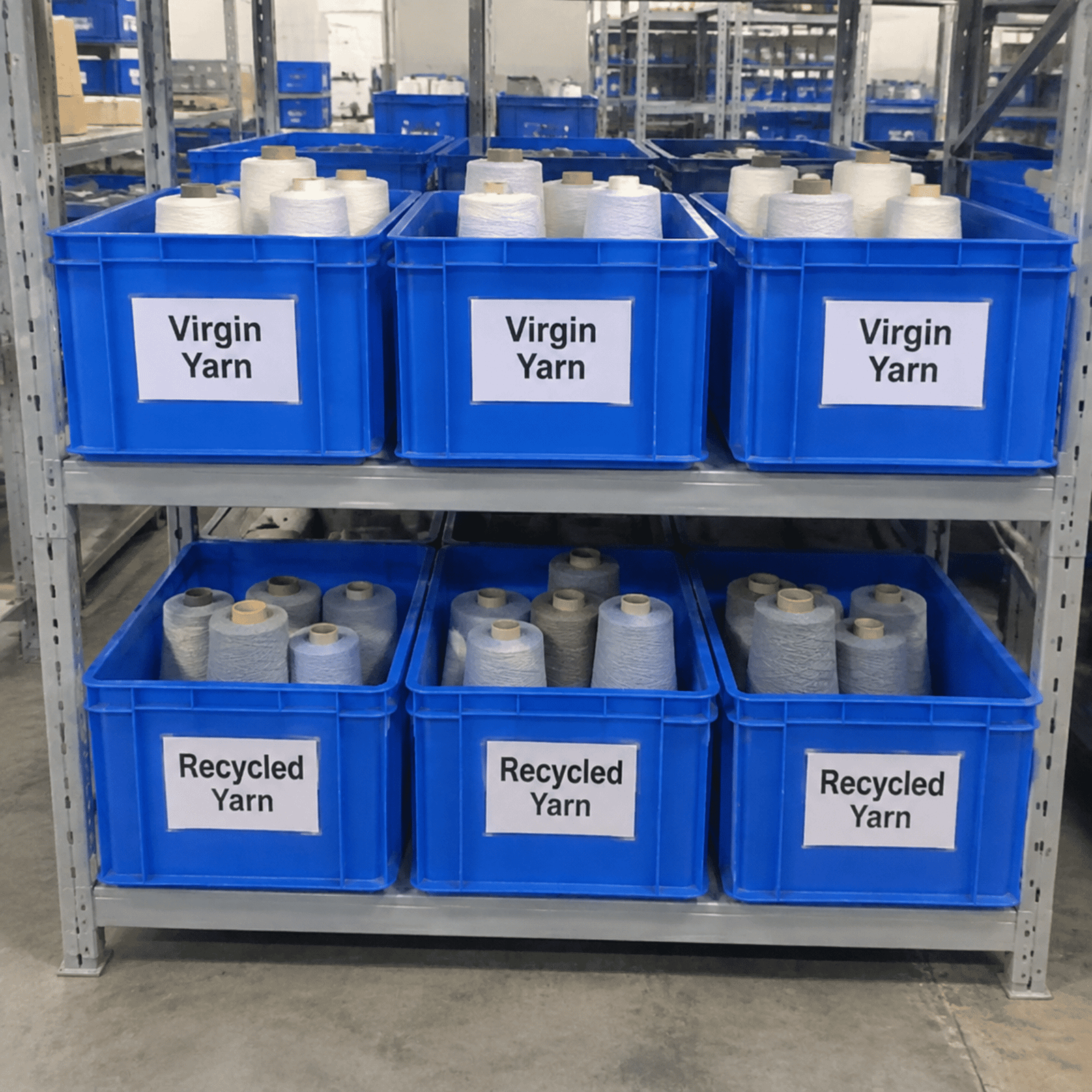
- Segregated storage: Recycled yarn must be stored separately from virgin yarn with clear labeling. In a facility that runs both materials — as most do — this means dedicating specific racks, bins, or even rooms.
- Production scheduling discipline: When a GRS order runs on a loom, the facility must document that the correct certified input material was loaded. Changeover procedures must be recorded.
- Transaction certificates per shipment: Every outbound shipment of certified product requires a TC issued by the certifying body (e.g., Control Union, IDFL, Ecocert). This is not a document the manufacturer generates internally — it must be requested from the certification body, which involves processing time and fees.
- Annual audits: A certified body conducts on-site audits at least once per year. These audits review material input/output balances, documentation accuracy, and physical inventory segregation. Unannounced audits can also occur.
- Fees: Annual certification and audit fees vary by certifying body and facility size but typically range from [data to be confirmed by author] for a small-to-mid-size label manufacturer. Transaction certificate fees are charged per TC.
How This Affects Your Procurement
As a buyer, GRS certification at your supplier's facility means:
- Lead time may be slightly longer for certified orders due to documentation requirements.
- Pricing will carry a premium — not just for the recycled yarn itself (which often costs more than virgin), but for the administrative overhead of maintaining certification.
- Minimum order quantities may apply for certified runs, because the segregation requirements make very small batch runs impractical.
How to Vet a Supplier's GRS Claim
Here is a quick verification checklist I recommend to every buyer:
- [ ] Ask for the GRS scope certificate — not a screenshot, the actual PDF with certificate number, scope detail, and expiry date.
- [ ] Cross-check the certificate number on the Textile Exchange database or the certifying body's public registry.
- [ ] Confirm the product category listed in the scope includes "woven labels" or "narrow textiles" — some manufacturers hold GRS for one product category but not another.
- [ ] Request a Transaction Certificate with your first order — if the supplier hesitates, delays indefinitely, or claims "we'll send it later," treat that as a red flag.
- [ ] Note the expiry date — GRS certificates are valid for one year. An expired certificate is not a valid certificate.
From our experience: The suppliers who push back hardest on providing TCs are often the ones who cannot provide them. A legitimately certified facility will have a process in place and can issue TCs as routine paperwork.
How Do You Protect Yourself from Batch Inconsistency and Certificate Fraud?
Batch consistency is one of the most underappreciated risks in sourcing recycled polyester yarn for woven labels. Unlike virgin polyester — which benefits from highly standardized petrochemical feedstocks — recycled yarn can vary from batch to batch depending on the source PET, the recycling facility's process controls, and dye-lot management.
To protect against quality drift and fraudulent documentation, buyers should establish a sampling protocol that includes dye-lot uniformity testing, tensile-strength verification, and per-shipment GRS Transaction Certificate requirements written directly into the purchase agreement.
Color-Lot Variability: The Hidden Problem
In our production, we've observed that some recycled yarn suppliers deliver excellent consistency across five or six shipments — and then the seventh batch shows a noticeable color shift. This typically happens when the supplier switches PET feedstock sources, which can alter how the yarn absorbs dye.
For a care label printed in black-on-white, this is unlikely to matter. For a main brand label in a custom Pantone color, even a slight shift can cause your QC team — or your retail partner's QC team — to flag the product.
What to Request During Sampling and Production
Here is the sampling and documentation protocol I recommend:
During Initial Sampling (Before Committing to a Supplier):
- Request at least two sample sets from different production batches — not just one perfect sample.
- Ask for a color fastness test report (washing, rubbing, light) specific to the recycled yarn. Do not accept test reports conducted on virgin yarn as a proxy.
- Request tensile-strength test data for the recycled yarn. While recycled polyester generally performs well, some lower-grade sources may show reduced tensile strength [data to be confirmed by author].
- Obtain the yarn supplier's GRS scope certificate and a sample Transaction Certificate to confirm the documentation workflow functions before you scale.
During Ongoing Production:
| Document / Test | Frequency | Purpose |
|---|---|---|
| GRS Transaction Certificate | Every shipment | Chain-of-custody proof |
| Color swatch comparison (vs. approved standard) | Every production batch | Catch color drift before shipment |
| Dye-lot number tracking | Every shipment | Enable traceability if issues arise post-delivery |
| Tensile-strength spot check | Quarterly or on supplier change | Detect material quality degradation |
Addressing Certificate Fraud Directly
I understand this is an uncomfortable topic, but our customers have encountered it and it needs to be discussed openly. Certificate fraud in the recycled-textile supply chain is documented and ongoing. It takes several forms:
- Expired certificates presented as current — the most common and easiest to catch.
- Certificates from one facility applied to shipments from a different facility — check that the facility name and address on the certificate match where your goods are actually produced.
- Fabricated Transaction Certificates — TCs have unique reference numbers that can be verified with the issuing certification body. If in doubt, contact the certifier directly.
Practical tip: Build verification into your supplier agreement. A clause stating that "each shipment of GRS-certified product must be accompanied by a valid Transaction Certificate, the absence of which constitutes grounds for order rejection" gives you contractual protection and signals to your supplier that you take traceability seriously.
When Should You Switch — and When Should You Wait?
Not every brand needs to convert its entire label lineup to recycled polyester yarn tomorrow. The decision should be driven by a clear assessment of your sustainability commitments, your label complexity, your retail partners' requirements, and your willingness to absorb the cost and certification overhead.
The right time to switch to recycled polyester yarn for woven labels is when you can verify the full certification chain, your label designs fall within the material's proven performance range, and the cost premium aligns with your margin structure — not simply when a marketing calendar demands a sustainability announcement.
A Phased Approach Works Best
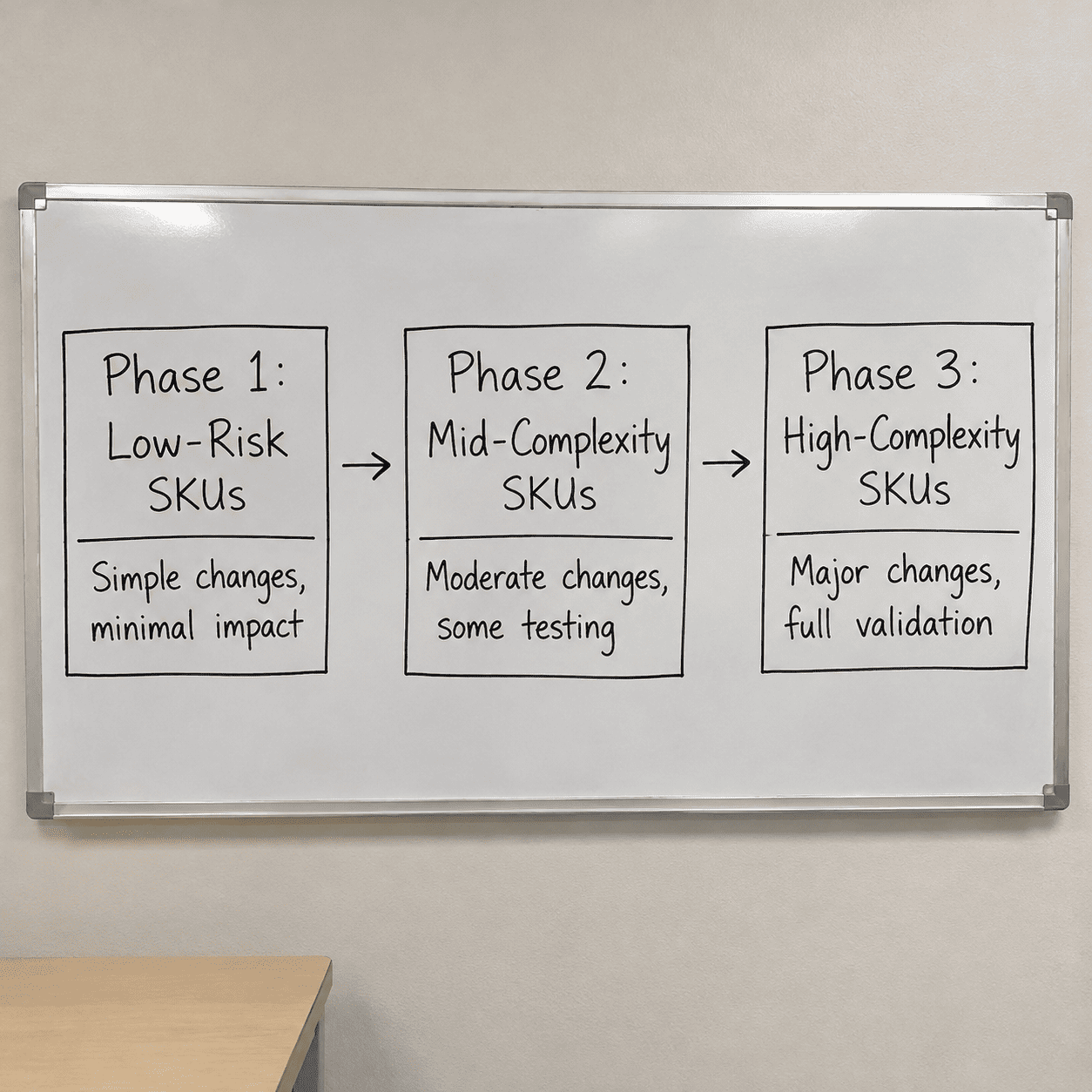
Based on the brands we work with, here is the approach that minimizes risk:
Phase 1 — Low-Risk SKUs (Months 1–3): Switch care labels, size labels, and simple 1–2 color brand tabs. These are high-volume, low-complexity items where recycled yarn performs equivalently to virgin. Use this phase to validate your supplier's documentation workflow and batch consistency.
Phase 2 — Mid-Complexity SKUs (Months 3–6): Test mid-density main labels with 3–4 colors. Order pre-production samples in recycled yarn and compare them side-by-side with your existing virgin-yarn labels. Involve your QC team and, if applicable, your retail partner's compliance team in the evaluation.
Phase 3 — Evaluate High-Complexity SKUs (Months 6+): For high-density damask labels, metallic-thread labels, or labels with fine gradient artwork, run controlled trials. Be prepared to maintain these SKUs in virgin yarn if the visual quality gap is not acceptable for your brand positioning.
Cost Considerations
Expect a price premium for recycled polyester yarn labels, driven by:
- Higher raw yarn cost (recycled polyester filament typically costs more than virgin6)
- Certification overhead (passed through in the unit price)
- Potential MOQ adjustments due to inventory segregation requirements
The premium varies by order volume and label complexity, but buyers should budget for it and weigh it against the tangible value recycled content delivers: retail partner compliance, consumer trust, and alignment with increasingly stringent regulatory requirements in the EU and US7.
Frequently Asked Questions
Can recycled polyester woven labels pass the same wash and durability tests as virgin polyester labels?
In our production experience, recycled polyester woven labels generally meet the same wash durability and color fastness standards as virgin polyester labels8 for most label types. However, we always recommend requesting test reports specific to the recycled yarn batch being used rather than relying on generic virgin-yarn data.
What is the minimum order quantity for GRS-certified recycled polyester woven labels?
MOQs for GRS-certified labels are typically higher than for standard labels due to inventory segregation and documentation requirements. The exact MOQ depends on your supplier's setup. At our facility, we work to keep MOQs flexible, but buyers should discuss certification-related minimums upfront during the quoting process.
How can I tell if a supplier's GRS certificate is real?
Cross-check the certificate number, facility name, and expiry date on the Textile Exchange public certificate database or directly with the certifying body listed on the document. Request a Transaction Certificate with every shipment and verify its reference number independently if you have any doubts.
Does switching to recycled polyester yarn affect lead times for woven labels?
Lead times may increase slightly — typically by a few days — due to the additional documentation requirements (Transaction Certificates) and potential need for dedicated production scheduling. Discuss timeline expectations with your supplier before placing certified orders to avoid surprises.
Is recycled polyester yarn available in the full Pantone color range?
Recycled polyester yarn can be dyed to match custom Pantone colors, but dye uptake characteristics may differ slightly from virgin yarn9. Always approve color on a physical sample woven with the actual recycled yarn, not a digital mockup or a swatch dyed on virgin fiber.
Conclusion
Recycled polyester yarn for woven labels offers a genuine path toward more sustainable garment trims — but only when buyers approach it with clear-eyed evaluation rather than blanket assumptions. The material performs well for low-to-mid-complexity labels, the certification chain (GRS) is non-negotiable for defensible claims, and batch consistency requires proactive sampling protocols. Start with your simplest SKUs, verify every certificate, and test thoroughly before scaling to complex label designs.
At Guangzhou Zhunming Trims, we produce woven labels in both virgin and recycled polyester yarn daily and have navigated the GRS certification process firsthand. If you are evaluating whether recycled polyester yarn fits your label lineup — or if you need help mapping your SKUs to a phased transition plan — reach out to our team for samples, technical guidance, and honest advice on what will and will not work for your specific requirements.
"Recycling Textiles: From Post-Consumer Polyester Garments ...", https://pmc.ncbi.nlm.nih.gov/articles/PMC11945271/. According to Textile Exchange's annual Preferred Fiber & Materials Market Report, the vast majority of recycled polyester is produced from post-consumer PET bottles, with fiber-to-fiber recycling still representing a small fraction of total recycled polyester output. Evidence role: general_support; source type: institution. Supports: Post-consumer PET bottles constitute the dominant feedstock for recycled polyester fiber production globally.. Scope note: Feedstock proportions vary by region and are shifting as fiber-to-fiber recycling technologies scale. ↩
"Effects of Repeated Thermo-Mechanical Processing on ...", https://pmc.ncbi.nlm.nih.gov/articles/PMC12899093/. Research on PET mechanical recycling has demonstrated that each reprocessing cycle reduces intrinsic viscosity and molecular weight due to thermal and hydrolytic chain scission, which can affect fiber surface morphology and light-reflective properties (see, e.g., Awaja & Pavel, 'Recycling of PET,' European Polymer Journal, 2005). Evidence role: mechanism; source type: paper. Supports: Mechanical recycling of PET causes chain scission and reduction in intrinsic viscosity, which can alter filament surface characteristics and optical properties.. Scope note: Most studies examine bulk PET recycling rather than the specific filament grades used in narrow-textile weaving. ↩
"Threading Your Way Through the Labeling Requirements Under ...", https://www.ftc.gov/business-guidance/resources/threading-your-way-through-labeling-requirements-under-textile-wool-acts. While no single published study quantifies the exact SKU distribution, industry practice and garment labeling requirements (including mandatory care and fiber content labels per FTC and EU regulations) mean that utilitarian label types typically outnumber high-complexity decorative labels in most brands' trim portfolios. Evidence role: general_support; source type: other. Supports: A majority of woven label SKUs in a typical apparel brand's lineup consist of care labels, size labels, and simple brand tabs that are low-complexity weaves.. Scope note: The 60–70% figure appears to be based on the author's production experience rather than a published industry survey; actual proportions will vary significantly by brand segment and product category. ↩
"Sustainability standards and certification", https://en.wikipedia.org/wiki/Sustainability_standards_and_certification. The Global Recycled Standard (GRS) was originally developed by Control Union Certifications in 2008 and ownership was transferred to Textile Exchange in 2011; Textile Exchange maintains and updates the standard and its implementation requirements. Evidence role: definition; source type: institution. Supports: Textile Exchange is the current owner and administrator of the Global Recycled Standard (GRS).. ↩
"Part 260 – Guides for the Use of Environmental Marketing Claims", https://www.ftc.gov/sites/default/files/attachments/press-releases/ftc-issues-revised-green-guides/greenguides.pdf. The U.S. Federal Trade Commission's Guides for the Use of Environmental Marketing Claims (16 CFR Part 260, revised 2012) specify that recycled-content claims must be qualified to indicate whether they refer to pre-consumer or post-consumer material and must be substantiated; the European Commission's proposed Green Claims Directive (2023/0085(COD)) would require companies to substantiate explicit environmental claims through independent verification based on recognized scientific evidence. Evidence role: general_support; source type: government. Supports: The FTC Green Guides require that recycled-content claims be substantiated and specific, and the proposed EU Green Claims Directive would mandate independent verification of environmental claims before they are communicated to consumers.. Scope note: The EU Green Claims Directive was proposed in 2023 and its final form may differ from the proposal; FTC Green Guides are guidance documents rather than binding regulations, though they inform enforcement actions. ↩
"Sustainable Sourcing Strategy: Recycled Polyester Price to TCO ...", https://fanterco.com/are-sustainable-fabrics-always-more-expensive-a-tco-driven-look-at-recycled-polyester-cost/. Industry analyses and market reports from sources such as Textile Exchange and ICIS indicate that recycled polyester (rPET) filament yarn has historically traded at a premium to virgin polyester, with the differential influenced by virgin PET resin prices (linked to crude oil), post-consumer PET bale availability, and demand from sustainability-driven brands. Evidence role: statistic; source type: research. Supports: Recycled polyester filament generally commands a price premium over virgin polyester, though the differential fluctuates with oil prices and PET bottle bale costs.. Scope note: Price premiums are volatile and vary by region, yarn specification, and order volume; in some market conditions the premium narrows significantly or inverts. ↩
"Federal Entities Should Collaborate on Reduction and Recycling Efforts", https://files.gao.gov/reports/GAO-25-107165/index.html. The European Commission's Strategy for Sustainable and Circular Textiles (2022) and the proposed Ecodesign for Sustainable Products Regulation include provisions for mandatory recycled fiber content and stricter substantiation of environmental claims; in the US, the FTC has signaled potential updates to its Green Guides and several states have introduced legislation targeting greenwashing in consumer products. Evidence role: general_support; source type: government. Supports: Both the EU and US are advancing regulatory frameworks that impose stricter requirements on environmental claims and may mandate recycled content in textiles.. Scope note: Many of these regulatory initiatives are still in proposal or implementation phases and their final requirements may differ from current drafts. ↩
"Changes in Mechanical Properties of Fabrics Made of Standard and ...", https://pmc.ncbi.nlm.nih.gov/articles/PMC10708220/. Published studies on recycled PET textile performance indicate that mechanically recycled polyester fibers generally achieve comparable tensile strength, abrasion resistance, and colorfastness ratings to virgin polyester when processed under controlled conditions, though some studies note marginal reductions in certain mechanical properties. Evidence role: general_support; source type: paper. Supports: Recycled polyester fibers generally achieve comparable mechanical and colorfastness performance to virgin polyester in standard textile testing.. Scope note: Most comparative studies test fabric-scale performance rather than narrow-textile or woven-label-specific applications; results may vary with yarn denier and weave density. ↩
"Mechanism of Accelerant on Disperse Dyeing for PET Fiber in the Silicone ...", https://pmc.ncbi.nlm.nih.gov/articles/PMC6473690/. Studies in textile dyeing science have shown that mechanically recycled PET fibers may exhibit altered crystallinity and surface morphology compared to virgin PET, which can affect disperse dye diffusion rates and final color yield (see, e.g., Sinha et al., 'Dyeing of recycled polyester,' in various textile research journals). Evidence role: mechanism; source type: paper. Supports: Recycled PET fibers can exhibit different dye uptake rates and color yield compared to virgin PET fibers due to changes in crystallinity and molecular weight from reprocessing.. Scope note: Dye uptake differences depend heavily on the specific recycling process, PET feedstock quality, and dyeing conditions; results from laboratory studies may not directly predict outcomes in narrow-textile production. ↩
0 Comments
Ask a question or share your garment accessories sourcing experience.