
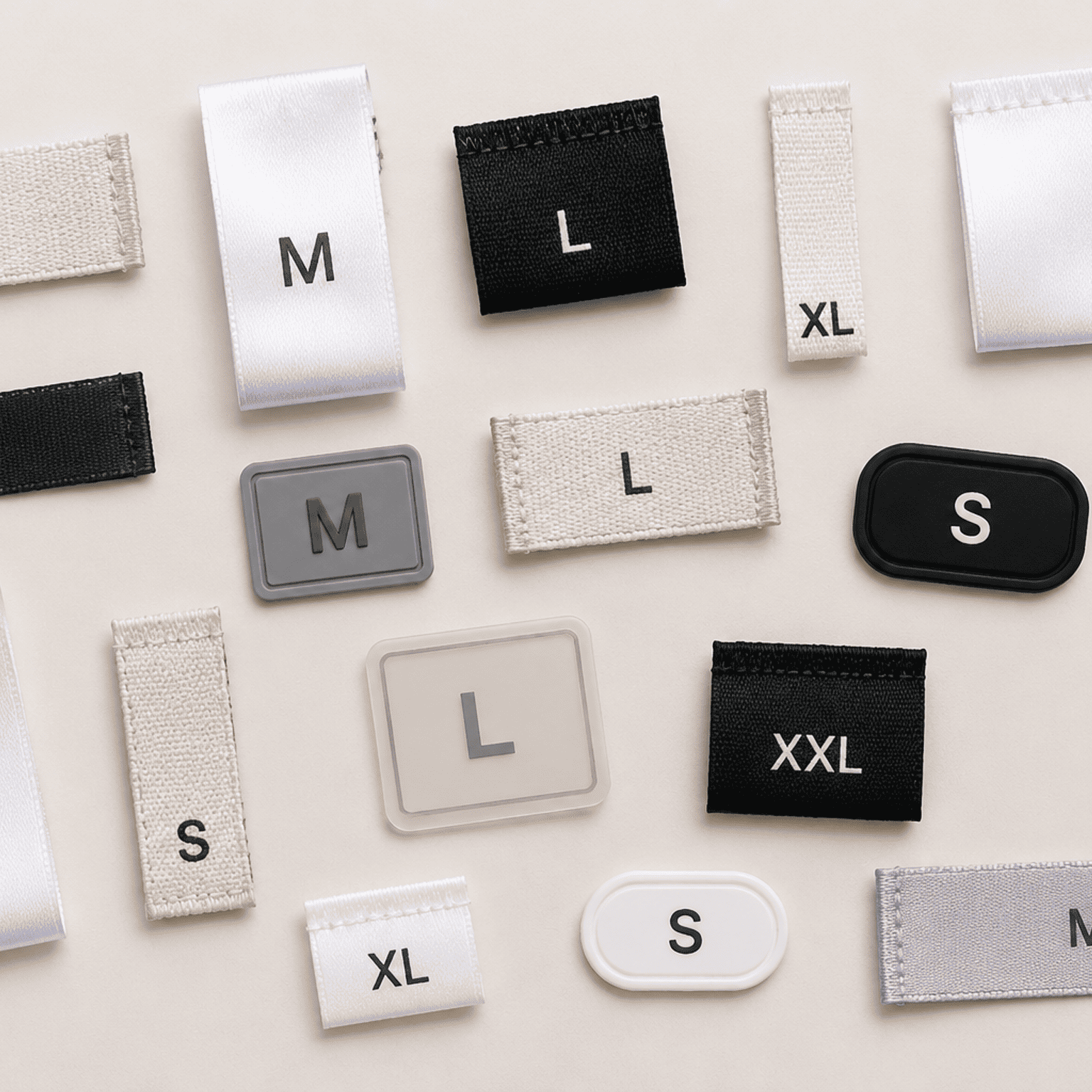
Custom Size Label Options for Fashion and Activewear
Choosing the right custom size label sounds simple — until you get your first batch of customer complaints about itchy necks or labels that fade after three washes. The truth is, a size label is not just a tiny tag with "S/M/L" on it. It's a material and construction decision that directly affects how your product feels, wears, and represents your brand.
Custom size label options break into two main paths: woven or satin labels for fashion garments that prioritize a premium feel, and heat-transfer or screen-printed labels for activewear that must eliminate skin irritation and survive frequent washing. Picking the wrong path for your garment category is the most common — and most costly — mistake first-time buyers make.
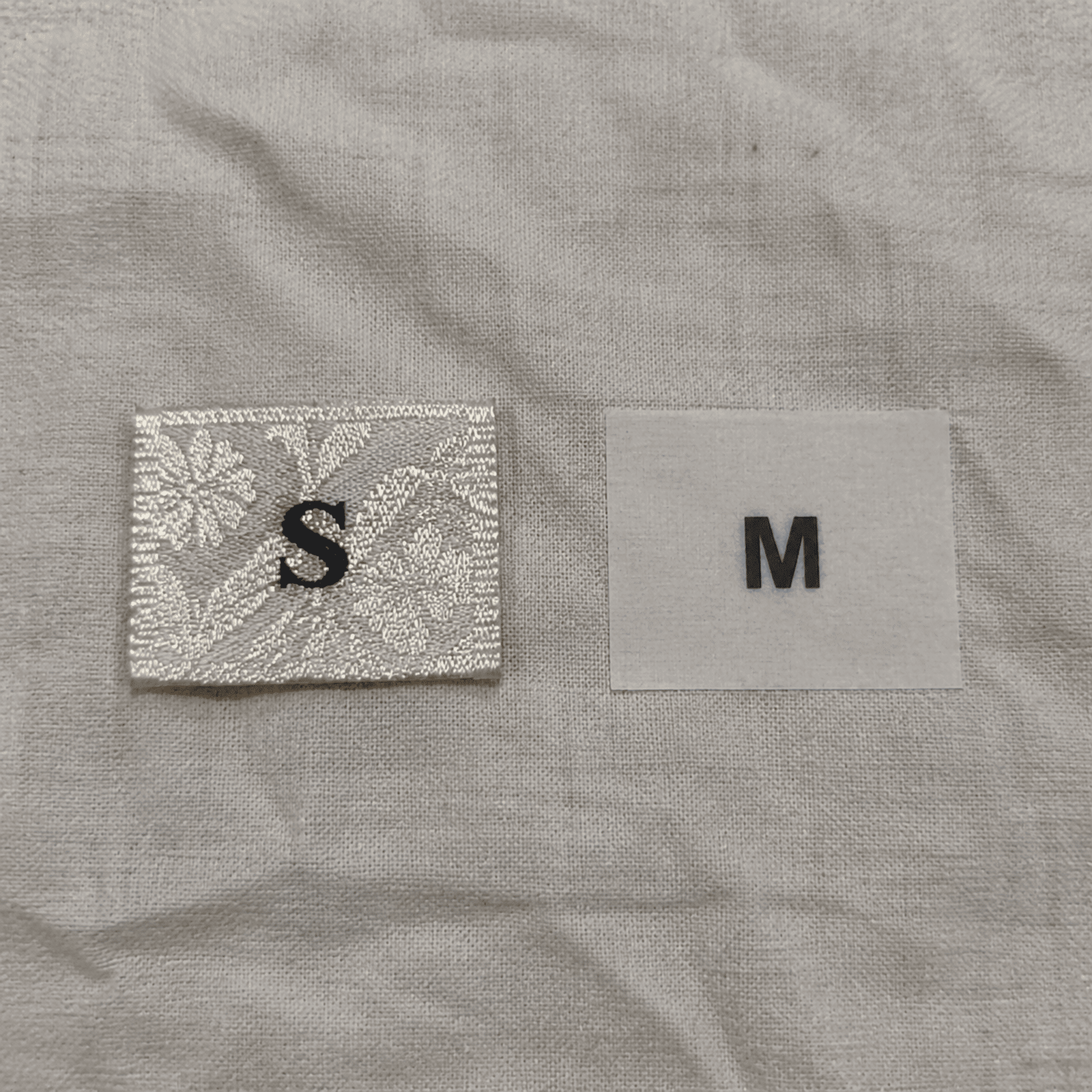
So how do you know which option fits your product? Let me walk you through the key decisions based on what I've seen working with hundreds of brands since 2016.
Why Do Fashion and Activewear Need Different Size Labels?
This is the fork in the road that most new buyers miss entirely. They send us a message saying "I need size labels" without realizing that a yoga legging and a wool blazer demand completely different solutions.
Fashion garments benefit from woven or satin size labels that add a tactile, premium touch. Activewear garments need tagless options — heat-transfer or screen-printed labels — because any raised edge or stiff material causes friction and irritation during movement and sweat1.
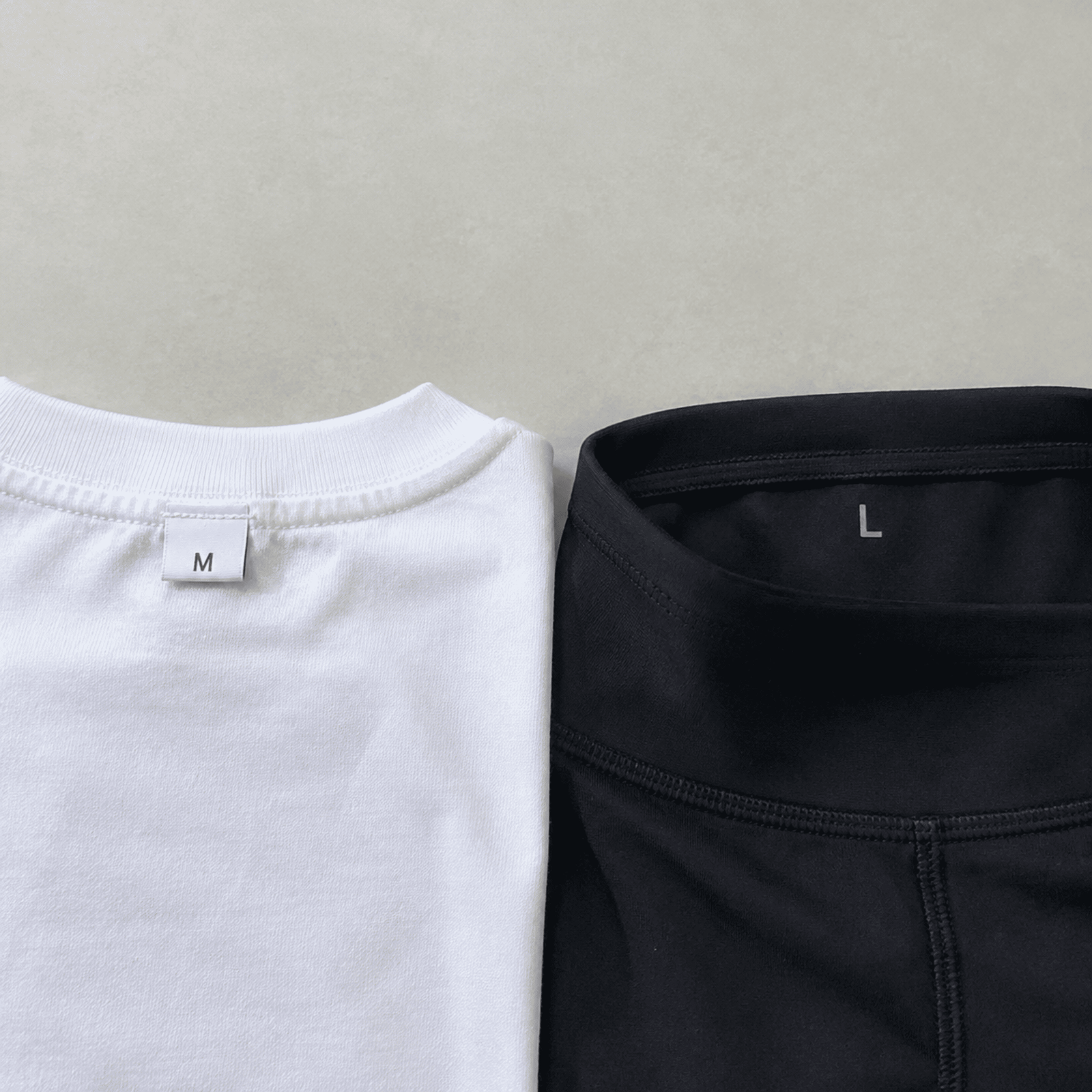
Fashion Labels: Touch and Presentation Matter
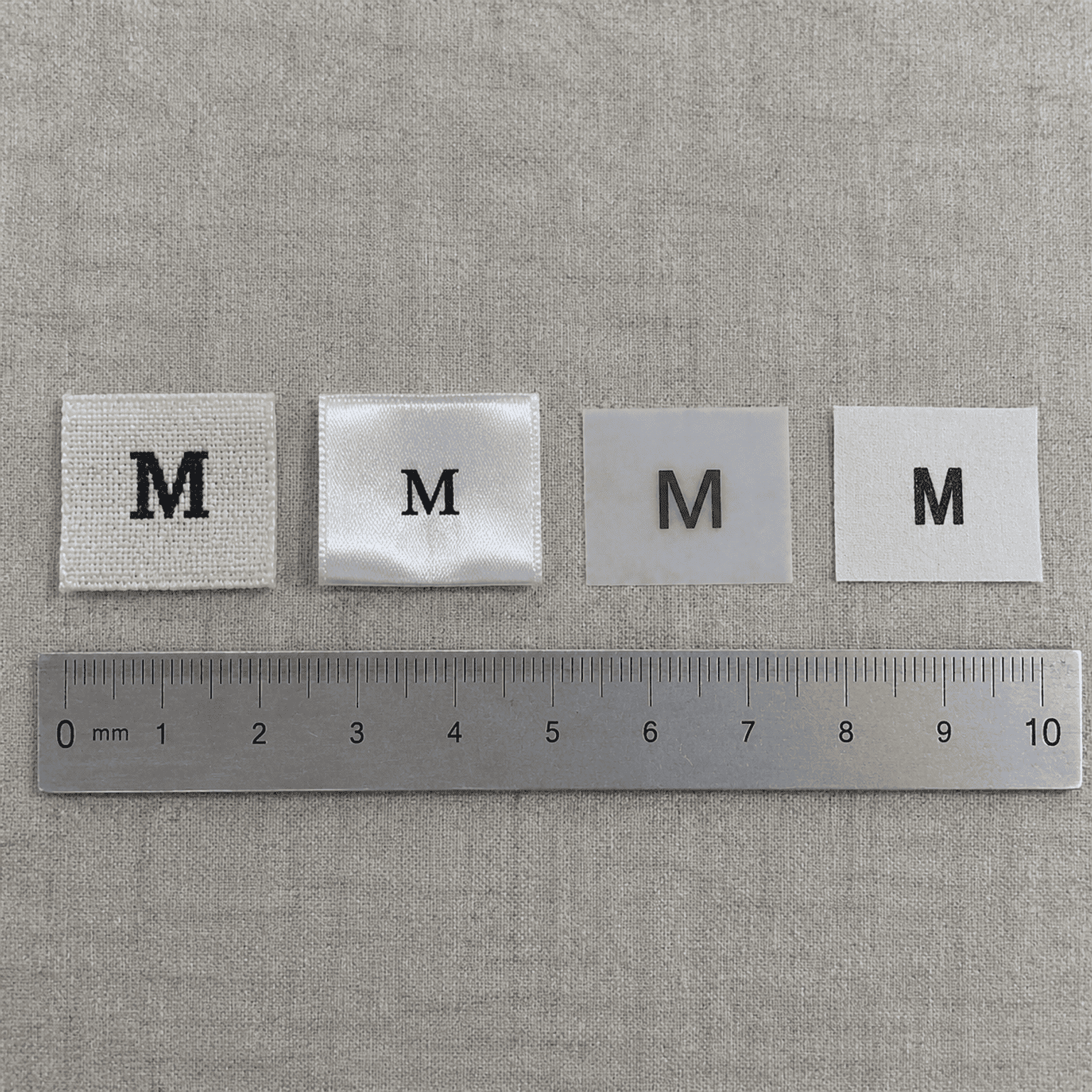
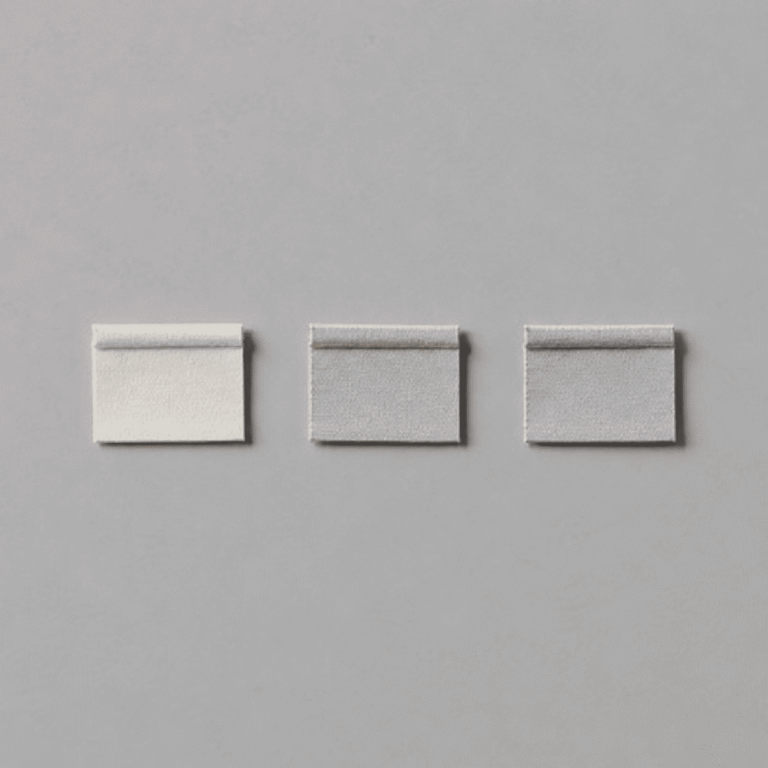
For fashion — think dresses, jackets, denim, knitwear — the size label is part of the brand experience. Customers notice it when they try on a garment. A soft woven damask label or a smooth satin label communicates quality2. Here, you want:
- Woven damask labels3 for sharp text and a structured feel
- Satin labels for a softer, more luxurious hand-feel
- Center-fold or end-fold attachment sewn into a neck seam or side seam
Activewear Labels: Comfort Is Non-Negotiable
For activewear — leggings, sports bras, running tops, compression wear — the rules change completely. In our experience working with activewear startups, the number one post-launch complaint is skin irritation from traditional sewn-in labels4. Your size labels must meet these functional baselines:
| Requirement | Why It Matters |
|---|---|
| Zero raised edges | Prevents chafing during repetitive movement |
| Stretch recovery | Label must move with the fabric, not against it5 |
| High wash durability | Activewear gets washed 2–3x more frequently6 |
| Colorfastness under sweat | Sweat and heat accelerate dye bleeding7 |
Heat-transfer labels8 are the go-to solution here. They bond directly to the fabric, leaving no edges and no stiffness. Screen-printed labels work too, especially for simpler designs on lighter fabrics9.
What Size and Placement Should You Specify?
A common mistake we see: brands order one standard label size and try to use it across every garment in their line. That rarely works well.
Size label dimensions and placement should match your garment type. Fashion labels typically run 25–40mm wide at the center-back neck. Activewear labels should be smaller — often 15–25mm — and placed at the hem, side seam, or printed directly inside the garment to avoid neck contact.
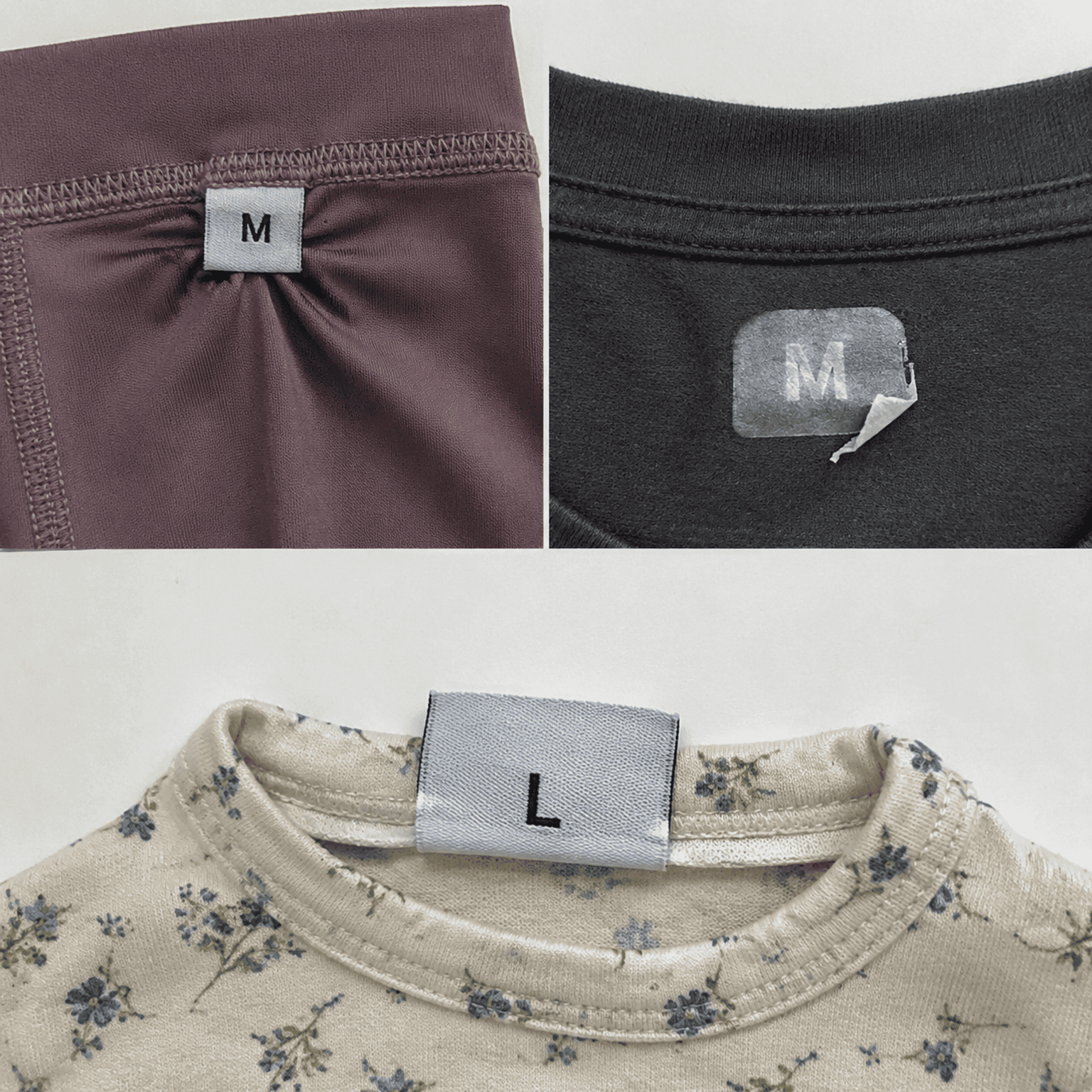
Here's a quick reference I share with our clients:
| Garment Type | Recommended Label Type | Typical Size | Best Placement |
|---|---|---|---|
| Blazers / Jackets | Woven damask, center-fold | 30–40mm wide | Center-back neck |
| T-shirts / Casual tops | Satin or woven, end-fold | 25–35mm wide | Center-back neck or side seam |
| Dresses / Skirts | Satin, mitre-fold | 20–30mm wide | Side seam or back waistband |
| Leggings / Yoga pants | Heat-transfer print | 15–25mm wide | Inner waistband or hem |
| Sports bras | Heat-transfer or screen-print | 10–20mm wide | Inner center-back panel |
| Compression tops | Heat-transfer print | 15–20mm wide | Lower hem, inside |
The takeaway: don't default to center-back neck for everything. For activewear, moving the label away from high-friction zones is a functional decision, not just a style choice.
What Mistakes Cost Brands Time and Money?
After handling custom size label projects for brands across 30+ countries, I can tell you the most expensive mistakes happen before production — during the specification stage.
The three costliest mistakes are: choosing the wrong label material for your garment category, skipping the sampling step before bulk production, and treating size labels as an afterthought instead of specifying them alongside your main garment development.
Mistake #1: Wrong Material for the Garment
Brands launching activewear lines often default to woven labels because "that's what labels look like." After their first customer reviews mention scratchy tags, they switch to heat-transfer — but they've already paid for a bulk run of woven labels they can't use.
Mistake #2: Skipping Physical Samples
I always recommend confirming material, dimensions, fold type, and color through a physical sample before committing to bulk. We offer 3–7 day sampling for this exact reason. A sample lets you:
- Feel the texture against the actual garment fabric
- Check print clarity at the final size
- Wash-test to verify durability
- Confirm color accuracy — screens lie, physical samples don't10
Mistake #3: Ordering Labels Too Late
Size labels should be specified during garment development, not after. When they're an afterthought, you're rushed, you skip sampling, and you end up with a mismatch that either delays your launch or ships with a compromised product.
Frequently Asked Questions
What's the minimum order quantity for custom size labels?
We offer flexible MOQs to support emerging brands. For woven and satin labels, typical minimums start low enough for small-batch production. Heat-transfer labels may vary. Contact us for specifics based on your label type and quantity needs.
How long does it take to get size label samples?
Our standard sampling turnaround is 3–7 days. I strongly recommend requesting samples before any bulk order — it's the single best way to avoid costly mistakes.
Can I use the same size label for both fashion and activewear products?
I wouldn't recommend it. Fashion and activewear have fundamentally different comfort and durability requirements. Using a woven label in activewear risks irritation complaints, while a heat-transfer label in a premium fashion piece may not deliver the tactile quality your brand needs.
Are your size labels safe for sensitive skin?
Our products carry OEKO-TEX® STANDARD 100 certification11, which buyers should verify as part of their compliance review. For activewear especially, heat-transfer labels eliminate physical contact points that cause irritation.
Conclusion
Custom size label options come down to one critical question: what garment category are you labeling? Fashion demands the premium feel of woven or satin labels. Activewear demands the invisible comfort of heat-transfer or screen-printed labels. Get this decision right, specify your dimensions and placement by garment type, and always confirm with a physical sample before bulk production.
If you're planning your next custom size label order and want guidance matched to your specific garment line, reach out to our team — we're here to help you get it right the first time.
"Skin physiology and textiles - consideration of basic ...", https://pubmed.ncbi.nlm.nih.gov/16766877/. Dermatological research has established that repetitive mechanical friction between textile surfaces and skin, exacerbated by moisture from sweat, is a primary cause of irritant contact dermatitis and chafing in athletes and active individuals. Evidence role: mechanism; source type: paper. Supports: That mechanical friction from textile components against skin, especially in the presence of moisture, causes irritation and contact dermatitis. Scope note: Most studies address general textile-skin friction rather than garment labels specifically ↩
"Tactile sensitivity alters textile touch perception - PMC - NIH", https://pmc.ncbi.nlm.nih.gov/articles/PMC11410198/. Research in sensory marketing and consumer psychology has demonstrated that haptic (touch-based) cues significantly influence consumers' quality judgments and willingness to pay, with smoother, softer textures generally associated with higher perceived quality and luxury positioning. Evidence role: general_support; source type: paper. Supports: That tactile and haptic cues from product components influence consumer perceptions of overall product quality and brand positioning. Scope note: Studies typically address product surfaces and packaging rather than garment labels specifically ↩
"Damask - Simple English Wikipedia, the free encyclopedia", https://simple.wikipedia.org/wiki/Damask. Damask is a figured fabric produced on a jacquard loom in which the pattern is created through the interplay of warp-dominant and weft-dominant weave areas, historically associated with high-quality textiles and capable of rendering fine, detailed designs with a structured hand-feel. Evidence role: definition; source type: encyclopedia. Supports: That damask is a reversible figured fabric woven on a jacquard loom, characterized by a pattern created by contrasting warp-face and weft-face weave structures, enabling fine detail and sharp text reproduction. Scope note: The term 'damask' in the garment label industry may refer to a simplified adaptation of traditional damask weaving rather than the full historical technique ↩
"A systematic review of tagging as a method to reduce theft in ...", https://pmc.ncbi.nlm.nih.gov/articles/PMC6979536/. Consumer surveys and dermatological studies have consistently identified sewn-in garment labels as a common source of skin irritation, with a significant proportion of consumers reporting that they routinely remove tags from clothing to alleviate discomfort. Evidence role: general_support; source type: research. Supports: That clothing labels are a widely reported source of skin discomfort and irritation among consumers, particularly in close-fitting garments. Scope note: Available research typically addresses general garment labels rather than activewear-specific post-launch complaint rankings ↩
"Threading Your Way Through the Labeling Requirements ...", https://www.ftc.gov/business-guidance/resources/threading-your-way-through-labeling-requirements-under-textile-wool-acts. Textile engineering guidelines for stretch and performance fabrics specify that all applied components, including labels, must accommodate the base fabric's elongation range and elastic recovery to maintain garment integrity, prevent localized stress points, and avoid delamination during repeated stretch cycles. Evidence role: mechanism; source type: research. Supports: That labels applied to stretch fabrics must accommodate the fabric's elongation and recovery to prevent puckering, delamination, or restricted movement. Scope note: Specific stretch recovery standards for labels are not universally codified and may depend on brand or manufacturer specifications ↩
"An empirical study of U.S. consumer purchase intention of ...", https://rex.libraries.wsu.edu/esploro/outputs/graduate/An-empirical-study-of-US-consumer/99900525075801842. Consumer textile care studies indicate that athletic and activewear garments are laundered after nearly every use, resulting in substantially higher wash cycles compared to casual or outerwear garments, which may be worn multiple times between washes. Evidence role: statistic; source type: research. Supports: That activewear and athletic garments are laundered significantly more often than casual or fashion garments. Scope note: Exact frequency multipliers vary by study methodology and consumer demographics; the 2–3x figure may be an approximation ↩
"Color Fastness to Perspiration Testing | ISO 105-E04", https://metslab.com/colorfastness-tests-colorfastness-to-perspiration. Textile colorfastness research demonstrates that exposure to human perspiration—both acidic and alkaline—combined with elevated temperatures weakens dye-fiber bonds, accelerating dye migration and color loss, as standardized in testing protocols such as ISO 105-E04 for colorfastness to perspiration. Evidence role: mechanism; source type: paper. Supports: That human perspiration (acidic and alkaline) and elevated temperatures degrade dye-fiber bonds, reducing colorfastness and causing dye migration or bleeding. Scope note: Standard test conditions may not perfectly replicate real-world athletic use scenarios involving prolonged sweat exposure ↩
"Heat Transfer Labels for T-Shirts | NYCL", https://newyorkcustomlabels.com/heat-xfer-labels-nycl. Heat-transfer labeling technology applies pre-printed designs to fabric substrates using controlled heat and pressure, fusing the label material directly into the textile surface and eliminating the raised edges and seam bulk associated with traditional sewn-in labels. Evidence role: mechanism; source type: research. Supports: That heat-transfer labels use heat and pressure to bond ink or film directly onto fabric, resulting in a flat, tagless application with no raised edges. Scope note: Performance varies by fabric type, transfer material, and application parameters ↩
"What are the limitations of screen printing? When is it better ...", https://printunion.eu/en/blog/what-are-the-limitations-of-screen-printing-when-is-it-better-to-choose-a-different-method. Screen printing applies ink through a mesh stencil directly onto fabric, producing a thin, flexible print layer well-suited to simple graphics and text; however, the technique has inherent resolution limits for fine detail and may produce perceptible ink buildup on heavier substrates. Evidence role: general_support; source type: research. Supports: That screen printing directly onto garments produces flat, tagless labels suitable for simple designs, though with limitations on detail resolution and ink buildup on heavier fabrics. Scope note: Performance comparisons between screen-printed and heat-transfer labels depend heavily on ink formulation, fabric composition, and curing process ↩
"The Designer's Guide to Color Accuracy in Digital Fabric ...", https://www.nbprintex.com/blog/the-designers-guide-to-color-accuracy-in-digital-fabric-printing. Color management science establishes that RGB-based digital displays render colors through additive light mixing within a device-dependent gamut that differs substantially from the subtractive color processes used in textile dyeing and printing, making on-screen proofs unreliable predictors of final textile color without calibrated color management workflows. Evidence role: mechanism; source type: research. Supports: That digital displays use RGB additive color mixing with a limited gamut that does not accurately represent colors as they appear on dyed or printed textiles, which use subtractive color processes. Scope note: Calibrated monitors with ICC profiles can reduce but not eliminate the discrepancy between screen and physical textile colors ↩
"Oeko-Tex", https://en.wikipedia.org/wiki/Oeko-Tex. OEKO-TEX® STANDARD 100 is a globally recognized independent certification system that tests textiles for harmful substances including pesticides, heavy metals, formaldehyde, and certain dyes, with testing criteria that vary by the degree of skin contact and intended user group (e.g., babies, direct skin contact, decorative materials). Evidence role: definition; source type: institution. Supports: That OEKO-TEX® STANDARD 100 is an independent testing and certification system for textile products at all stages of production, verifying they are free from harmful levels of over 100 substances. Scope note: The certification addresses chemical safety rather than mechanical comfort properties such as friction or stiffness ↩
0 Comments
Ask a question or share your garment accessories sourcing experience.