


A Complete Guide to Clothing Label Attachment Methods
Choosing the right clothing label attachment methods can feel overwhelming — especially when a wrong pick leads to peeling labels, customer complaints, or costly rework. Most buyers default to sewing simply because they don't realize better options exist for their specific fabric and garment type.
There are five main clothing label attachment methods: sew-in, heat transfer, ultrasonic welding, iron-on adhesive, and fold-and-insert. The right choice depends on your fabric type, wash-durability needs, and garment category — not just unit price. Picking the wrong method is the fastest way to trigger rework and missed deadlines.
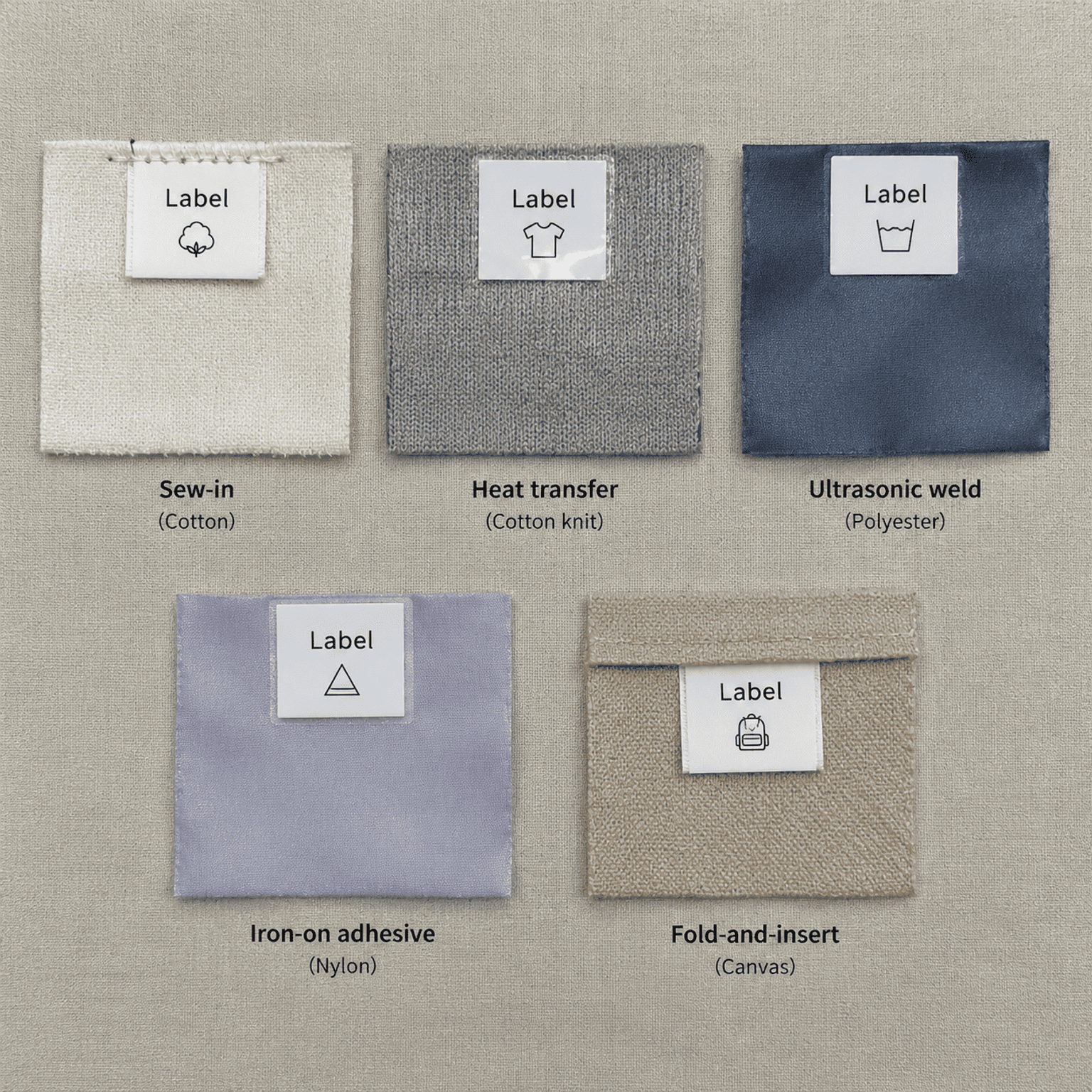
Let me walk you through each method so you can confidently write the right spec into your next production order.
Which label attachment method fits your fabric?
Every method is locked to specific fabrics. Ignoring this causes the majority of label failures I see in production.
Sew-in labels work on nearly all woven and knit fabrics. Heat transfer suits cotton and poly blends1. Ultrasonic welding is best for synthetics2. Iron-on adhesive fits stable wovens3. Fold-and-insert labels go into seams during garment construction.

| Method | Best Fabrics | Avoid When |
|---|---|---|
| Sew-in | Almost all fabrics | Ultra-sheer or tagless designs |
| Heat transfer | Cotton, poly-cotton blends | Coated, waterproof, or high-stretch fabrics |
| Ultrasonic weld | Synthetics (nylon, polyester) | Natural fibers like cotton or linen |
| Iron-on adhesive | Stable wovens, canvas | Stretch knits or heat-sensitive materials |
| Fold & insert | Any (sewn into seams) | Garments with no accessible seam |
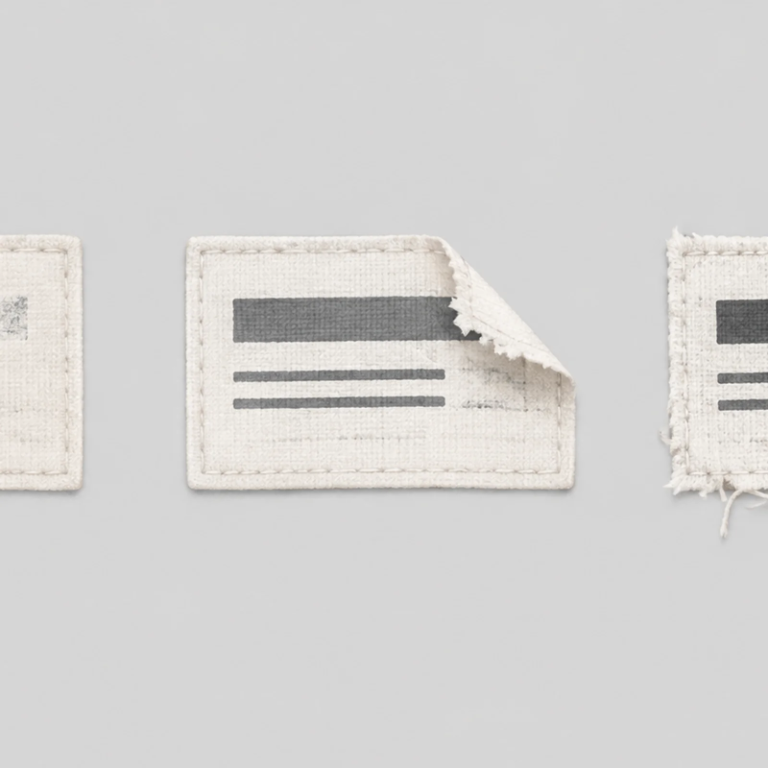
In our production experience, the #1 real-world failure is heat transfer on incompatible fabrics4. Clients apply transfers to waterproof jackets or four-way stretch leggings, then see peeling or blurring after just a few washes. The method itself isn't bad — the mismatch is.
Is heat transfer really better than sew-in for comfort?
DTC brands chasing the "tagless" trend often rush to heat transfer without understanding the trade-offs.
Heat transfer labels do improve skin feel — no scratchy tag. But they have a wash-count ceiling that varies by fabric. On compatible materials like cotton tees, they hold up well. On the wrong fabric, they fail fast. Always request a wash test before committing to bulk.
The honest trade-off
- Comfort: Heat transfer wins. No raised edge against skin.
- Durability: Sew-in labels typically outlast the garment5. Heat transfers may fade or crack over time6, depending on the material.
- Fabric testing: Heat transfer demands it. Sew-in is forgiving.
My recommendation: If your product targets a market with strict wash-durability expectations, ask your supplier about industry-standard wash testing (such as AATCC or ISO protocols7) before choosing heat transfer. Don't skip this step.
Does the cheapest method actually save you money?
This is where I see buyers get burned. A lower unit price can hide higher total costs.
Price-only decisions overlook fabric prep, factory equipment requirements, minimum order thresholds, and rework risk. A "cheap" method that causes 5% rework on a 10,000-piece run costs far more8 than specifying the right method upfront.
Hidden costs to consider
- Equipment: Does your garment factory have the right press or machine?
- Rework rate: Wrong method = peeling labels = re-labeling by hand.
- Delivery delays: Rework pushes your timeline, and missed seasons mean lost revenue.
- MOQ differences: Some methods require higher minimums, affecting small-batch brands.
Are there legal requirements for label attachment?
Yes — markets like the US (FTC)9 and EU (Regulation 1007/2011)10 may have rules about label permanence and placement. Requirements vary by country and product category. Always verify the specific regulations for your target market with a qualified compliance advisor before finalizing your spec.
Frequently Asked Questions
Can I switch from sew-in to heat transfer mid-production?
Generally no. Switching methods mid-run disrupts workflow, may require different equipment, and risks inconsistency. Decide your method before production begins.
How do I test if heat transfer works on my fabric?
Request sample labels from your supplier and apply them to your actual fabric. Wash-test the sample multiple times. Most reliable suppliers offer free samples for this purpose.
What's the most versatile attachment method?
Sew-in labels remain the most universally compatible method. They work on nearly every fabric and survive the most wash cycles.
Conclusion
Choosing the right clothing label attachment methods is a fabric-compatibility and durability decision — not just a line item on a quote. Match the method to your fabric, test before bulk, and factor in total cost including rework risk. Getting this right protects your delivery timeline and your brand reputation.
Need help selecting the best attachment method for your next order? Contact our team at Guangzhou Zhunming Trims — we offer free samples, fast prototyping, and honest advice based on years of production experience.
"Best fabric for heat transfer vinyl (2026 Edition)", https://www.htvront.com/blogs/basics/best-fabric-for-heat-transfer-vinyl?srsltid=AYCX9vL43MfCwbOLZ4LQC-HrKdWEDU8O4_c1S6CcnPGdLiT4K9InTbpC. Textile engineering literature indicates that heat transfer processes rely on thermoplastic adhesive bonding, which performs optimally on stable, heat-tolerant substrates such as cotton and polyester-cotton blends due to their surface energy and thermal resistance properties. Evidence role: mechanism; source type: research. Supports: Cotton and polyester-cotton blends provide suitable surface characteristics for heat transfer label adhesion. Scope note: Specific adhesion performance varies by transfer adhesive formulation, application temperature, and fabric finish. ↩
"Mechanisms of ultrasonic joining of textile materials", https://ptacts.uspto.gov/ptacts/public-informations/petitions/1556778/download-documents?artifactId=DfHRmjzS3NaOaK-frISO_9FQov-wG3RqWY5WgJLKShlCEpjreZeghfI. Ultrasonic welding bonds thermoplastic materials by converting high-frequency mechanical vibrations into localized heat at the interface, causing the polymer chains to melt and re-solidify; this mechanism is effective only with synthetic fibers that have a defined melting point, such as polyester and nylon (Shi & Little, 2000; Textile Research Journal). Evidence role: mechanism; source type: research. Supports: Ultrasonic welding requires thermoplastic materials that can soften and fuse under high-frequency vibration, making synthetic fibers like nylon and polyester suitable substrates. Scope note: Performance depends on specific welding parameters including frequency, amplitude, and pressure, which vary by fabric weight and construction. ↩
"A Review of Fusible Interlinings Usage in Garment Manufacture", https://pmc.ncbi.nlm.nih.gov/articles/PMC6290625/. Research on fusible interlinings and heat-activated adhesives in textiles demonstrates that bond strength is highest on dimensionally stable woven substrates, where the adhesive can form a continuous bond line; stretch knits subject the bond to repeated deformation that causes delamination, while heat-sensitive materials risk thermal damage during application (Pheby, 1998; Textile Research Journal). Evidence role: mechanism; source type: research. Supports: Heat-activated adhesive labels bond effectively to dimensionally stable woven fabrics but perform poorly on stretch knits due to mechanical stress on the adhesive bond. Scope note: Iron-on label adhesives vary in formulation; some newer adhesives may offer improved performance on moderate-stretch fabrics. ↩
"TOP 5 HEAT TRANSFER PROBLEMS AND HOW TO FIX ...", https://www.dekographics.com/blog/top-5-heat-transfer-problems/. Quality control literature in apparel manufacturing identifies substrate-adhesive incompatibility as a primary cause of heat transfer label failure, particularly on coated, waterproof, or high-stretch fabrics where surface treatments or mechanical deformation compromise adhesive bonding. Evidence role: general_support; source type: research. Supports: Substrate incompatibility is a recognized cause of heat transfer label failure in garment manufacturing. Scope note: The claim that this is the single most common label failure mode is based on the author's production experience and may not be generalizable across all manufacturing contexts. ↩
"Heat Transfer Labels vs Woven Labels", https://qualitywovenlabels.com/blog/post/heat-transfer-labels-vs-woven-labels-which-is-right-for-your-brand. Industry testing and textile quality literature generally indicate that woven sew-in labels, being constructed from durable polyester or cotton yarns stitched directly to the garment, maintain legibility and structural integrity over a greater number of wash cycles than heat transfer labels, which are subject to adhesive degradation and surface abrasion. Evidence role: general_support; source type: research. Supports: Woven sew-in labels generally demonstrate superior wash durability compared to heat transfer labels due to their construction from woven textile substrates. Scope note: Comparative durability depends heavily on specific label materials, adhesive formulations, and laundering conditions; controlled comparative studies are limited in the published literature. ↩
"Exploration on ability of printable modified papers for ... - PMC", https://pmc.ncbi.nlm.nih.gov/articles/PMC10121600/. Studies on the durability of heat transfer prints on textiles show that repeated laundering causes progressive degradation through mechanisms including adhesive fatigue, surface abrasion of the printed film, and chemical attack from detergents, leading to visible cracking and color fading (Textile Research Journal; AATCC Review). Evidence role: mechanism; source type: research. Supports: Heat transfer labels can degrade through cracking and fading due to mechanical abrasion and chemical exposure during repeated laundering. Scope note: Degradation rates depend on transfer type (plastisol, sublimation, vinyl), wash conditions, and fabric substrate; high-quality transfers on compatible fabrics may show minimal degradation over many cycles. ↩
"Heat Transfer Labels With Polychromatic Effects", https://patentscope.wipo.int/search/en/WO2020041168. The American Association of Textile Chemists and Colorists (AATCC) publishes test methods such as AATCC TM 135 (dimensional changes in home laundering) and AATCC TM 150 (dimensional changes in commercial laundering), while ISO 6330 provides international procedures for domestic washing and drying, all of which are commonly referenced for evaluating the wash durability of applied labels and prints. Evidence role: definition; source type: institution. Supports: AATCC and ISO publish standardized laundering test methods used to evaluate the durability of textile finishes and applied labels. Scope note: These standards test general laundering effects on textiles; specific protocols for heat transfer label adhesion testing may require additional or adapted methods. ↩
"Preventing Hidden Rework Costs in Garment Manufacturing", https://www.linkedin.com/posts/mazharul-islam-a9b9a6228_a-small-rework-with-a-hidden-cost-in-garment-activity-7507275732151070720-GsbQ. Studies on apparel manufacturing quality costs indicate that rework and repair operations can account for 5–15% of total production costs, with labeling defects among the common causes requiring manual correction that disrupts workflow and extends lead times (Textile Progress; Journal of Textile and Apparel, Technology and Management). Evidence role: statistic; source type: research. Supports: Rework rates in garment manufacturing for labeling and finishing defects can significantly increase total production costs. Scope note: The specific 5% rework rate cited in the article appears illustrative rather than derived from a specific dataset; actual rates vary widely by factory, method, and product type. ↩
"Apparel and Labeling", https://www.ftc.gov/news-events/topics/tools-consumers/apparel-labeling. The U.S. Federal Trade Commission's Care Labeling Rule (16 CFR Part 423) requires that care labels be attached to garments in a manner that ensures they remain legible and attached for the useful life of the product (FTC, Care Labeling of Textile Wearing Apparel). Evidence role: general_support; source type: government. Supports: The FTC enforces care labeling rules under 16 CFR Part 423, which includes requirements for label attachment permanence. Scope note: The FTC rule primarily addresses care labels; other labeling requirements (e.g., fiber content, country of origin) fall under separate regulations such as the Textile Fiber Products Identification Act. ↩
"Regulation - 1007/2011 - EN - EUR-Lex - European Union", https://eur-lex.europa.eu/eli/reg/2011/1007/oj/eng. Regulation (EU) No 1007/2011 of the European Parliament and of the Council on textile fibre names and related labelling requires that labels indicating fibre composition be securely attached, easily legible, and durable (Official Journal of the European Union, L 272, 18 October 2011). Evidence role: general_support; source type: government. Supports: EU Regulation 1007/2011 governs textile fibre labelling and includes provisions on how labels must be attached to textile products. Scope note: This regulation primarily addresses fibre composition labelling; care labelling in the EU is not mandatory at the EU level but may be required by individual member states or industry standards. ↩
0 Comments
Ask a question or share your garment accessories sourcing experience.