
Sew-on Labels vs Iron-on Heat Transfer Labels: Which Is Better for Apparel?
Choosing between sew-on labels and iron-on heat transfer labels is one of the most common questions I get from new brand owners. Pick the wrong one, and you're looking at peeling labels, customer complaints, or unnecessary rework. The truth? Neither is universally "better." The right answer depends on your fabric, your garment, and your production setup.
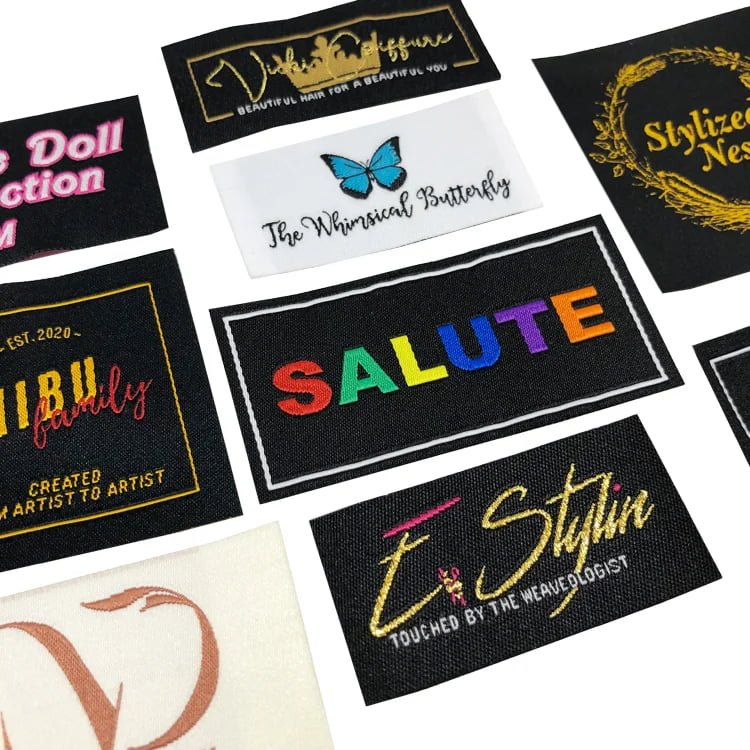
Sew-on labels and heat transfer labels each excel in different contexts. Woven sew-on labels work best on structured fabrics like cotton tees and wool garments, while heat transfer labels are often the smarter choice for stretchy activewear, children's clothing, and tagless comfort. The "better" label is the one that matches your specific product.
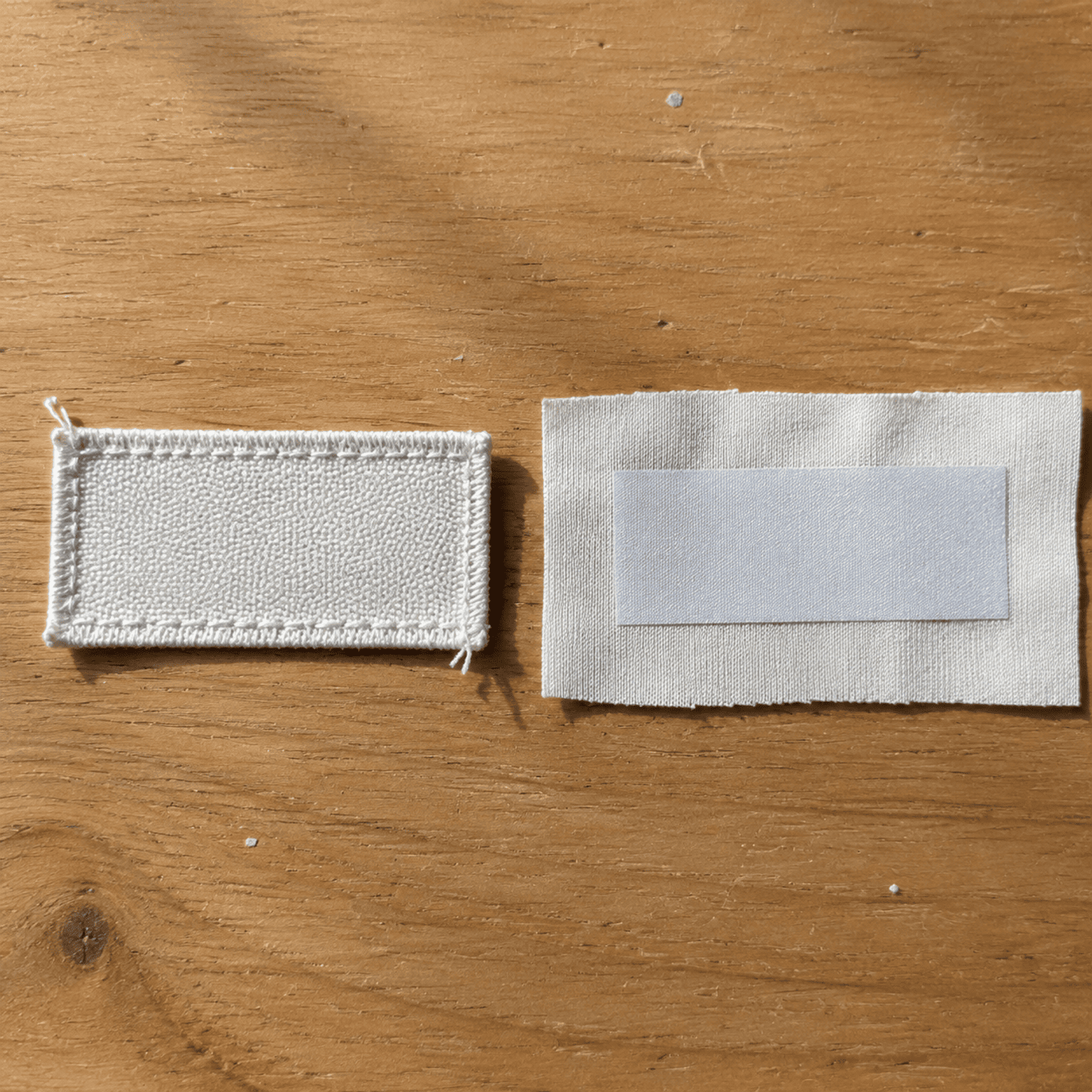
So how do you actually decide? Below, I'll walk you through the key factors — fabric type, cost, perceived quality, and durability — from the perspective of someone who manufactures both label types every day.
Which Label Type Works Best for Your Fabric?
Clients often come to us asking, "Which label is cheaper?" But the first thing we actually check is: what fabric are you using? That single variable changes everything.
Fabric dictates label compatibility. Stretch and synthetic fabrics favor heat transfer labels, while stable, structured fabrics pair naturally with sew-on woven labels. Start with your fabric, not your budget.
Stretch and Synthetic Fabrics
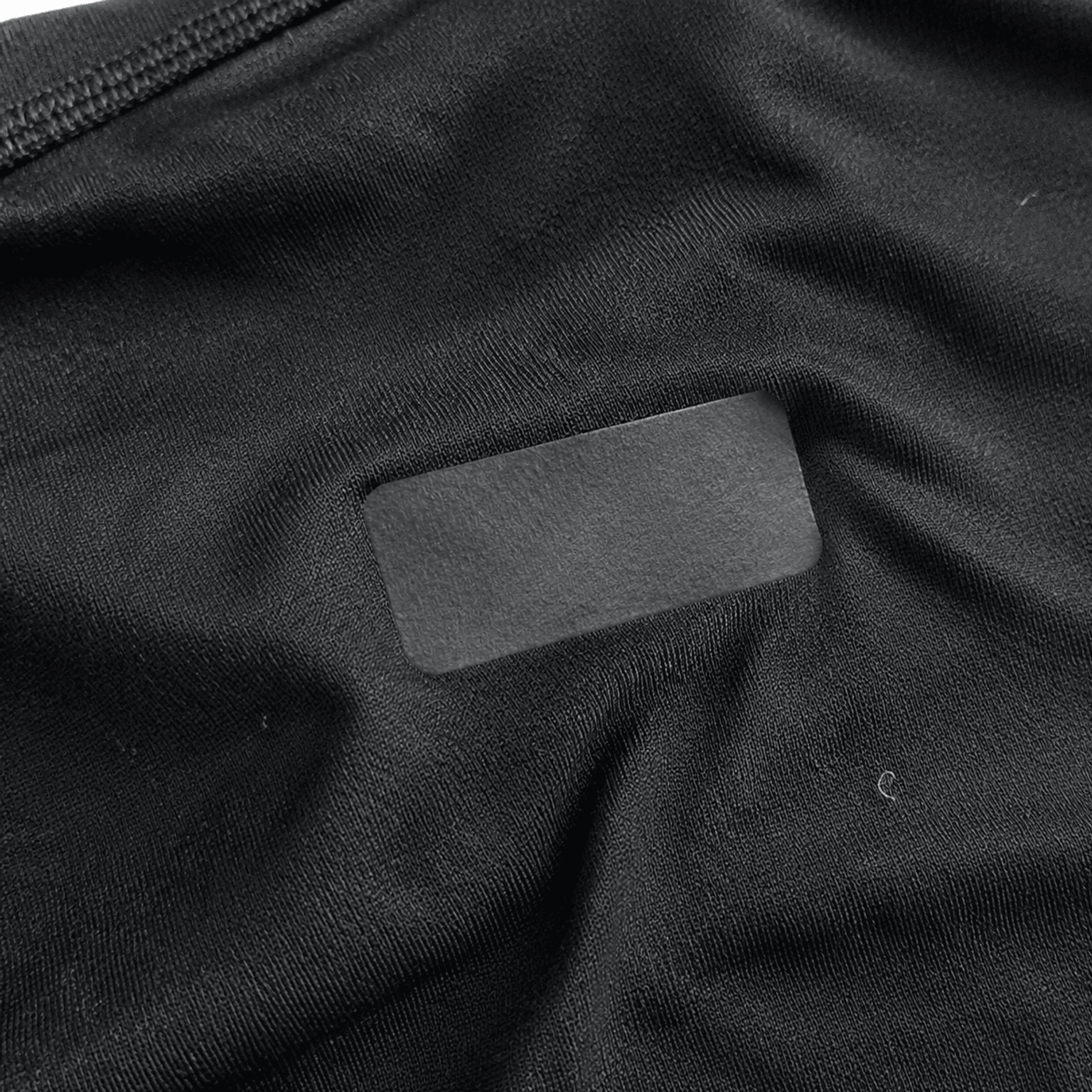
If you're making yoga pants, sports bras, or polyester performance wear, heat transfer labels are usually the way to go. Here's why: sew-on labels create a rigid patch on stretchy fabric. That means uncomfortable edges, puckering during wear, and stitching that can break when the fabric stretches repeatedly.
Heat transfer labels, on the other hand, bond directly to the fabric surface1. They move with the garment. No raised edges. No irritation. That's exactly why major sportswear brands went "tagless" years ago2.
Structured and Natural Fabrics
For cotton t-shirts, denim jackets, wool coats, or linen shirts, woven sew-on labels are a strong match. These fabrics don't stretch much, so the label sits flat and stays put. The texture of a woven label also complements the look and feel of these materials — it adds a tactile, finished quality that buyers notice.
| Fabric Type | Better Label Match | Why |
|---|---|---|
| Polyester / Spandex blends | Heat transfer | Moves with stretch, no irritation |
| Cotton knits (tees, hoodies) | Sew-on woven | Stable fabric holds stitching well |
| Wool / Cashmere | Sew-on woven | Heat can damage delicate fibers3 |
| Children's knits | Heat transfer | Tagless comfort, safety |
| Denim / Canvas | Sew-on woven | Sturdy base, premium appearance |
Quick rule of thumb: If the fabric stretches more than 10–15%, lean toward heat transfer4. If it's stable and structured, sew-on labels usually win.
Are Heat Transfer Labels Really Cheaper?
This is one of the biggest myths I encounter. People assume iron-on labels are the "budget" option. In our production experience, the cost gap is smaller than most people think — and sometimes it flips entirely.
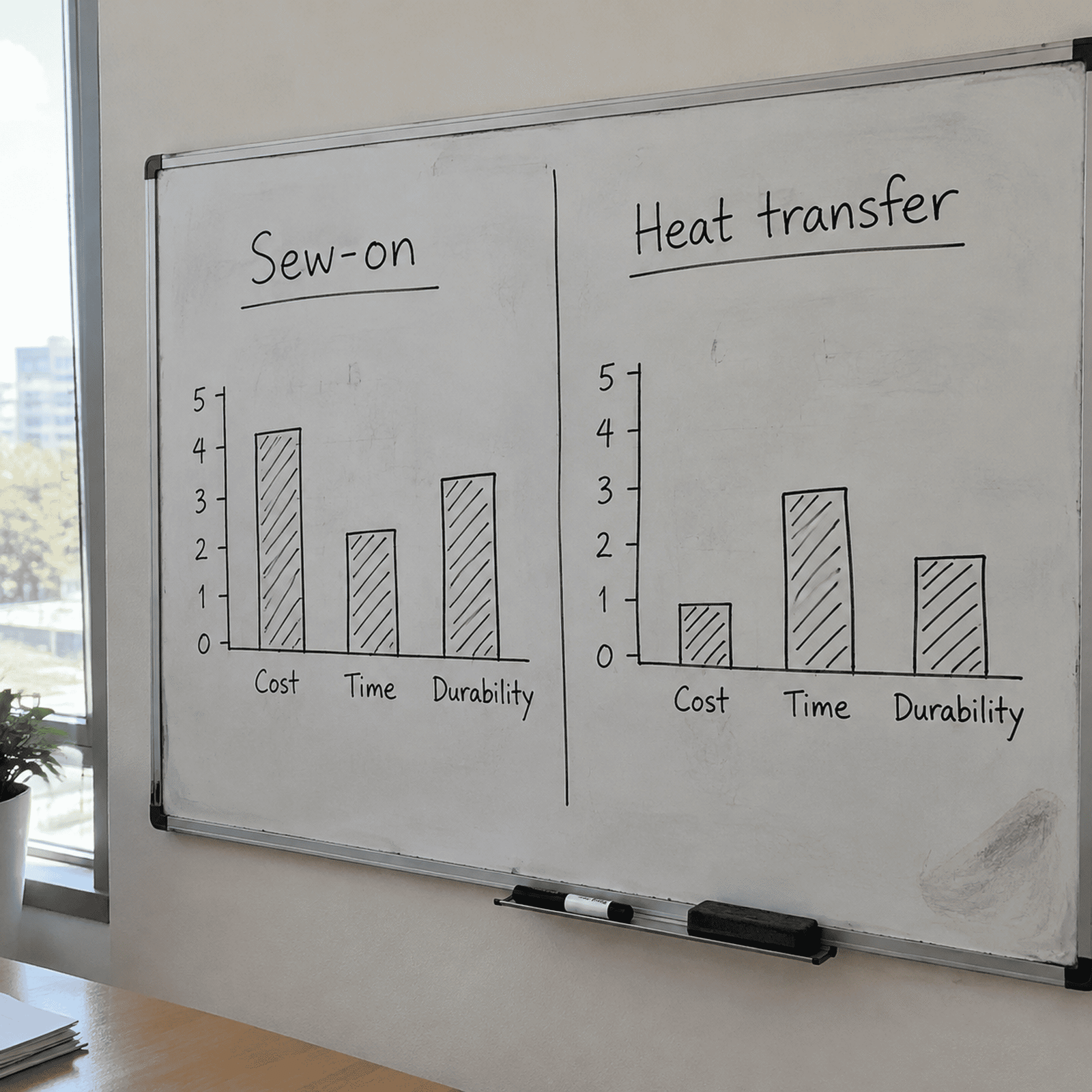
Heat transfer labels are not automatically cheaper than woven sew-on labels. True cost depends on order volume, artwork complexity, and whether your fabric needs a special adhesive formulation. Always compare total landed cost, not just unit price.
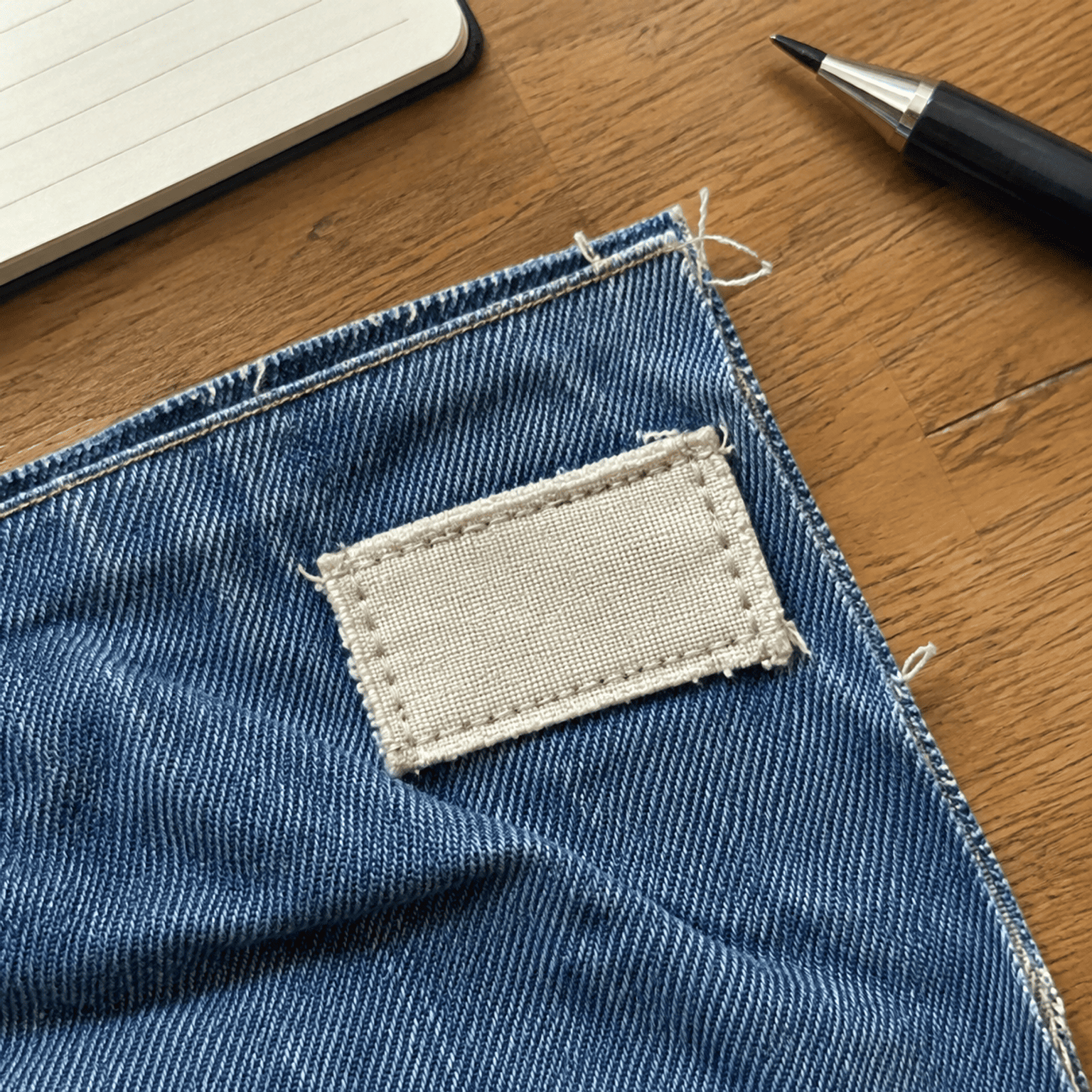
What Actually Drives Label Cost?
- Order quantity: Woven labels have higher setup costs but become very cost-effective at volume. Heat transfer labels can be more economical for small runs.
- Color and artwork complexity: A woven label with 8 colors costs significantly more than a 2-color version. Heat transfer labels handle complex artwork (gradients, photos) more easily.
- Special adhesive: Some fabrics — particularly coated or water-repellent materials — require custom adhesive formulations5 for heat transfer labels. That adds cost.
- Hidden labor cost: Sew-on labels require sewing time in your production line. Heat transfer labels require a heat press and trained operators. Neither is "free" to apply.
Bottom line: Get quotes for both. Don't assume.
Does "Premium" Always Mean Woven Sew-on Labels?
Not at all. I've seen brand owners insist on sew-on woven labels for performance leggings because they seem "more premium." Then their customers complain about scratchy tags. Premium means right for the end-use.
A thick woven label feels luxurious in a tailored blazer. That same label in a baby onesie is a comfort failure. Heat transfer "tagless" labels are the premium choice in children's wear, intimates, and athleisure — because premium in those categories means invisible comfort.
Matching Label Feel to Brand Positioning
- Tailored clothing, outerwear, denim: Woven damask labels with clean folded edges signal craftsmanship6.
- Activewear, loungewear, kids' clothing: A smooth, flat heat transfer label signals that you've thought about the wearer's experience.
- Streetwear: This category actually goes both ways. Some streetwear brands use oversized woven labels as a design element. Others go fully tagless for a clean look.
The takeaway: Don't default to "woven = high-end." Ask yourself what "premium" means to your customer.
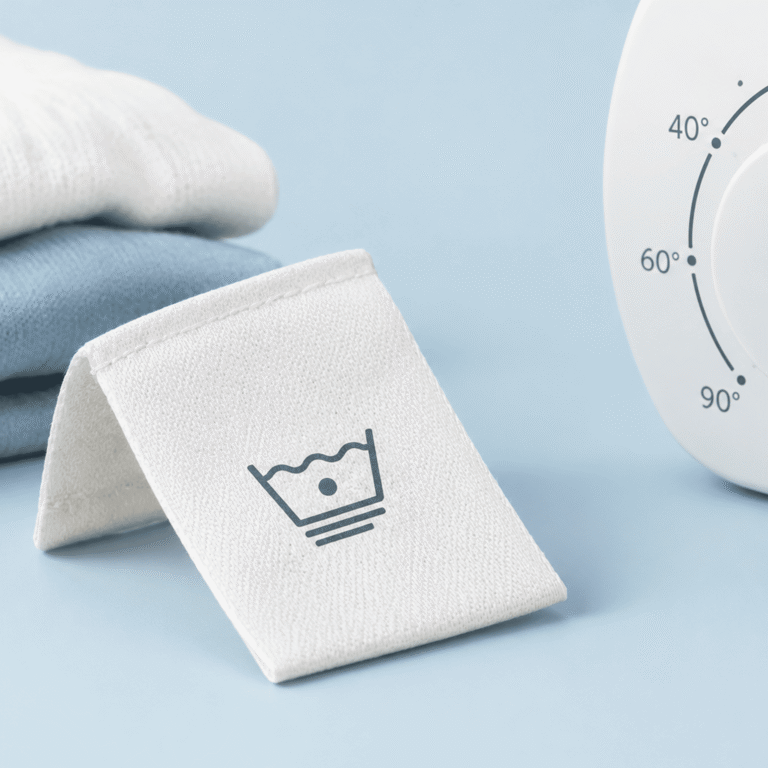
Which Label Type Lasts Longer After Washing?
"Do heat transfer labels peel off in the wash?" I hear this weekly. The honest answer: it depends entirely on how they're applied.
Heat transfer label durability is a process variable, not a label-type verdict. Temperature, pressure, dwell time, and adhesive-fabric compatibility all determine washability7. A well-applied heat transfer label can outlast a poorly stitched sew-on label.
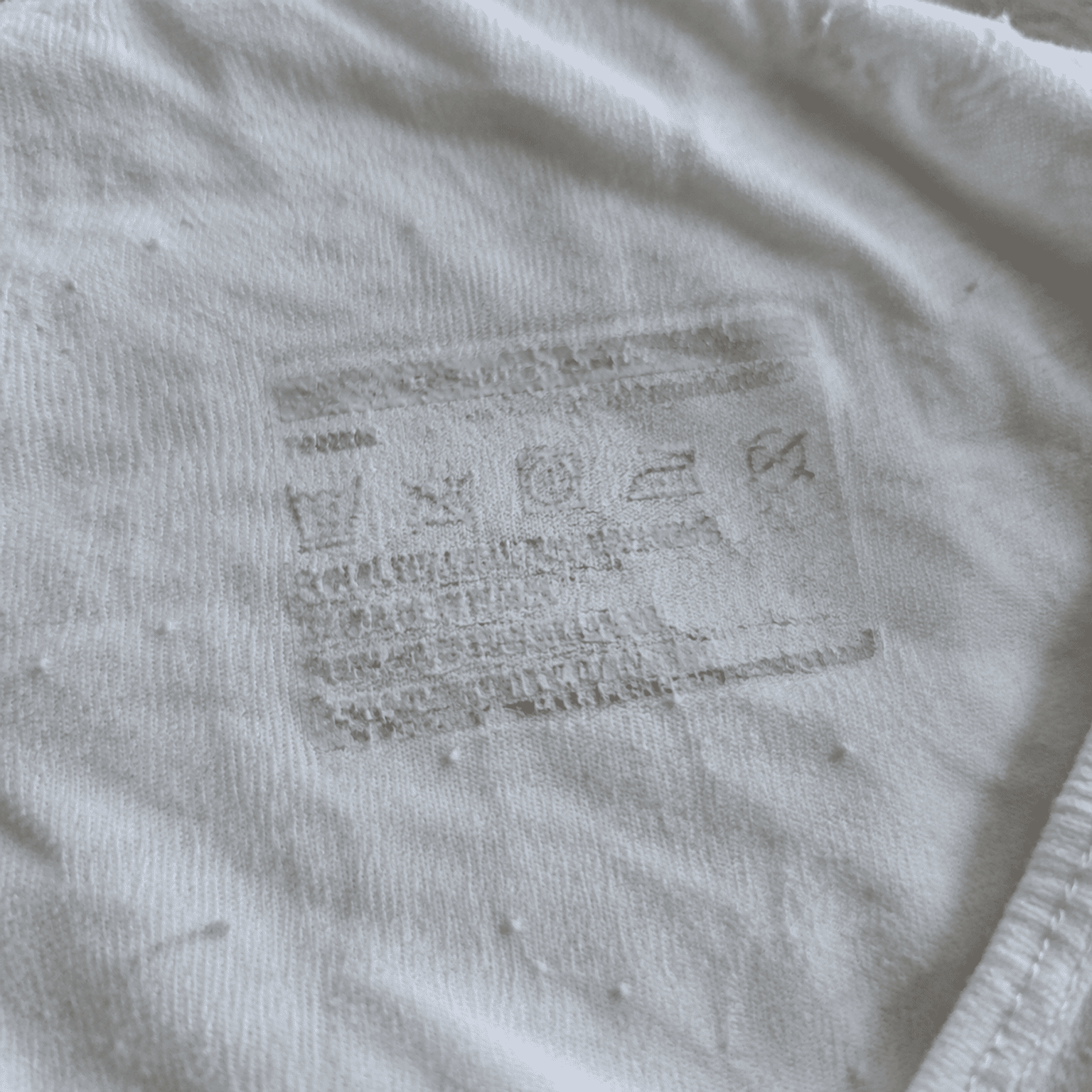
What Controls Heat Transfer Durability?
In our facility, when we produce heat transfer labels, we test adhesive compatibility with the client's specific fabric before bulk production. The key parameters are:
- Temperature: Too low and it won't bond. Too high and you risk scorching the fabric.
- Pressure: Even, consistent pressure across the label surface.
- Dwell time: The seconds the press stays closed — this must match the adhesive type.
- Fabric surface: Coated, moisture-wicking, or heavily textured fabrics need special adhesive formulations.
When all four variables are dialed in, heat transfer labels hold up extremely well through repeated laundering. When they're off — even slightly — you get peeling. This is why choosing a supplier who tests before bulk production matters so much.
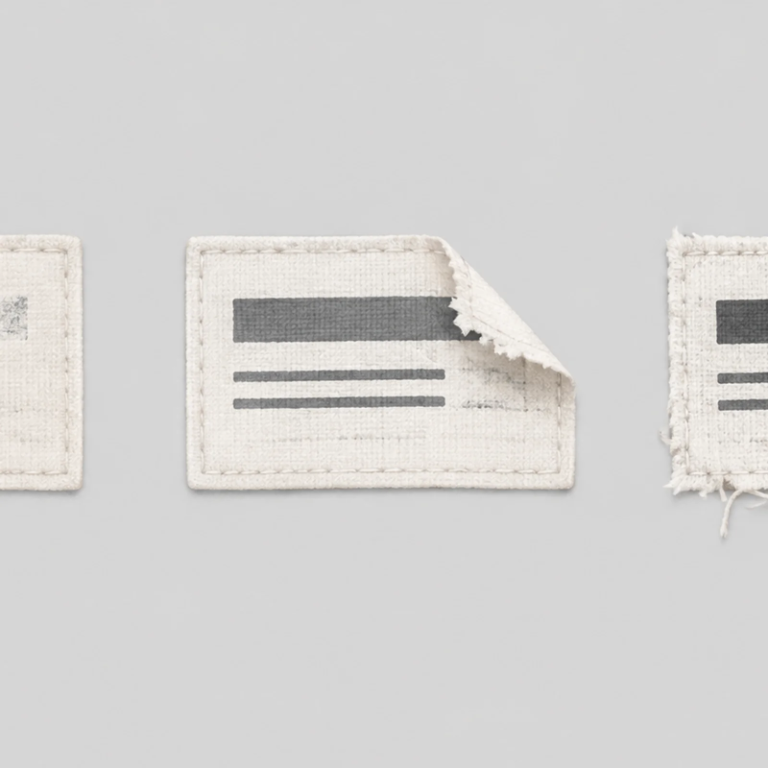
Sew-on labels, meanwhile, are mechanically attached. Their durability depends on thread quality and stitch density. A loosely stitched label will fray and detach over time8.
Frequently Asked Questions
Can I use both label types on the same garment?
Yes. Many brands use a woven sew-on label at the neck for branding and a heat transfer care label inside the body for comfort. This combination is very common in mid-range to premium apparel.
What's the minimum order quantity for each label type?
It varies by supplier. In our experience, woven labels typically start around 100–300 pieces9, while heat transfer labels can start even lower. We offer flexible MOQs for both.
Do heat transfer labels work on all fabrics?
Not all. Heavily textured, coated, or heat-sensitive fabrics (like certain silks) may not bond well. Always request a pre-production adhesion test on your actual fabric before committing to bulk.
Are heat transfer labels safe for children's clothing?
Yes, and they're often preferred. Tagless heat transfer labels eliminate choking hazards from loose tags10 and reduce skin irritation11 — both important for kids' apparel compliance.
Conclusion
The choice between sew-on labels and heat transfer labels isn't about which is objectively "better." It's about which matches your fabric, your garment category, and your customer's expectations. Stretchy activewear? Heat transfer. Structured cotton or wool? Sew-on woven. Kids' clothing? Almost always tagless heat transfer.
As a manufacturer who produces both label types daily, my advice is simple: start with your fabric and your end-use, then choose the process. And always test before bulk production.
If you're launching a new product line and need help deciding, reach out to our team. We'll review your fabric, garment type, and order size — then recommend the right label solution. Free samples and spec sheets are available on request.
"Preventing Delamination in Silicone-on-Fabric Labels", https://chieflabels.com/blog/preventing-silicone-fabric-delamination/. Heat transfer labeling relies on thermoplastic adhesive systems—commonly polyurethane or polyester-based hot-melt films—that achieve fabric adhesion through a combination of mechanical interlocking with fiber surfaces and polymer chain entanglement during the heat-press cycle. Evidence role: mechanism; source type: research. Supports: Heat transfer labels use thermoplastic adhesive films that melt under heat and pressure, penetrating the fabric surface to create a mechanical and chemical bond upon cooling.. Scope note: Bond quality and mechanism vary significantly depending on adhesive chemistry, fabric composition, and application parameters. ↩
"Selling Style I: The History of Fashion Marketing Through the ...", https://textiles.ncsu.edu/news/2019/05/selling-style-i-the-history-of-fashion-marketing-through-the-19th-century/. Hanes introduced its tagless t-shirt line in 2002, and other major sportswear and basics brands followed suit over the subsequent decade, making heat transfer care labels an industry standard for performance and comfort apparel. Evidence role: historical_context; source type: other. Supports: Major apparel brands, including Hanes and Nike, transitioned to tagless heat transfer labels in the early-to-mid 2000s to improve wearer comfort.. Scope note: Exact timelines vary by brand and product category; the transition was gradual rather than a single industry-wide event. ↩
"Advanced Cooling Textiles: Mechanisms, Applications, and ...", https://pmc.ncbi.nlm.nih.gov/articles/PMC10933611/. Protein-based fibers such as wool and cashmere begin to undergo thermal degradation at temperatures around 130–150°C, which overlaps with the typical application range for heat transfer adhesives (150–180°C), posing a risk of fiber damage and surface marking. Evidence role: mechanism; source type: research. Supports: Wool and cashmere are protein-based (keratin) fibers that are susceptible to thermal degradation, scorching, and loss of hand feel at temperatures commonly used for heat transfer label application.. Scope note: Specific damage thresholds depend on fiber quality, fabric weight, and the exact heat transfer adhesive system used; some low-temperature adhesives may be compatible. ↩
"Threading Your Way Through the Labeling Requirements ...", https://www.ftc.gov/business-guidance/resources/threading-your-way-through-labeling-requirements-under-textile-wool-acts. Textile engineering literature indicates that sewn attachments on high-stretch fabrics can cause seam puckering and reduced dimensional stability, particularly when fabric elongation exceeds moderate thresholds. Evidence role: mechanism; source type: research. Supports: Fabrics with significant elongation percentages are prone to puckering and stitch breakage when rigid labels are sewn in, making heat transfer labels preferable.. Scope note: The specific 10–15% figure may be an industry heuristic rather than a formally established standard in textile science literature. ↩
"Threading Your Way Through the Labeling Requirements ...", https://www.ftc.gov/business-guidance/resources/threading-your-way-through-labeling-requirements-under-textile-wool-acts. DWR-treated and coated fabrics present low surface energy substrates that impede adhesive wetting and mechanical interlocking, requiring modified adhesive formulations—such as higher-tack or chemically reactive systems—to achieve adequate bond strength for heat transfer labels. Evidence role: mechanism; source type: research. Supports: Durable water repellent (DWR) coatings and other surface treatments reduce fabric surface energy, inhibiting standard thermoplastic adhesive wetting and bonding.. Scope note: The specific adhesive modifications needed vary by coating type and fabric construction; not all coated fabrics present the same degree of bonding difficulty. ↩
"Woven Labels Damask Quality - High Definition Weaving", https://www.woven-printed-garment-labels.com/high-definition-damask-woven-labels/. Damask-woven labels use a satin weave structure that allows for finer detail and a smoother surface finish compared to taffeta-woven labels, and have historically been used in higher-end apparel to convey quality and brand prestige. Evidence role: definition; source type: encyclopedia. Supports: Damask weaving produces a finer, higher-density label with smoother detail rendering than taffeta weave, and is traditionally associated with premium garment branding.. Scope note: Consumer perception of label quality is subjective and influenced by multiple factors beyond weave type, including brand context and garment category. ↩
"HEAT, TIME, AND PRESSURE – The Holy Trinity of ... - digitran", https://www.digitran.de/en/blogpost/heat-time-and-pressure-the-holy-trinity-of-heat-transfer-applications/. Textile labeling industry guidelines and adhesive manufacturers specify that heat transfer label bond strength is a function of application temperature, platen pressure, dwell time, and adhesive-substrate compatibility, with wash durability commonly evaluated per AATCC or ISO laundering test methods. Evidence role: expert_consensus; source type: research. Supports: Heat transfer label adhesion and wash durability are governed by application temperature, pressure, dwell time, and adhesive compatibility with the substrate fabric.. Scope note: Specific optimal parameter ranges differ by adhesive system and fabric type; no single universal standard governs all heat transfer label applications. ↩
"Woven vs Satin vs Damask Labels: Which to Choose & Why", https://labelriver.com/blog/woven-vs-satin-vs-damask-labels-which-one-to-choose-and-why/. Textile quality standards such as ASTM D1683 and ISO 13935 establish that seam strength and durability are functions of stitch density, thread tensile strength, and stitch type; insufficient stitch density in label attachment leads to premature thread breakage and label detachment under laundering stress. Evidence role: general_support; source type: institution. Supports: Stitch density and thread tensile strength are established factors in sewn seam and label attachment durability, as defined by textile testing standards.. Scope note: These standards address seam strength broadly rather than garment label attachment specifically, though the underlying mechanical principles apply. ↩
"FAQs - Woven-Printed Garment-Labels", https://www.woven-printed-garment-labels.com/custom-made-clothing-fabric-labels-for-your-brand/. Industry sources indicate that custom woven label production typically requires minimum orders ranging from 100 to 500 pieces, reflecting the fixed costs of jacquard loom programming and thread setup. Evidence role: general_support; source type: other. Supports: Custom woven label manufacturers commonly set minimum order quantities in the low hundreds due to loom setup costs.. Scope note: MOQs vary widely by supplier, region, and label complexity; some suppliers offer lower minimums at premium per-unit pricing. ↩
"Small Parts Ban and Choking Hazard Labeling", https://www.cpsc.gov/Business--Manufacturing/Business-Education/Business-Guidance/Small-Parts-for-Toys-and-Childrens-Products. The U.S. Consumer Product Safety Commission (CPSC) enforces standards under CPSIA regarding small parts on children's products; detachable components, including poorly attached labels, can be classified as choking hazards for children under three years of age. Evidence role: general_support; source type: government. Supports: U.S. consumer product safety regulations address small parts and detachable components on children's clothing as potential choking hazards.. Scope note: CPSC regulations address detachable small parts broadly rather than specifically singling out sewn-in garment labels as a primary choking hazard category. ↩
"Home-based devices in dermatology: a systematic review of ...", https://pmc.ncbi.nlm.nih.gov/articles/PMC8918178/. Dermatological literature identifies garment labels as a common cause of mechanical irritant contact dermatitis, particularly in individuals with sensitive skin or atopic conditions; tagless labeling methods reduce direct friction and edge contact with the skin surface. Evidence role: general_support; source type: research. Supports: Sewn-in garment labels are a recognized source of mechanical skin irritation and contact dermatitis, and tagless alternatives reduce this risk.. Scope note: Most published studies address textile-related dermatitis broadly rather than specifically comparing sewn-in versus heat transfer label irritation rates. ↩
0 Comments
Ask a question or share your garment accessories sourcing experience.