

How to Choose Label Material Based on Garment Washing Temperature
Choosing label material based on garment washing temperature is one of those decisions that seems small — until it goes wrong. A label that cracks, fades, or curls after a few washes doesn't just look bad. It triggers returns, complaints, and real damage to your brand reputation1. The fix is simple: start with the wash, not the label.
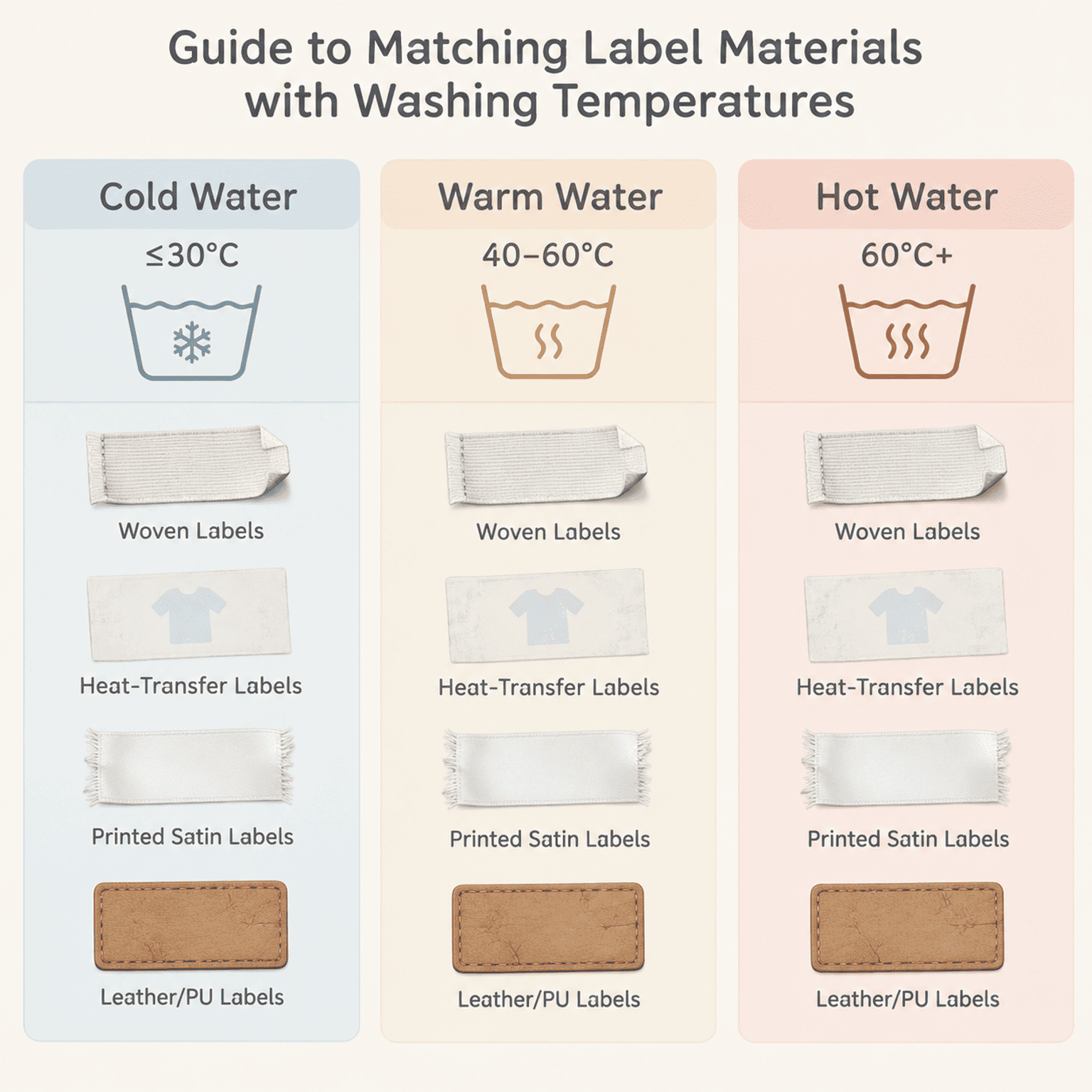
The right label material depends entirely on the washing temperature your garment will actually face. Match the garment's care profile — cold wash, warm wash, or industrial hot wash — to a material that can survive those conditions repeatedly. No single label material works for every scenario. Polyester woven labels handle up to 60°C well2. Heat transfer labels perform best at ≤40°C3. Industrial wash above 60°C demands specialized options.
Below, I'll walk you through the decision framework we use with our own customers — based on real failure patterns we've seen across hundreds of projects in 30+ countries. Let's break it down by temperature tier.
Why Should Washing Temperature Be Your Starting Point?
Most buyers start by asking "which label looks best?" That's backwards. The garment's washing conditions should drive your material choice — not aesthetics or unit cost.
When you start from the washing scenario, you immediately eliminate materials that will fail. This saves you from after-sales headaches that cost far more than the label itself.
The Real Cost of Getting It Wrong
In our experience across hundreds of projects, the pattern is always the same. A buyer picks a label material because it looks great on a sample card. The garment ships. After a few consumer washes, the labels crack, peel, or become unreadable. Then come the complaints, the returns, and the awkward conversations with retail buyers.
I've personally handled after-sales cases where the label failure contradicted what the original supplier promised. The spec sheet said "wash durable." Reality said otherwise. The brand paid the price — not the label supplier.
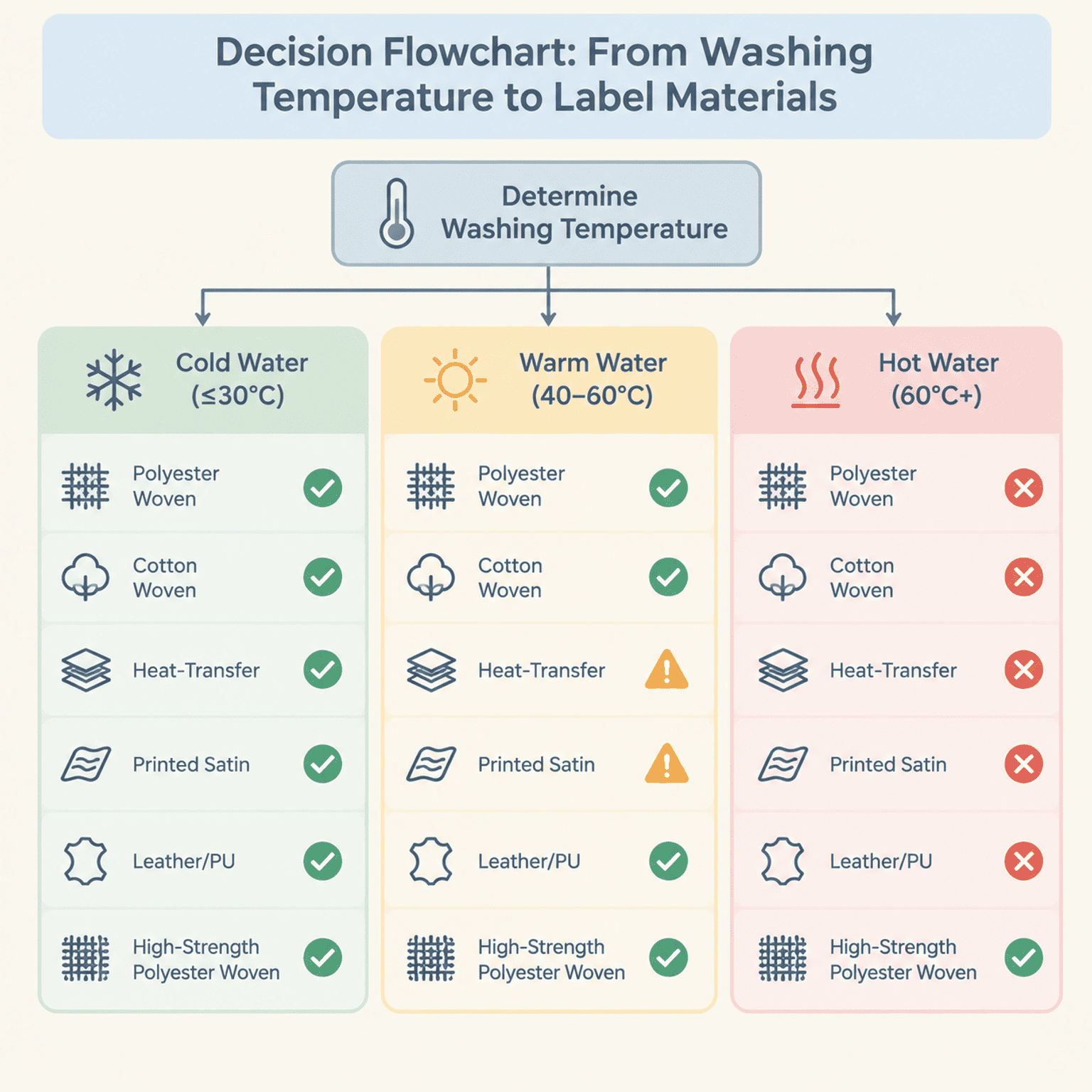
Here's the framework we recommend:
- Define your garment's care profile — how will the end consumer actually wash it?
- Identify the washing temperature tier — cold (≤30°C), warm (40–60°C), or hot (60°C+)?
- Match compatible label materials to that tier
- Then optimize for aesthetics, cost, and MOQ
This order matters. It's the difference between a label that lasts and one that doesn't.
What Happens to Different Label Materials at Each Temperature Tier?
Not all label materials react to heat the same way. Here's where the myth-busting starts: many buyers assume "woven = durable at any temperature." That's simply not true.
Each label type has a thermal and mechanical limit. Exceed it, and you get specific, predictable failure modes — fading, shrinkage, cracking, curling, or complete illegibility.
Cold Wash (≤30°C): Most Materials Are Safe
At cold wash temperatures, nearly all label materials perform well. This is the comfort zone for:
- Woven labels (polyester and cotton)
- Heat transfer labels / printed labels
- PVC/rubber labels
- Satin and damask labels
If your garment is a delicate fashion piece washed cold, your material choice is wide open. Prioritize aesthetics and brand feel here.
Warm Wash (40–60°C): The Critical Middle Zone
This is where most failures begin — and where most buyers underestimate the risk.
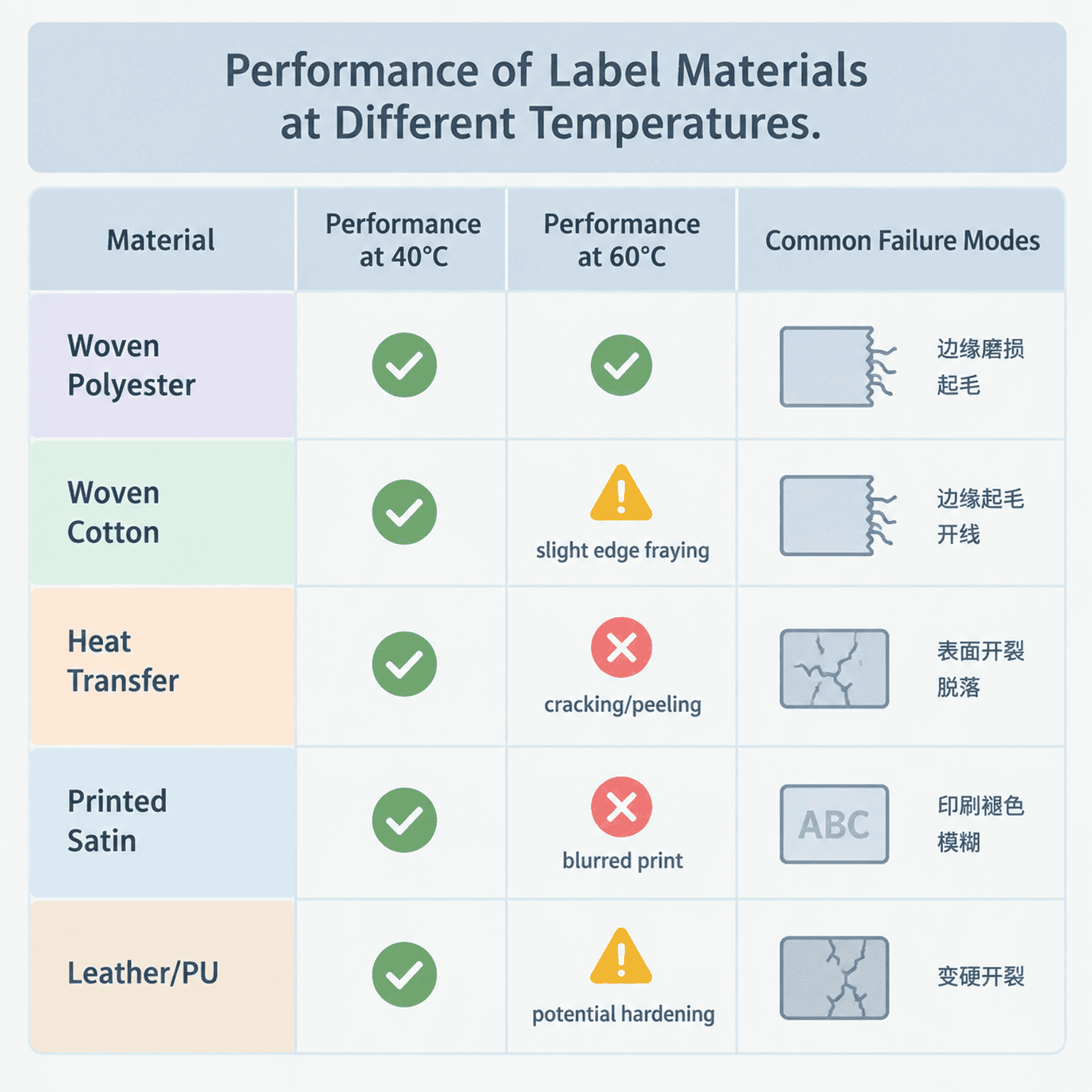
| Material | Performance at 40°C | Performance at 60°C |
|---|---|---|
| Polyester woven labels | Stable, no issues | Generally stable; verify with wash test |
| Cotton woven labels | Good | Starts softening; edges may fray over repeated washes |
| Heat transfer labels | Usually fine | Risk zone — cracking, peeling, fading common |
| Printed satin labels4 | Acceptable | Print can blur or wash out |
| Leather/PU labels5 | Fine | May stiffen or crack depending on grade |
Key takeaway: Heat transfer labels and printed labels have a narrower safe window than most buyers realize. They're popular for their clean look and low cost — but if your garment will be washed at 60°C regularly, you're gambling with legibility and appearance.
Hot Wash (60°C+ / Industrial Laundering)
This tier covers workwear, uniforms, hospitality linens, and medical garments6 — anything subjected to commercial or industrial laundering at 70–90°C.
This is where we've seen the most costly failures. Here's what happens:
- Polyester woven labels can shrink or distort above 75°C over repeated cycles
- Cotton woven labels fray significantly and lose shape
- Heat transfer labels almost always fail — cracking, peeling, complete illegibility
- Printed labels wash out quickly
For industrial wash scenarios, you need materials specifically engineered for high-temp durability — such as high-tenacity polyester woven labels7 or specialized heat-resistant transfer films. Always ask your supplier specifically about industrial wash ratings, and don't just trust the spec sheet.
How Can You Verify a Supplier's Washability Claims?
Spec sheets and supplier claims are necessary — but in our experience, they're not sufficient. Washability ratings can be tested under ideal lab conditions that don't match real-world consumer behavior.
The safest approach is to request wash-test samples before committing to a bulk order. This one step has saved many of our customers from expensive mistakes.

A Practical Verification Checklist
Here's what we recommend to every buyer, especially for warm and hot wash applications:
- Request 5–10 label samples from your supplier before bulk production
- Sew or apply them to actual garment fabric — not just test cards
- Wash them at your garment's rated care temperature for at least 10–15 cycles
- Inspect for: fading, cracking, curling, edge fraying, print legibility, shrinkage
- Document results with photos — this becomes your QC benchmark
We've seen cases where a supplier's "60°C rated" label failed visibly by the 8th wash cycle. The spec sheet wasn't wrong per se — the testing conditions just didn't reflect real use. Trust but verify.
If your supplier pushes back on providing wash-test samples, that itself is a signal. A confident supplier welcomes testing.
Frequently Asked Questions
Can I use heat transfer labels on garments washed at 60°C?
In our experience, heat transfer labels perform reliably at ≤40°C. At 60°C, we've repeatedly seen cracking, peeling, and fading after several wash cycles. If 60°C washing is expected, consider polyester woven labels instead — or request high-temp-rated transfer films and verify with wash tests.
Are woven labels always the safest choice for high-temperature washing?
Not automatically. Polyester woven labels handle up to about 60°C well, but they can degrade under industrial laundering at 75–90°C. Cotton woven labels fray faster at high temps. Always match the specific woven material to your temperature tier rather than assuming "woven = indestructible."
How many wash cycles should I test before approving a label material?
We recommend a minimum of 10–15 wash cycles at the garment's rated care temperature8. This simulates roughly 3–6 months of consumer use9 and reveals failure patterns that won't show up after just 2–3 washes.
Do I need different labels for domestic vs. industrial laundering?
Yes. Industrial laundering (common for uniforms, hospitality, and workwear) uses significantly higher temperatures, stronger detergents, and more aggressive mechanical action10. Labels that survive home washing at 60°C may fail quickly under industrial conditions. Always specify the laundering environment to your supplier.
Conclusion
Choosing label material based on garment washing temperature is a risk-management decision, not a cosmetic one. Start with your garment's actual care profile. Match the washing temperature tier to compatible materials. Then verify with real wash-test samples before bulk production. This simple sequence prevents the after-sales failures — cracked prints, faded text, curling edges — that cost far more than any label.
If you're sourcing labels for a new product and aren't sure which material fits your washing conditions, reach out to our team. We'll review your garment's care profile and recommend the right match — with free samples so you can verify before you commit.
"Apparel and Labeling", https://www.ftc.gov/news-events/topics/tools-consumers/apparel-labeling. Research on apparel quality perception indicates that visible defects—including label deterioration—are among the factors that reduce consumer satisfaction and increase return rates, as consumers interpret such defects as indicators of overall product quality (cf. studies on garment quality cues and consumer behavior in the Journal of Fashion Marketing and Management). Evidence role: general_support; source type: research. Supports: Visible quality defects in garment components, including labels, contribute to consumer dissatisfaction, product returns, and negative brand perception.. Scope note: Most studies address garment defects broadly rather than isolating label failure as a specific driver of returns. ↩
"Thermo-Physiological Comfort Properties of Sportswear with ...", https://pmc.ncbi.nlm.nih.gov/articles/PMC8624076/. Polyester (PET) fibers exhibit a glass transition temperature of approximately 67–81°C, meaning they retain dimensional stability and mechanical properties under standard domestic wash conditions up to 60°C (see ISO 6330 for standardized textile washing procedures). Evidence role: mechanism; source type: research. Supports: Polyester fibers maintain structural integrity and dimensional stability at temperatures up to approximately 60°C in repeated domestic laundering cycles.. Scope note: Fiber-level thermal properties may not fully account for label construction variables such as yarn density, weave type, and finishing treatments. ↩
"Application Tips for Heat Transfer Products", https://www.averydennison.com/na/en/industries/apparel/application-tips-ntp. Heat transfer labels rely on thermoplastic adhesive bonding to fabric substrates; repeated exposure to elevated wash temperatures accelerates adhesive softening and mechanical stress at the bond interface, leading to cracking and peeling (cf. textile finishing and labeling literature on thermoplastic film durability). Evidence role: general_support; source type: research. Supports: Heat transfer labels using thermoplastic adhesive films are prone to cracking and delamination when repeatedly exposed to wash temperatures above 40°C.. Scope note: Performance varies significantly by adhesive formulation and transfer film grade; some industrial-grade heat transfer labels are engineered for higher temperatures. ↩
"Satin Labels vs Woven Labels: Choosing the Right Finish", https://qualitywovenlabels.com/blog/post/satin-labels-vs-woven-labels-choosing-the-right-finish. Wash fastness of printed textile labels depends on ink-substrate adhesion; smooth satin weaves offer less mechanical anchorage for surface-applied inks, making them more vulnerable to print degradation under repeated laundering at elevated temperatures (cf. colorfastness testing per ISO 105-C06). Evidence role: mechanism; source type: research. Supports: Ink adhesion on smooth satin label substrates is more susceptible to degradation at elevated wash temperatures due to reduced mechanical interlocking between ink and fiber surface.. Scope note: Performance depends heavily on ink type (e.g., resin-based vs. dye-based) and any post-print curing or coating applied. ↩
"Case Study Of Durability, Abrasion Resistance, And ...", https://ir.library.illinoisstate.edu/cgi/viewcontent.cgi?article=1001&context=urs2021fcs. Polyurethane coatings used in synthetic leather are susceptible to hydrolysis at elevated temperatures, leading to surface cracking and loss of flexibility; the rate of degradation increases significantly above 50°C in aqueous environments (Oprea, S., 'Degradation of crosslinked poly(ester-urethanes) in water,' Polymer Degradation and Stability). Evidence role: mechanism; source type: paper. Supports: Polyurethane (PU) synthetic leather can undergo hydrolytic degradation and stiffening when repeatedly exposed to hot water and detergents, with effects accelerating above 50–60°C.. Scope note: Degradation rates vary substantially by PU formulation, coating thickness, and whether hydrolysis-resistant grades are used. ↩
"G. Laundry and Bedding | Infection Control", https://www.cdc.gov/infection-control/hcp/environmental-control/laundry-bedding.html. EN 14065 establishes a risk analysis framework for biocontamination control in industrial textile processing; healthcare and hospitality linens are commonly laundered at 71–90°C to achieve thermal disinfection, as recommended by public health guidelines (e.g., CDC and NHS laundry guidelines). Evidence role: general_support; source type: institution. Supports: Healthcare textiles and workwear are typically laundered at 70–90°C to meet hygiene and decontamination requirements specified by industry and regulatory standards.. Scope note: Exact temperature requirements vary by jurisdiction, facility type, and specific contamination risk level. ↩
"Understand Your Fibers | Textiles", https://site.extension.uga.edu/textiles/textile-basics/understand-your-fibers/. High-tenacity polyester yarns are produced through enhanced drawing processes that increase molecular orientation and crystallinity, resulting in tensile strengths significantly above standard textile-grade PET and improved resistance to mechanical and thermal stress during industrial laundering (Textile Terms and Definitions, The Textile Institute). Evidence role: definition; source type: encyclopedia. Supports: High-tenacity polyester fibers are engineered with higher molecular orientation and crystallinity, providing superior tensile strength and dimensional stability under demanding laundering conditions.. Scope note: Label-level performance also depends on weave construction, finishing, and edge treatment, not fiber tenacity alone. ↩
"Care Labeling of Textile Wearing Apparel & Certain Piece ...", https://www.ftc.gov/legal-library/browse/rules/care-labeling-textile-wearing-apparel-certain-piece-goods-text. ISO 6330 provides standardized domestic washing and drying procedures for textile testing; industry practice for label durability assessment typically involves 10–50 wash cycles depending on the end-use application, with 10–15 cycles serving as a practical minimum for identifying early failure modes. Evidence role: general_support; source type: institution. Supports: Standardized textile wash durability testing commonly uses 10–50 wash cycles to evaluate component performance, with lower cycle counts appropriate for initial screening.. Scope note: The equivalence of test cycles to months of consumer use varies widely depending on garment type, consumer washing frequency, and laundering conditions. ↩
"CONSUMER LAUNDERING HABITS", https://www.ftc.gov/sites/default/files/documents/public_comments/16-cfr-part-423-trade-regulation-rule-care-labeling-textile-wearing-apparel-and-certain-piece-goods.r511915-00004%C2%A0/00004-61210.pdf. Consumer laundry behavior surveys indicate that frequently worn garments such as workwear and casual clothing are washed approximately 1–4 times per month on average, depending on garment type and cultural norms (AISE/A.I.S.E. consumer habits survey; Laitala, K. et al., 'Consumers' clothing disposal behaviour,' Journal of Cleaner Production). Evidence role: statistic; source type: research. Supports: Average consumer washing frequency for regularly worn garments ranges from approximately 1–4 times per month, making 10–15 cycles roughly equivalent to 3–6 months of typical use.. Scope note: Washing frequency varies significantly by garment category, climate, and individual consumer habits; the 3–6 month estimate is an approximation. ↩
"WaterSense at Work Section 3.5: Laundry Equipment", https://www.epa.gov/system/files/documents/2023-06/ws-commercial-watersense-at-work_Section_3.5_Laundry_Equipment.pdf. ISO 15797 specifies standardized industrial laundering and finishing procedures for testing workwear textiles, with wash temperatures typically ranging from 75°C to 92°C and the use of alkaline detergents, reflecting conditions substantially more severe than domestic laundering as defined in ISO 6330. Evidence role: definition; source type: institution. Supports: Industrial laundering processes operate at significantly higher temperatures (typically 70–90°C), use alkaline detergents, and employ more aggressive mechanical action than domestic washing.. ↩

0 Comments
Ask a question or share your garment accessories sourcing experience.