

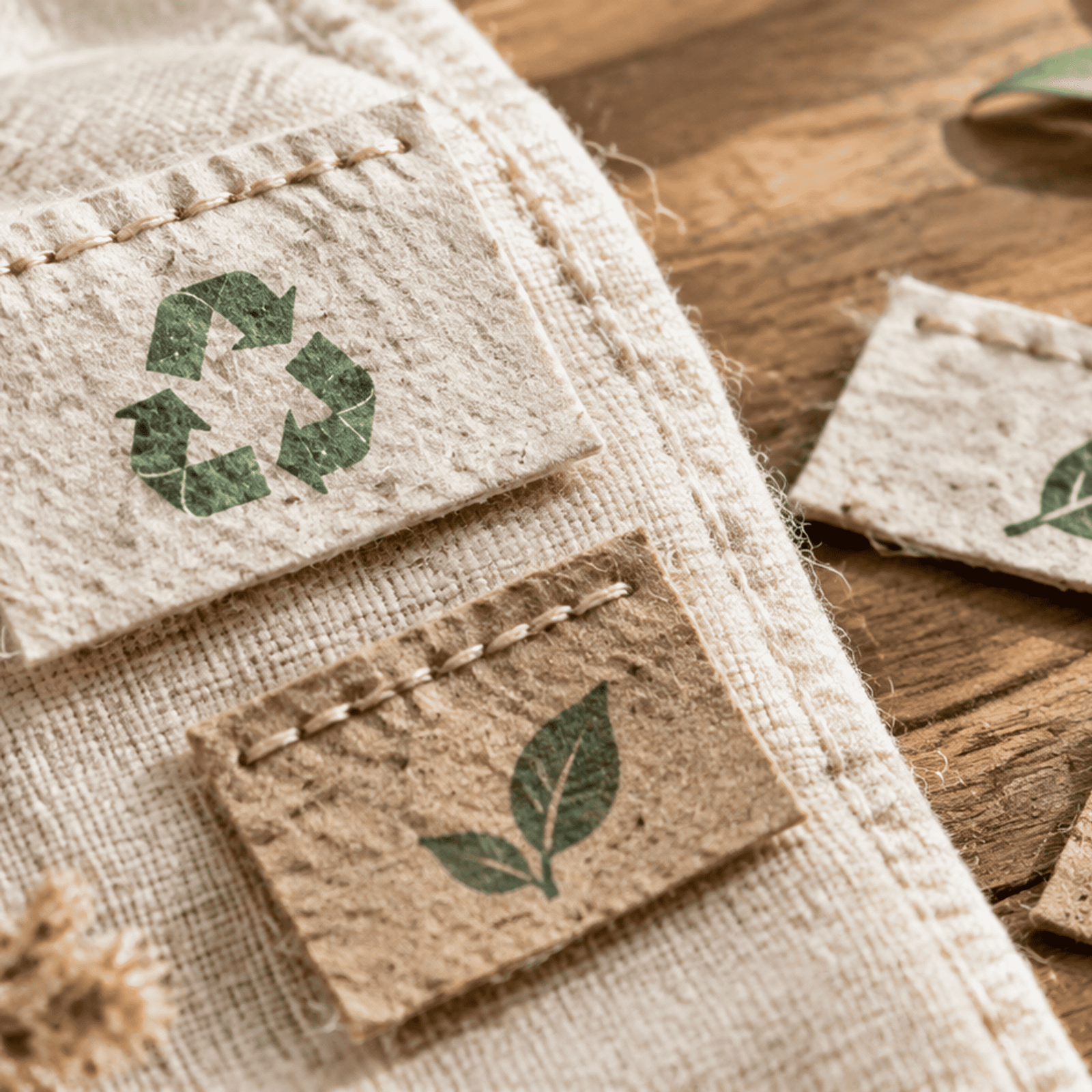
Recycled Garment Label Materials: Sustainable Options for Fashion Brands
Choosing recycled garment label materials sounds simple — until you realize "recycled" covers a dozen different materials, each with different durability, cost, and certification implications. Pick the wrong one and you risk labels falling apart in the wash, or worse, a greenwashing accusation. The key is matching the right recycled material to your actual product needs.
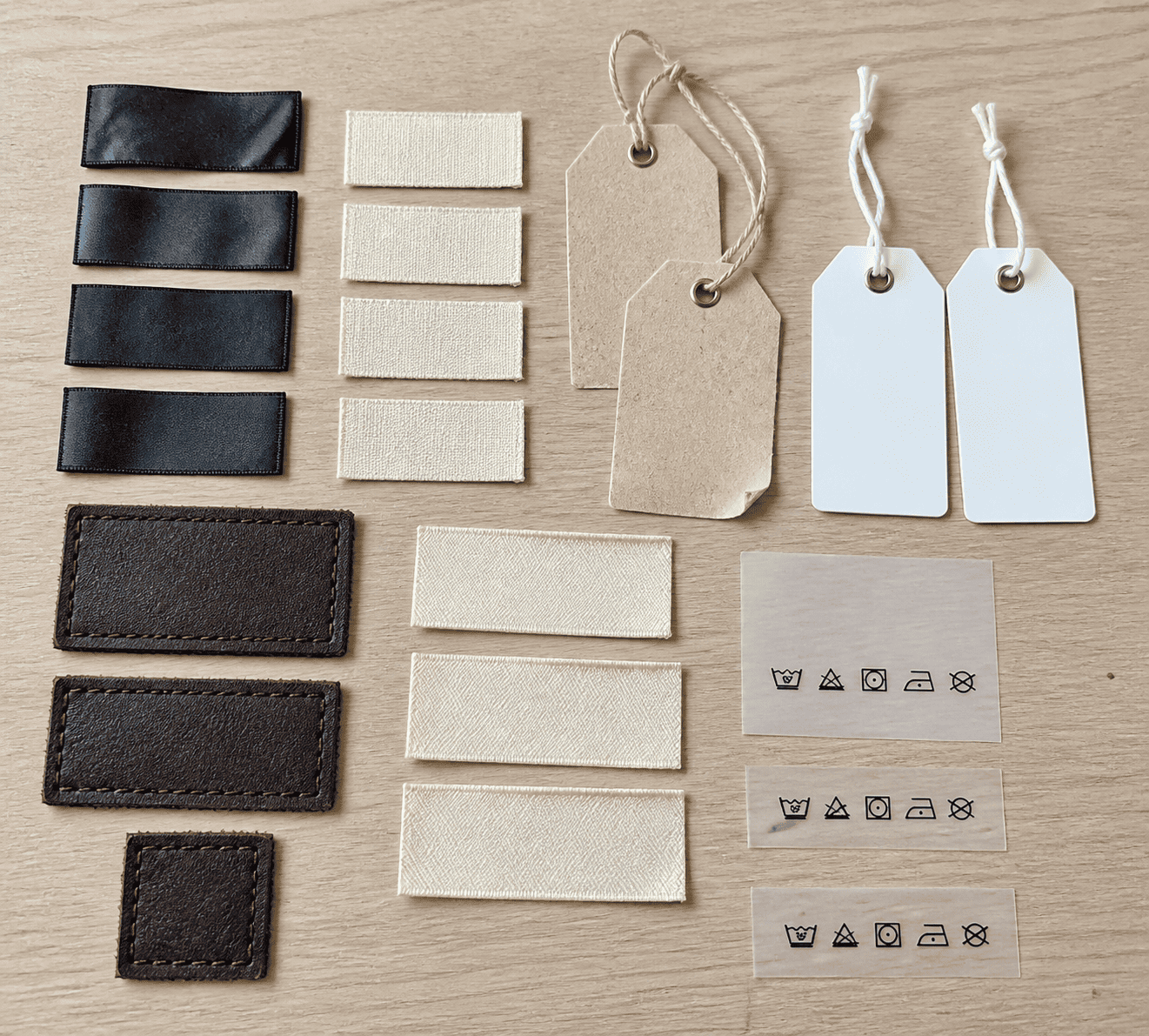
Recycled garment label materials include rPET woven labels, recycled cotton labels, recycled paper hang tags, FSC-certified tags, recycled leather patches, and eco-ink heat transfers. The best choice depends on three factors: how many wash cycles the label must survive, whether you need third-party certification or simply a brand story, and your budget. There is no single "best" recycled material — only the right one for your use case.
I've helped brands across 30+ countries navigate this exact decision. Below, I'll walk you through how we approach recycled label selection in real production conversations — so you can avoid common mistakes and find your fit faster.
Which Recycled Label Material Fits Your Product?
Most buyers start by asking "what recycled materials are available?" That's the wrong first question. The right question is: "What does this label need to survive?"
The best way to choose a recycled label material is to start with your use case — specifically wash-cycle requirements and where the label sits on the garment. Labels sewn into clothing need wash durability; hang tags never touch water. This single distinction eliminates half your options immediately.
When clients ask us to source recycled labels, we always start with two diagnostic questions:
- How many wash cycles must this label survive?
- Is this for regulatory compliance or brand storytelling?
Here's a quick decision matrix we use internally:
| Material | Wash Durability | Best For | Tactile Quality | Relative Cost |
|---|---|---|---|---|
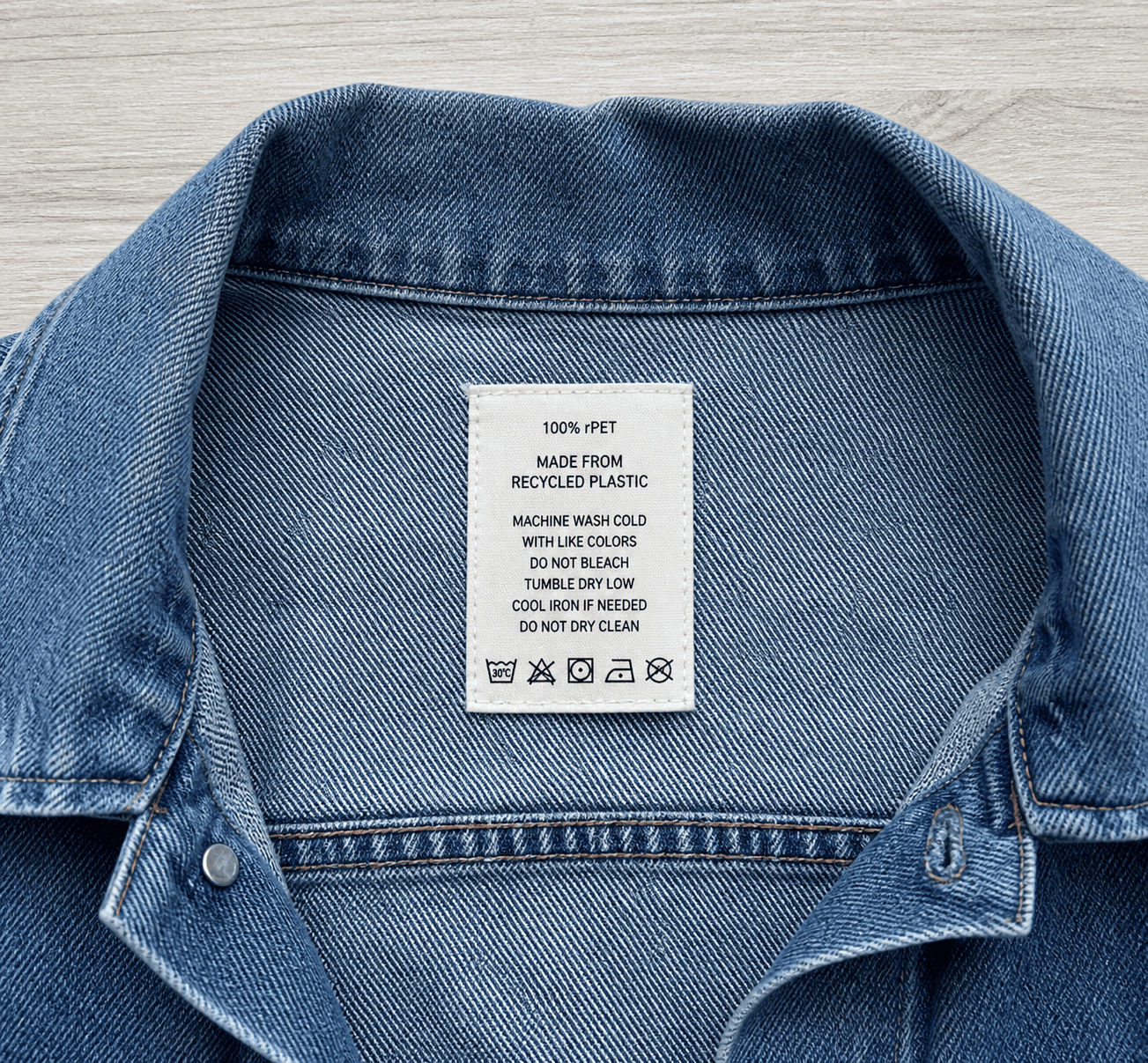
| rPET woven labels | High (50+ washes) | Sewn-in care/brand labels | Smooth, similar to polyester | Low premium |
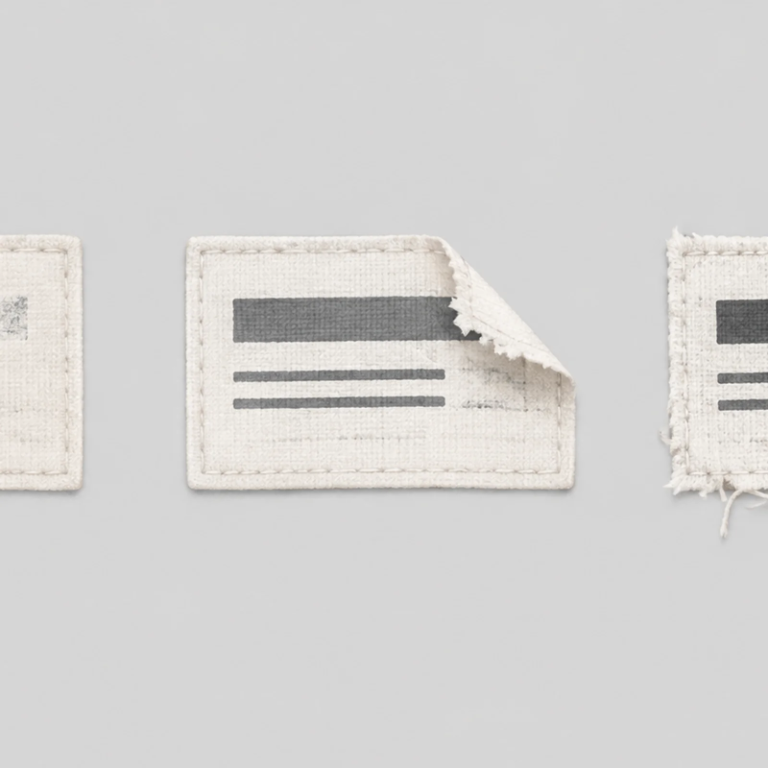
| Recycled cotton woven labels1 | Moderate (20–30 washes) | Premium brand labels | Soft, natural hand-feel | Moderate premium |
| Recycled paper hang tags | None (not washable) | Swing tags, price tags | Textured, natural look | Very low premium |
| FSC-certified hang tags2 | None | Retail-ready hang tags | Smooth or textured | Low premium |
| Recycled leather / washable paper patches | Moderate to high | Denim, outerwear patches | Rugged, premium | Moderate premium |
| Eco-ink heat transfer labels | High | Tagless care labels | Flat, printed on fabric | Low premium |
The takeaway: rPET woven labels are the workhorse for sewn-in applications. Recycled cotton is your choice when hand-feel matters more than extreme durability. Recycled paper and FSC hang tags are the easiest, most cost-effective sustainability signal because they never face water.
Are You Confusing "Recycled" With "Organic" and "Biodegradable"?
This is the single biggest terminology mix-up I see in procurement. Brands use these words interchangeably — and that's where greenwashing risk starts.
"Recycled," "organic," and "biodegradable" describe three completely different things. Recycled means made from post-consumer or post-industrial waste3. Organic means grown without synthetic chemicals. Biodegradable means the material breaks down naturally4. Each has different certifications and supply chains. Mixing them up can lead to compliance problems and misleading claims.
| Term | What It Means | Key Certification | Example Label Material |
|---|---|---|---|
| Recycled | Made from recovered waste material | GRS (Global Recycled Standard)5 | rPET yarn6, recycled cotton |
| Organic | Grown without synthetic pesticides/fertilizers | GOTS (Global Organic Textile Standard)7 | Organic cotton woven labels |
| Biodegradable | Breaks down in natural conditions | OK Compost, TUV | Certain paper tags, PLA-based materials |
Pro tip: A label can be recycled but not biodegradable (like rPET)8. It can be organic but not recycled (like virgin organic cotton). Don't assume one equals the other — and don't let your marketing team claim otherwise.
Do You Actually Need Certification — Or Just the Right Material?
This is the decision gate most brands skip. And it's the one that saves you the most money (or keeps you out of legal trouble).
If your target market enforces sustainability-labeling laws — such as the EU's Green Claims Directive9 or certain US state regulations10 — you need third-party certification like GRS or FSC with full chain-of-custody documentation. If you're telling a brand story without regulatory pressure, using verified recycled material without full certification can be sufficient and significantly more affordable.

In our production experience, roughly half of clients don't actually need full GRS certification. They need material-level traceability — proof that the yarn or paper is genuinely recycled — without the cost of a full chain-of-custody audit.
Here's how I frame it:
- Certification required: You sell to EU retailers with green-claims policies, or your brand makes specific environmental claims on packaging. Get GRS-certified labels and verify documentation with your auditor.
- Certification optional: You want your hang tag to say "made with recycled paper" as a brand value signal, and you're not making quantified environmental claims. Material certificates from the supplier may be enough.
Important: I'm a label manufacturer, not a certification auditor. Always verify your specific regulatory obligations with a qualified compliance advisor. What I can tell you is which materials are available with or without certification — and the cost difference is real.
Is the Price Premium Actually That High?
Short answer: probably not as high as you think.
The price premium for recycled garment label materials is typically modest — often less than buyers expect. Recycled paper hang tags carry almost no premium. rPET woven labels cost slightly more than conventional polyester. The biggest premium sits with recycled cotton woven labels, but even there, the per-unit difference is small at reasonable volumes.
Here's what I tell brands who are hesitant: labels are one of the lowest-cost components of a garment11. Even a 15–20% premium on a label that costs fractions of a dollar per unit adds very little to your total garment cost. The brand value and customer perception you gain usually outweigh the cost increase many times over.
That said, I always recommend requesting quotes for your specific specs. Material costs fluctuate, and your order volume, label size, and color complexity all affect pricing.
Frequently Asked Questions
What is the most durable recycled label material?
rPET woven labels offer the highest wash durability among recycled options, typically surviving 50+ wash cycles12. They perform nearly identically to conventional polyester woven labels, making them the go-to choice for sewn-in brand and care labels.
Can recycled labels look as good as conventional ones?
Absolutely. In our production experience, recycled woven labels — especially rPET — achieve the same print clarity, color range, and finish as conventional labels. Most consumers cannot tell the difference by sight or touch.
What's the minimum order quantity for recycled labels?
MOQs vary by material and supplier. We offer flexible MOQs across all recycled label categories, including rPET woven labels and recycled paper hang tags. Request a quote with your specs for exact minimums.
Do recycled labels automatically make my brand sustainable?
No. Labels are a small part of a garment's total environmental footprint. However, they are one of the most visible and cost-effective starting points for communicating your sustainability commitment to customers.
Conclusion
Choosing the right recycled garment label materials comes down to three decisions: wash durability requirements, certification needs versus brand storytelling, and realistic cost expectations. Start with your use case, get clear on terminology, and don't overpay for certification you may not need. If you're evaluating recycled label options for your brand, our team can help you match materials to your exact product specs — reach out to our customer service team for free samples and a detailed quote.
"Recycled fibers from pre- and post-consumer textile waste as ...", https://pmc.ncbi.nlm.nih.gov/articles/PMC9626686/. Research on mechanically recycled cotton indicates that the shredding process significantly reduces fiber length and tensile strength compared to virgin cotton, which can result in lower abrasion resistance and reduced durability in woven or knitted products made from recycled cotton yarns. Evidence role: mechanism; source type: research. Supports: That mechanically recycled cotton fibers are shorter and weaker than virgin cotton fibers, resulting in reduced tensile strength and durability in finished textile products. Scope note: Published studies typically examine recycled cotton in apparel fabrics rather than woven labels specifically; label durability also depends on weave construction and blending ratios ↩
"Forest Stewardship Council", https://en.wikipedia.org/wiki/Forest_Stewardship_Council. The Forest Stewardship Council (FSC) chain-of-custody certification tracks FSC-certified material through the production process, enabling paper-based products such as hang tags and packaging to carry the FSC label as verification of responsible forest sourcing. Evidence role: definition; source type: institution. Supports: That the Forest Stewardship Council (FSC) provides chain-of-custody certification for paper and wood-based products, including hang tags and packaging, verifying that materials originate from responsibly managed forests. ↩
"Guides for the Use of Environmental Marketing Claims", https://www.ftc.gov/sites/default/files/attachments/press-releases/ftc-issues-revised-green-guides/greenguides.pdf. The U.S. Federal Trade Commission's Green Guides (16 CFR Part 260) define recycled content as encompassing both pre-consumer (post-industrial) material diverted from the waste stream during manufacturing and post-consumer material generated by end users of products. Evidence role: definition; source type: government. Supports: That 'recycled content' in materials is formally defined to include both post-consumer material (recovered from consumer use) and pre-consumer/post-industrial material (diverted from the waste stream during manufacturing). Scope note: The FTC Green Guides are U.S.-specific; other jurisdictions may apply slightly different definitions or thresholds for recycled content claims ↩
"Guides for the Use of Environmental Marketing Claims", https://www.ftc.gov/sites/default/files/attachments/press-releases/ftc-issues-revised-green-guides/greenguides.pdf. According to the FTC Green Guides, marketers should not make unqualified biodegradable claims unless they can demonstrate that the entire product will completely decompose within one year after customary disposal, as degradation rates vary substantially by material composition and disposal environment. Evidence role: definition; source type: government. Supports: That biodegradability refers to a material's ability to decompose through biological processes, but the rate and completeness of degradation depend heavily on environmental conditions such as temperature, moisture, and microbial activity. Scope note: Biodegradability standards differ across jurisdictions and testing protocols (e.g., ISO 14855 for composting conditions vs. natural soil or marine environments); the article's simplified definition may not capture these distinctions ↩
"Sustainability standards and certification", https://en.wikipedia.org/wiki/Sustainability_standards_and_certification. The Global Recycled Standard, administered by Textile Exchange, is a full-product standard that sets requirements for third-party certification of recycled content, chain of custody, social and environmental practices, and chemical restrictions in textile production. Evidence role: definition; source type: institution. Supports: That the Global Recycled Standard (GRS) is an internationally recognized, third-party certification verifying recycled content and responsible production in textiles. ↩
"Polyethylene terephthalate", https://en.wikipedia.org/wiki/Polyethylene_terephthalate. Recycled polyethylene terephthalate (rPET) fiber is manufactured by collecting post-consumer PET containers, washing and granulating them into flakes, and then melting and extruding the material into polyester staple fiber or filament yarn suitable for textile applications. Evidence role: mechanism; source type: encyclopedia. Supports: That rPET (recycled polyethylene terephthalate) yarn is produced by collecting post-consumer PET plastic (commonly beverage bottles), cleaning and shredding it into flakes, melting and extruding it into new polyester fiber or filament. Scope note: The proportion of post-consumer versus post-industrial PET feedstock varies by supplier; not all rPET yarn originates exclusively from beverage bottles ↩
"GOTS", https://en.wikipedia.org/wiki/GOTS. The Global Organic Textile Standard (GOTS) is recognized as the world's leading processing standard for textiles made from organic fibers, defining criteria from harvesting of raw materials through environmentally and socially responsible manufacturing to labeling. Evidence role: definition; source type: institution. Supports: That GOTS is the leading global standard for the processing of textiles made from organic fibers, covering ecological and social criteria across the entire supply chain. ↩
"Occurrence, toxicity and remediation of polyethylene ... - PMC", https://pmc.ncbi.nlm.nih.gov/articles/PMC8755403/. Polymer science research indicates that polyethylene terephthalate (PET) is highly resistant to microbial degradation under ambient environmental conditions, with estimated persistence of several hundred years in landfill or natural environments, regardless of whether the PET is virgin or recycled. Evidence role: mechanism; source type: research. Supports: That polyethylene terephthalate (PET), whether virgin or recycled, is highly resistant to biodegradation under natural environmental conditions and persists for hundreds of years. Scope note: Emerging enzymatic recycling and PET-degrading enzyme research (e.g., PETase) may alter future biodegradability prospects, but these technologies are not yet commercially applicable to textile products ↩
"Green claims - Environment - European Commission", https://environment.ec.europa.eu/topics/circular-economy-topics/green-claims_en. The European Commission's proposed Directive on Green Claims (2023/0085) would require traders to substantiate explicit environmental claims using recognized scientific evidence and standardized assessment methods, with third-party verification, before such claims are communicated to consumers. Evidence role: general_support; source type: government. Supports: That the EU proposed the Green Claims Directive to require companies to substantiate environmental claims with verified evidence and standardized methodologies before communicating them to consumers. Scope note: As of the article's context, the Green Claims Directive may still be in legislative process and not yet fully enacted; specific enforcement timelines and final requirements may differ from the proposal ↩
"Greenwashing - California Department of Justice", https://oag.ca.gov/environment/greenwashing. California Business and Professions Code sections 17580–17581 regulate environmental marketing claims by requiring that terms such as 'recycled' meet specific definitions and substantiation requirements, while additional state-level proposals such as New York's Fashion Sustainability and Social Accountability Act seek broader disclosure mandates for the apparel industry. Evidence role: general_support; source type: government. Supports: That several US states have enacted or proposed legislation regulating environmental marketing claims, including California's environmental marketing claims statutes and proposed fashion sustainability disclosure acts. Scope note: The regulatory landscape is evolving; some referenced legislation may be proposed rather than enacted, and enforcement mechanisms vary significantly by state ↩
"Garment Costing: The Complete Guide for Fashion Brands", https://www.kobolabs.io/blog/ops/garment-costing. Apparel industry costing analyses consistently show that fabric accounts for approximately 50–70% of total garment cost, with labor comprising 20–30%, while trims including labels, hang tags, and buttons typically represent less than 5% of the finished garment cost. Evidence role: general_support; source type: education. Supports: That trims and labels typically represent a very small fraction of total garment manufacturing cost, with fabric and labor constituting the dominant cost components. Scope note: Exact cost proportions vary by garment type, brand tier, and sourcing region; the cited ranges are industry generalizations rather than universal figures ↩
"Analysis of Properties of Water-Repellent Fabrics Made ...", https://jtatm.textiles.ncsu.edu/index.php/JTATM/article/view/20822. Textile durability testing per ISO 6330 standards indicates that recycled polyester (rPET) fabrics retain structural integrity and appearance through repeated laundering cycles at rates comparable to virgin polyester, though exact cycle counts depend on yarn denier, weave density, and wash conditions. Evidence role: statistic; source type: research. Supports: That rPET (recycled polyester) textiles demonstrate wash durability comparable to virgin polyester, withstanding numerous wash cycles without significant degradation. Scope note: Most published durability data pertains to rPET fabrics generally rather than woven labels specifically; label-scale performance may vary by construction ↩

0 Comments
Ask a question or share your garment accessories sourcing experience.