

OEKO-TEX Certified Garment Label Materials: What You Need to Know
Choosing OEKO-TEX certified garment label materials sounds straightforward — until you realize your supplier's certificate might not cover the exact label you're ordering. Procurement managers assume one certificate means total coverage. It doesn't. A single uncertified label component can break your entire compliance chain, putting retail partnerships and market access at risk.
OEKO-TEX certified garment label materials are labels — woven, printed, leather, or heat transfer — that have been independently tested and verified to meet OEKO-TEX STANDARD 100 thresholds for harmful substances. Certification applies to specific tested materials and product classes, not to a supplier's entire catalog. Buyers must verify that the certificate number on file matches the exact label type, material composition, and product class they are ordering.
That single paragraph contains the most important lesson I've learned after years of submitting different label materials for OEKO-TEX testing at our facility in Guangzhou. Below, I'll walk you through exactly how certification works at the material level, what testing looks like for each label type, why "eco-friendly" claims are not the same thing, and how to manage the real cost and lead-time trade-offs involved.
Does an OEKO-TEX Certificate Cover Every Label a Supplier Sells?
This is the most dangerous assumption in garment trim procurement. Buyers see a supplier's OEKO-TEX STANDARD 100 certificate framed on the wall and conclude that every product in the catalog is covered. That single assumption has caused compliance failures I've witnessed firsthand.
An OEKO-TEX STANDARD 100 certificate covers only the specific product categories, material compositions, and product classes listed on that certificate. If a supplier is certified for polyester woven labels, that certification does not automatically extend to their PU leather patches, heat transfer labels, or printed satin labels.
How Certificate Scope Actually Works
When we first pursued OEKO-TEX STANDARD 100 certification, I assumed we could submit a single application for "garment labels" and be done. That's not how it works. The testing body examines each distinct material composition separately. Our woven labels — made from polyester yarns with specific dye formulations — went through one round of testing. When we later wanted to certify our leather patches, we had to submit those as a separate application because the material composition, chemical inputs, and risk profile are entirely different.
Here's what this means in practical terms for buyers:
| What Buyers Assume | What Actually Happens |
|---|---|
| "Supplier is OEKO-TEX certified" = all products covered | Certificate covers only listed product types and compositions |
| One certificate number covers woven + printed + leather labels | Each material category may require separate testing and listing |
| Certificate is valid indefinitely | Certificates must be renewed annually; product scope can change1 |
| Any label from a certified factory is safe to claim as certified | Only labels matching the certificate's product class and appendix are certified |
Clients often ask us why their leather patch isn't covered by the same certificate as their woven labels. The answer is simple: different materials contain different chemical risk profiles. Polyester woven labels involve dye chemistry. Leather patches involve tanning agents and heavy metals. The testing parameters are fundamentally different.
What Buyers Should Verify Before Ordering
Before placing an order for OEKO-TEX certified garment label materials, I recommend these verification steps:
- Request the actual certificate, not just a logo or claim. Every OEKO-TEX STANDARD 100 certificate has a unique number.
- Check the certificate appendix. The appendix lists the specific product types and materials covered. Match your order to that list.
- Cross-reference on the official OEKO-TEX website. The OEKO-TEX Label Check database lets you verify any certificate number in real time.
- Confirm the product class. OEKO-TEX STANDARD 100 has four product classes (baby, direct skin contact, no direct skin contact, decoration)2. Your label's classification should match the end-use garment.
- Ask if the certificate is current. Certificates expire annually. A 2022 certificate is not valid for 2024 shipments.
Pro tip: If your supplier can't produce the certificate appendix showing your specific label type, that's a red flag — not a paperwork oversight.
What Testing Do Different Garment Label Materials Go Through?
Not all garment label materials are created equal in the eyes of a testing lab. Buyers who source multiple label types — woven care labels, printed satin labels, embossed leather patches, heat transfer tags — need to understand that each triggers a different set of test parameters under OEKO-TEX STANDARD 100.
Each label material type faces testing protocols tailored to its specific chemical risk profile. Woven labels are tested primarily for dye-related substances. Printed labels focus on ink chemistry. Leather patches undergo rigorous heavy metal and tanning chemical analysis. Heat transfer labels add adhesive layer and film safety to the equation.
Woven Labels: Dye Chemistry Is the Focus
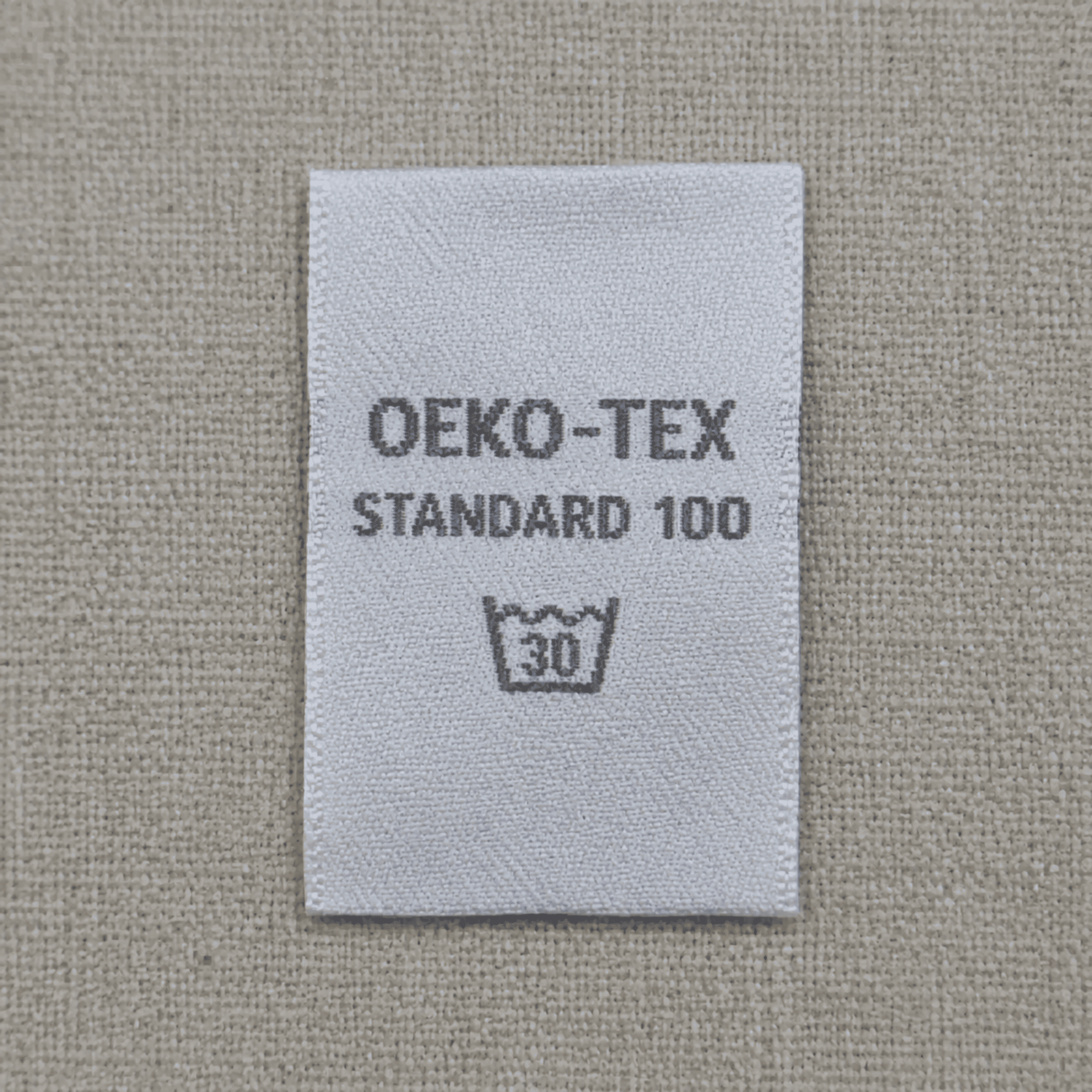
When we submitted our woven labels for OEKO-TEX STANDARD 100 testing, the key parameters were restricted AZO dyes, formaldehyde content, pH value, and color fastness. Woven labels are typically made from polyester or polyester-cotton blended yarns, and the primary chemical risk comes from the dyeing process.
In our experience, the most common testing concern for woven labels was AZO dye compliance. Certain AZO dyes can release carcinogenic aromatic amines, and they're restricted under both OEKO-TEX and EU REACH regulations3. Suppliers using low-cost dye houses may not realize their dye batches contain restricted compounds until testing reveals it.
Key test parameters for woven labels:
- Restricted AZO dyes (aromatic amines)
- Formaldehyde content
- pH value
- Extractable heavy metals
- Color fastness to perspiration and saliva (especially for Product Class I — baby articles)
Printed Labels: Ink and Substrate Both Matter
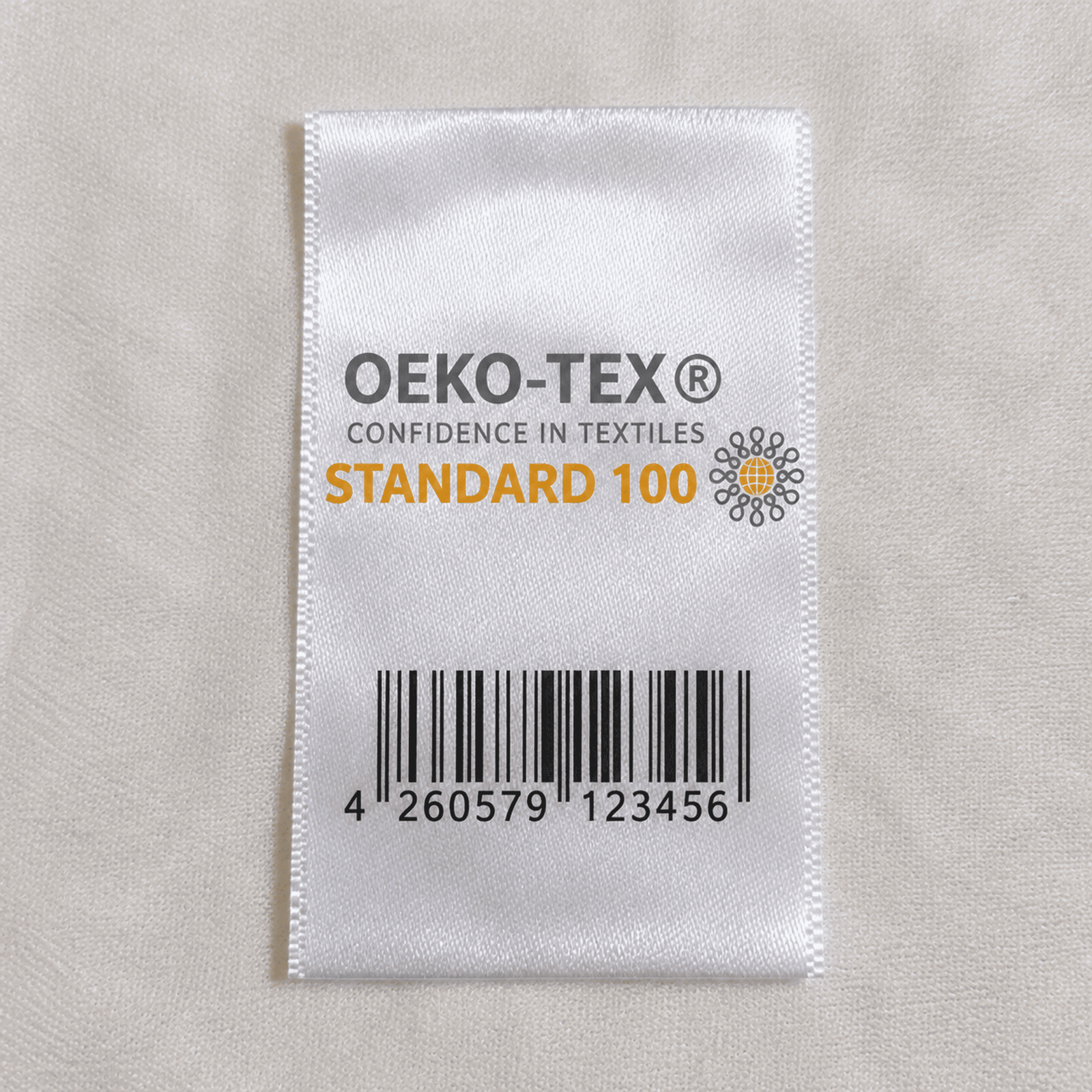
Printed labels add another layer of complexity. The substrate (often satin polyester or nylon taffeta) is one risk factor. The printing ink — whether screen-printed, flexographic, or digitally printed — is another. When we test printed labels, the lab examines both components.
Water-based inks are generally lower-risk than solvent-based inks, but water-based does not automatically mean OEKO-TEX compliant. The specific pigments, binders, and additives in the ink formulation all matter. I've seen water-based ink labels fail testing because of elevated phthalate levels in the binder.
Leather Patches: The Most Complex Testing Profile
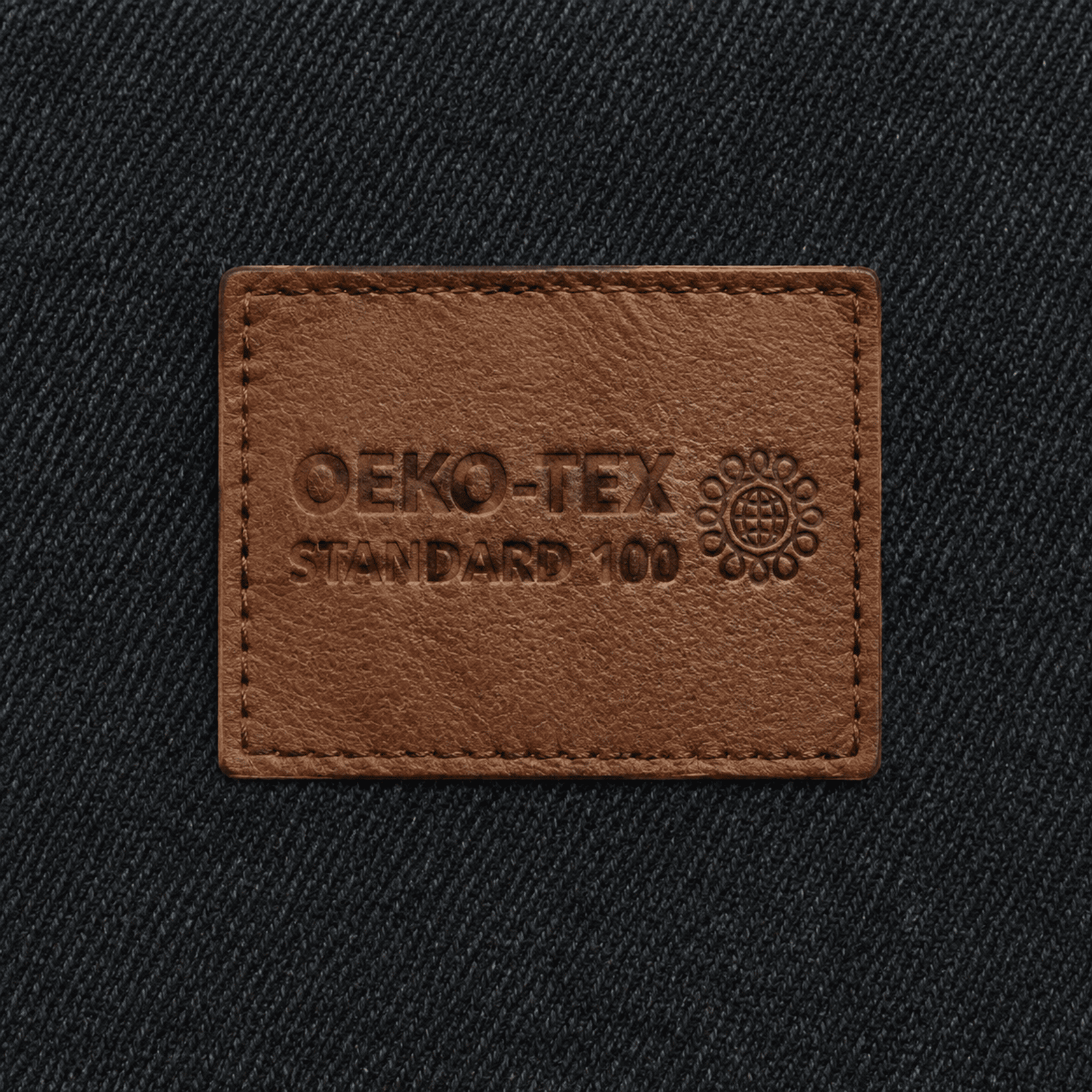
Leather patches are, in our experience, the most difficult label material to certify. Leather involves tanning processes that introduce a wide range of chemicals:
- Chromium VI (a carcinogenic byproduct of chrome tanning)
- Formaldehyde (used in some finishing processes)
- Extractable heavy metals (lead, cadmium, mercury)
- PCP/TeCP (chlorinated phenols used as preservatives)
- Restricted AZO dyes in dyed leather
Chrome-tanned leather is particularly scrutinized because Chromium III (the tanning agent) can oxidize into Chromium VI under certain conditions4. When we submitted our leather labels, the Chromium VI parameter was the test we watched most closely.
Heat Transfer Labels: Adhesive Is the Hidden Variable
Heat transfer labels involve a printed design layer bonded to an adhesive film that melts onto fabric under heat and pressure. The adhesive layer is the hidden variable. It can contain phthalates, formaldehyde, and volatile organic compounds (VOCs) depending on the formulation.
| Label Material | Primary Test Concerns | Typical Risk Factors |
|---|---|---|
| Woven labels | AZO dyes, formaldehyde, pH | Dye batch variation, low-cost dye suppliers |
| Printed labels | Ink chemistry, phthalates, heavy metals | Solvent-based inks, uncertified pigments |
| Leather patches | Chromium VI, heavy metals, PCP | Chrome tanning process, preservation chemicals |
| Heat transfer labels | Adhesive VOCs, phthalates, formaldehyde | Adhesive formulation, film composition |
Understanding these differences helps procurement teams ask the right questions and avoid assuming that one material's certification covers another.
Does "Eco-Friendly" Mean the Same as OEKO-TEX Certified?
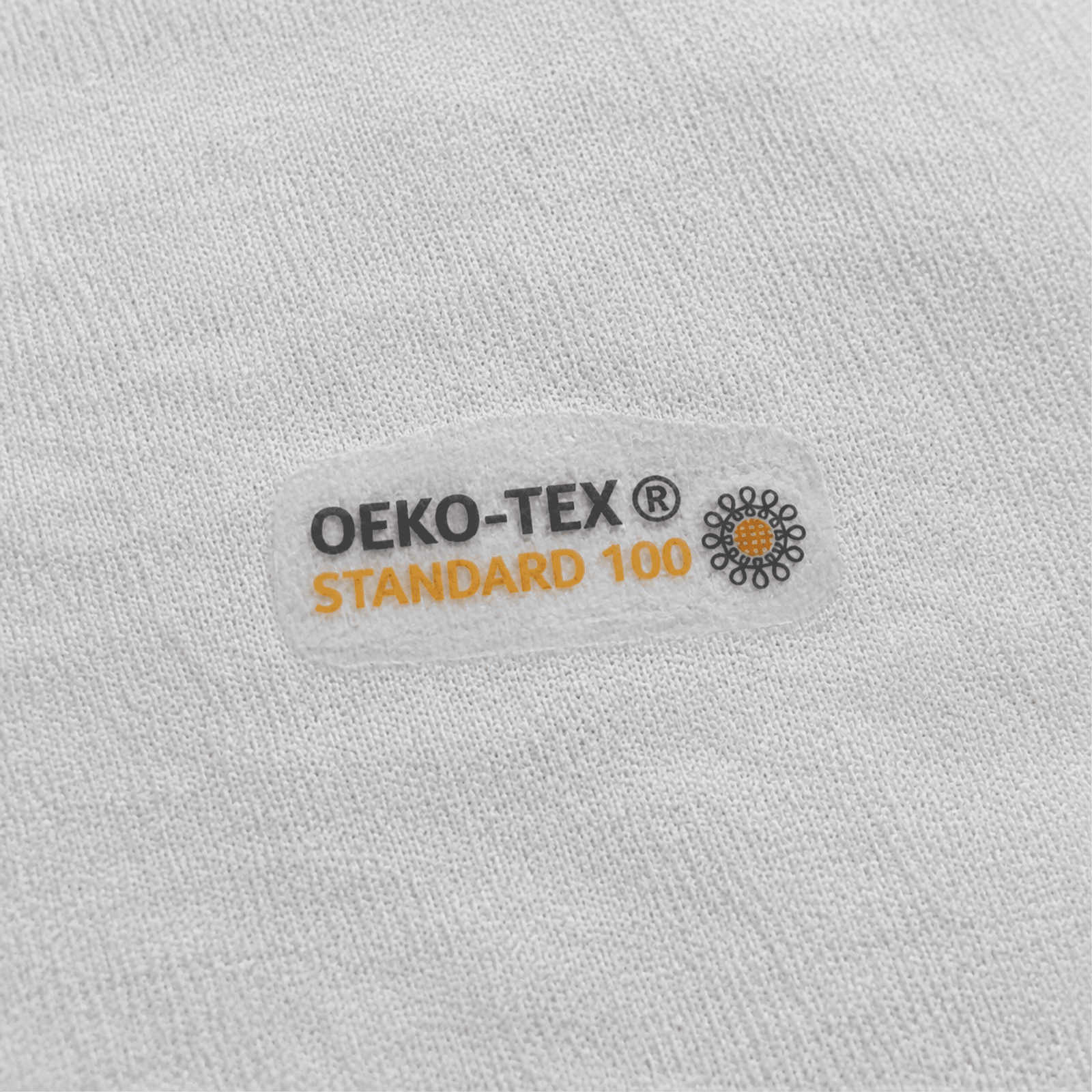
The garment industry is awash in environmental claims. Recycled polyester labels. Water-based ink printing. Organic cotton hang tags. These sound responsible. But here's the problem: none of these claims automatically satisfy OEKO-TEX STANDARD 100 requirements. And buyers who conflate sustainability marketing with certified safety status are taking a compliance risk.
"Eco-friendly" is a marketing descriptor with no standardized definition. OEKO-TEX STANDARD 100 certification is a third-party verified result confirming that a specific product has been tested against a defined list of harmful substances and passed. These are two fundamentally different things.
Why Recycled Polyester Labels Aren't Automatically Certified
I field this question at least once a week. A buyer says, "We're using recycled polyester woven labels — that's eco-friendly, so it should pass OEKO-TEX, right?" Not necessarily.
Recycled polyester yarn is made from post-consumer PET (plastic bottles) or post-industrial polyester waste5. The recycling process itself can introduce contaminants. Depending on the source material and recycling facility, recycled polyester can contain elevated levels of antimony, heavy metals, or other substances that wouldn't appear in virgin polyester.
The sustainability story (recycled content, reduced virgin material use) is separate from the safety story (no harmful substances above threshold limits). Both matter. But one does not prove the other.
Common "Eco" Claims That Don't Equal Certification
| Marketing Claim | What It Actually Means | OEKO-TEX Relevance |
|---|---|---|
| "Water-based ink" | Ink uses water as primary solvent instead of organic solvents | Does not guarantee compliance with OEKO-TEX restricted substance thresholds |
| "Recycled polyester" | Yarn made from recycled PET | No guarantee of harmful substance absence; testing still required |
| "Organic cotton" | Cotton grown without synthetic pesticides (GOTS/OCS scope) | Organic farming certification ≠ harmful substance testing of the finished label |
| "Vegan leather" | Non-animal material (often PU-based) | PU materials can contain phthalates, DMF, and other restricted substances6 |
| "Chemical-free" | Undefined and scientifically meaningless | No product is literally chemical-free; this is a red-flag marketing term |
Distinguishing OEKO-TEX STANDARD 100 from Other Certifications
It's also worth clarifying that OEKO-TEX itself operates multiple certification programs. For garment label materials, the relevant one is almost always OEKO-TEX STANDARD 100, which tests the finished product for harmful substances.
- OEKO-TEX STANDARD 100: Tests the product for harmful substances. This is what buyers need for label compliance.
- OEKO-TEX ECO PASSPORT: Tests chemicals and colorants used in textile production. Relevant for dye or ink manufacturers, not label buyers.
- OEKO-TEX MADE IN GREEN: A traceable product label that combines STANDARD 100 product safety with STeP facility certification. More comprehensive but less common in trim sourcing.
- OEKO-TEX STeP: Certifies production facilities, not products.
When a buyer asks for "OEKO-TEX certified labels," they almost always need STANDARD 100. But I've seen suppliers present ECO PASSPORT certificates for their ink as if it covers the finished label. It doesn't. The finished label must be tested as a complete product.
Why Do OEKO-TEX Certified Garment Label Materials Cost More?
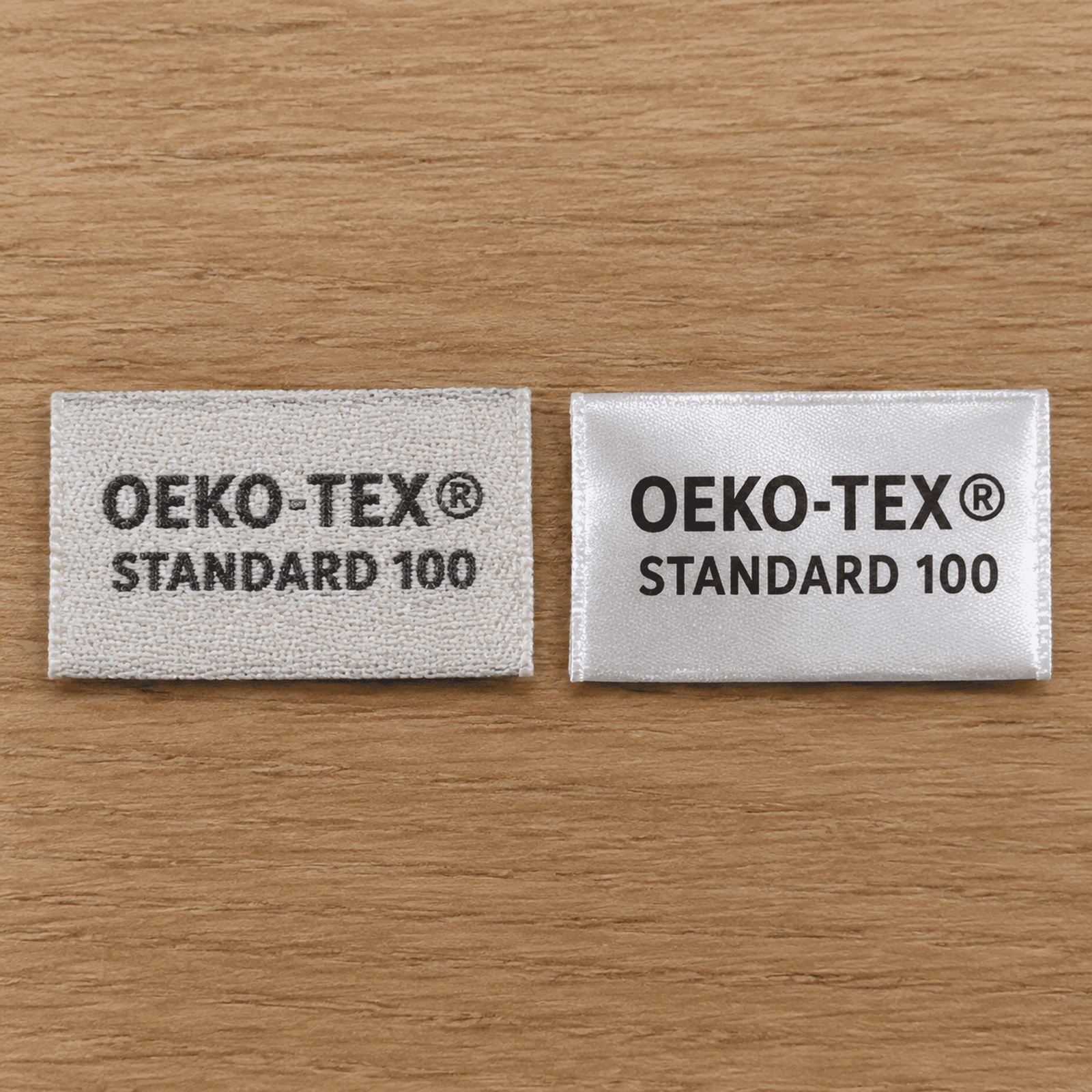
Let's address the question head-on. Certified label materials typically cost 10–25% more than their non-certified equivalents, depending on the material type. For leather patches, the premium can be even higher. Buyers deserve to understand where that cost comes from.
The higher cost of OEKO-TEX certified garment label materials reflects restricted chemical inputs, mandatory third-party testing fees, annual certification renewal, and ongoing compliance management — not an arbitrary supplier markup.
Breaking Down the Cost Drivers
Here are the real cost components, based on our experience as a manufacturer:
-
Restricted raw material inputs. Certified labels require dyes, inks, adhesives, and base materials that meet OEKO-TEX restricted substance lists. These inputs are more expensive than unrestricted alternatives. For example, OEKO-TEX-compliant dyes for woven labels cost more than standard textile dyes because the dye manufacturer must also control for restricted aromatic amines and heavy metals.
-
Third-party testing fees. Every material category submitted for certification must be tested by an accredited OEKO-TEX partner institute (e.g., Hohenstein, Testex, IFTH)7. Testing fees typically range from $500–$2,000+ per product group, depending on complexity. Leather patches, with their longer list of test parameters, cost more to test than simple polyester woven labels.
-
Annual renewal. OEKO-TEX certificates are valid for one year. Renewal requires retesting or audit confirmation, adding recurring costs.
-
Supply chain documentation. Maintaining certification requires traceability of raw material sourcing. We must document our yarn suppliers, dye suppliers, and ink suppliers — and verify that their materials are compatible with OEKO-TEX requirements. This documentation overhead is real.
-
Lead time impact. Certified materials may have longer lead times because we cannot simply switch to the cheapest available raw material when a preferred supplier is out of stock. We must source within our approved material chain.
Framing Cost as Compliance Investment
I always tell clients: the cost premium on certified labels is not a luxury markup. It's a compliance insurance premium. Consider the alternative costs:
- A major retailer rejects your shipment because labels fail compliance testing → cost of re-labeling or destroying inventory
- An Amazon listing gets flagged for non-compliant materials → lost revenue during suspension
- A European market authority tests your product and finds restricted substances → recall costs, reputational damage, potential fines
When framed against these risks, a 10–25% premium on label materials looks like a bargain.
Buyer scenario: One of our U.S.-based distribution clients initially pushed back on the cost difference between certified and non-certified woven labels. Six months later, one of their retail accounts began requiring OEKO-TEX documentation for all garment components — including trim. They came back and switched their entire label line to certified materials. The cost of switching mid-season was higher than if they'd started with certified materials from the beginning.
How Can Buyers Verify OEKO-TEX Certification for Their Specific Labels?
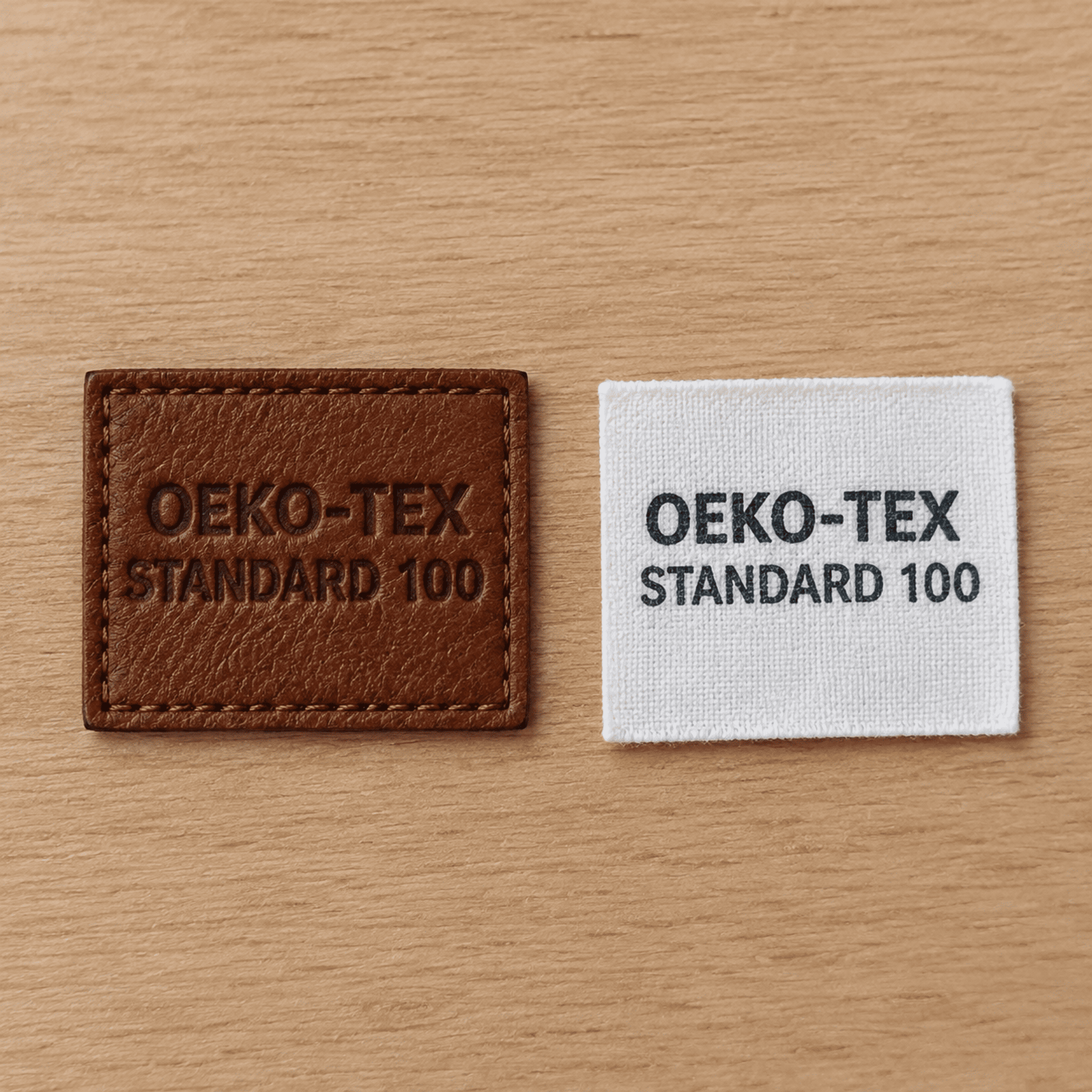
Verification is the step most buyers skip — and it's the step that matters most. Having worked with procurement managers across 30+ countries, I can tell you that the majority request a "copy of the OEKO-TEX certificate" and file it away without checking whether it actually covers their specific order.
To genuinely verify OEKO-TEX certification for your garment label materials, you need to cross-reference the certificate number, check the product class, confirm the product scope on the appendix, and validate the certificate's active status on the official OEKO-TEX database.
A Step-by-Step Verification Process
Based on what we advise our clients, here's a practical verification workflow:
Step 1: Request the full certificate plus appendix. The certificate itself is a one-page summary. The appendix is where the detail lives — it lists specific product categories, material compositions, and the product class. If a supplier only sends the summary page, ask for the appendix.
Step 2: Match product class to your garment's end use.
| Product Class | Description | Typical Use Case |
|---|---|---|
| Class I | Baby articles (ages 0–3) | Labels in baby clothing, bibs, accessories |
| Class II | Articles with direct skin contact | Labels in underwear, T-shirts, bedding |
| Class III | Articles with no direct skin contact | Labels in jackets, coats, outer layers |
| Class IV | Decoration materials | Labels used as decorative elements, home furnishing |
A label certified under Class III cannot be used in a baby bodysuit that requires Class I certification. The testing thresholds for Class I are significantly stricter, particularly for formaldehyde, saliva resistance, and phthalates.
Step 3: Verify the certificate online. Go to the official OEKO-TEX website and enter the certificate number. The database will confirm whether the certificate is active, who holds it, and what products it covers. This takes two minutes and eliminates the risk of forged or expired certificates.
Step 4: Confirm the certificate is current. Certificates expire. A certificate issued in January 2023 expired in January 2024. If your supplier's certificate shows a past expiration date, it's no longer valid — regardless of what the sales representative tells you.
Step 5: For ongoing orders, request periodic confirmation. If you place quarterly or semi-annual repeat orders, ask your supplier to confirm certificate renewal annually. Certification status can change if a supplier fails retesting or discontinues renewal.
In our experience, the suppliers who proactively share updated certificates and appendix documents are the ones who take compliance seriously. If getting a certificate copy feels like pulling teeth, treat that as information about the supplier's compliance culture.
Frequently Asked Questions
Can I use my supplier's OEKO-TEX logo on my product if I buy certified labels from them?
Not automatically. The right to use the OEKO-TEX STANDARD 100 logo on your product or marketing depends on licensing terms and correct product class labeling. Buyers should consult the official OEKO-TEX labeling guidelines and, if needed, apply for their own label license. Your supplier's certificate authorizes their use of the mark, not yours.
Do all garment retailers require OEKO-TEX certification for labels?
No. Requirements vary by retailer and market. However, major European retailers, many U.S. department stores, and platforms like Amazon increasingly request third-party certification for all garment components, including trims8. Even where not mandatory, having certified label materials simplifies compliance documentation and reduces audit risk.
How long does it take to get garment labels OEKO-TEX certified?
From sample submission to certificate issuance, the process typically takes 3–6 weeks in our experience, depending on the testing institute's queue and the material complexity. Leather patches generally take longer due to the extended list of test parameters. Plan certification timelines well ahead of production schedules.
Is OEKO-TEX STANDARD 100 the same as REACH compliance?
No. OEKO-TEX STANDARD 100 and EU REACH are separate regulatory frameworks, though they share overlapping restricted substance lists. OEKO-TEX thresholds are often stricter than REACH requirements for certain substances9. A product that passes OEKO-TEX testing will generally satisfy REACH requirements for the tested parameters, but the two certifications are not interchangeable. Buyers targeting the EU market should verify both.
Can I mix certified and non-certified labels on the same garment?
Technically, yes — but it defeats the purpose. If a garment needs to meet OEKO-TEX STANDARD 100 as a finished product, every component must be certified or tested, including labels, trims, and accessories. One non-certified care label can cause the entire garment to fail product-level certification.
Conclusion
OEKO-TEX certified garment label materials are not a checkbox — they're a verified compliance chain that requires material-specific testing, active certificate management, and informed buyer verification. The core takeaway is this: certification attaches to specific tested materials, not to supplier relationships. Different label types — woven, printed, leather, heat transfer — face different testing protocols and carry different risk profiles. "Eco-friendly" marketing claims are no substitute for third-party certification. And the cost premium on certified materials is a compliance investment that protects your brand, your retail partnerships, and your market access.
At Guangzhou Zhunming Trims, we hold OEKO-TEX STANDARD 100 certification and have direct experience submitting multiple label material categories for testing. If you're sourcing garment labels and need to confirm certification scope, product class, or material-specific compliance, contact our team for a consultation. We'll help you match the right certified label materials to your specific product requirements — and provide the documentation your retail partners demand.
"OEKO-TEX® STANDARD 100 FAQ", https://www.hohenstein.us/en-us/oeko-tex/output-control/standard-100/faq. According to OEKO-TEX, STANDARD 100 certificates are issued with a one-year validity period, after which renewal requires updated testing to ensure continued compliance with the current version of the standard's limit values and criteria. Evidence role: definition; source type: institution. Supports: That OEKO-TEX STANDARD 100 certificates are valid for one year and must be renewed through retesting or audit confirmation. ↩
"Oeko-Tex", https://en.wikipedia.org/wiki/Oeko-Tex. The OEKO-TEX STANDARD 100 testing criteria are organized into four product classes with progressively stringent limit values, where Product Class I (baby articles) applies the strictest thresholds and Product Class IV (decorative materials) the least restrictive. Evidence role: definition; source type: institution. Supports: That OEKO-TEX STANDARD 100 uses four product classes: Product Class I (baby articles), Product Class II (direct skin contact), Product Class III (no direct skin contact), and Product Class IV (decoration materials). ↩
"Detection of azo dyes and aromatic amines in women under ...", https://pmc.ncbi.nlm.nih.gov/articles/PMC5991632/. EU REACH Regulation Annex XVII, Entry 43 restricts textile and leather articles that may release any of 22 listed aromatic amines from AZO dyes at detectable concentrations above 30 mg/kg, based on their classification as carcinogenic to humans. Evidence role: mechanism; source type: government. Supports: That certain AZO dyes can cleave to release carcinogenic aromatic amines and are restricted under EU REACH Annex XVII Entry 43. ↩
"Chromium released from leather – I: exposure conditions that ...", https://pmc.ncbi.nlm.nih.gov/articles/PMC4415597/. Research on chrome-tanned leather has demonstrated that Cr(III) can be oxidized to Cr(VI) during leather aging, particularly under conditions of elevated pH, UV irradiation, and the presence of certain fat-liquoring agents, posing a health risk due to Cr(VI)'s carcinogenic and allergenic properties. Evidence role: mechanism; source type: research. Supports: That trivalent chromium (Cr III) used in chrome tanning can oxidize to hexavalent chromium (Cr VI) under certain conditions such as UV exposure, aging, and alkaline pH. Scope note: The rate and extent of oxidation vary significantly depending on tanning process conditions and post-tanning treatments ↩
"Impact of Chemicals and Processing Treatments on Thermo ...", https://pmc.ncbi.nlm.nih.gov/articles/PMC12250887/. Studies on recycled PET fibers have identified that antimony trioxide, used as a catalyst in PET production, can persist through the recycling process, and that post-consumer PET feedstock may introduce additional contaminants depending on collection and processing conditions. Evidence role: mechanism; source type: research. Supports: That recycled polyester derived from post-consumer PET can contain elevated levels of contaminants such as antimony depending on the source material and recycling process. Scope note: Contaminant levels vary significantly by recycling facility and feedstock quality; not all recycled polyester exhibits elevated harmful substance levels ↩
"Greener Alternatives to Dimethylformamide Use in ...", https://bcgc.berkeley.edu/sites/default/files/nike-dmf_finalreport-2019.pdf. Research on polyurethane-coated textiles and synthetic leather has identified residual dimethylformamide (DMF) from the solvent-based PU coating process as a substance of concern, with DMF restricted under EU REACH Annex XVII at concentrations above 0.3 mg/kg in consumer articles. Evidence role: mechanism; source type: research. Supports: That polyurethane-based synthetic leather materials may contain dimethylformamide (DMF), phthalate plasticizers, and other substances of concern. Scope note: DMF levels depend on the specific PU manufacturing process; water-based PU systems may have significantly lower DMF residues ↩
"Oeko-Tex", https://en.wikipedia.org/wiki/Oeko-Tex. The OEKO-TEX Association comprises independent textile research and testing institutes worldwide, including Hohenstein (Germany), Testex (Switzerland), and IFTH (France), which are authorized to conduct product testing and issue OEKO-TEX STANDARD 100 certificates. Evidence role: general_support; source type: institution. Supports: That Hohenstein, Testex, and IFTH are member institutes of the OEKO-TEX Association authorized to conduct STANDARD 100 testing and certification. ↩
"Product compliance documentation", https://sellercentral.amazon.com/help/hub/reference/external/GFYECKCN9TSQ8H5B?locale=en-US. Amazon's product compliance programs require sellers of certain textile and apparel categories to provide documentation demonstrating compliance with applicable safety regulations, which may include third-party test reports for restricted substances. Evidence role: general_support; source type: other. Supports: That Amazon has implemented product safety and compliance documentation requirements for textile and apparel sellers, including restricted substance testing. Scope note: Amazon's specific requirements vary by product category and marketplace region, and the extent to which trim-level certification is mandated may differ from the article's characterization ↩
"OEKO-TEX® STANDARD 100 FAQ", https://www.hohenstein.us/en-us/oeko-tex/output-control/standard-100/faq. Comparative analyses of textile chemical regulations note that OEKO-TEX STANDARD 100 sets limit values for substances such as formaldehyde and certain heavy metals that are lower (more restrictive) than the corresponding REACH Annex XVII thresholds, reflecting the voluntary standard's precautionary approach. Evidence role: general_support; source type: research. Supports: That OEKO-TEX STANDARD 100 applies limit values for certain restricted substances that are more stringent than those mandated under EU REACH. Scope note: The comparison depends on the specific substance and product class; not all OEKO-TEX limits are stricter than REACH for every parameter ↩

0 Comments
Ask a question or share your garment accessories sourcing experience.