

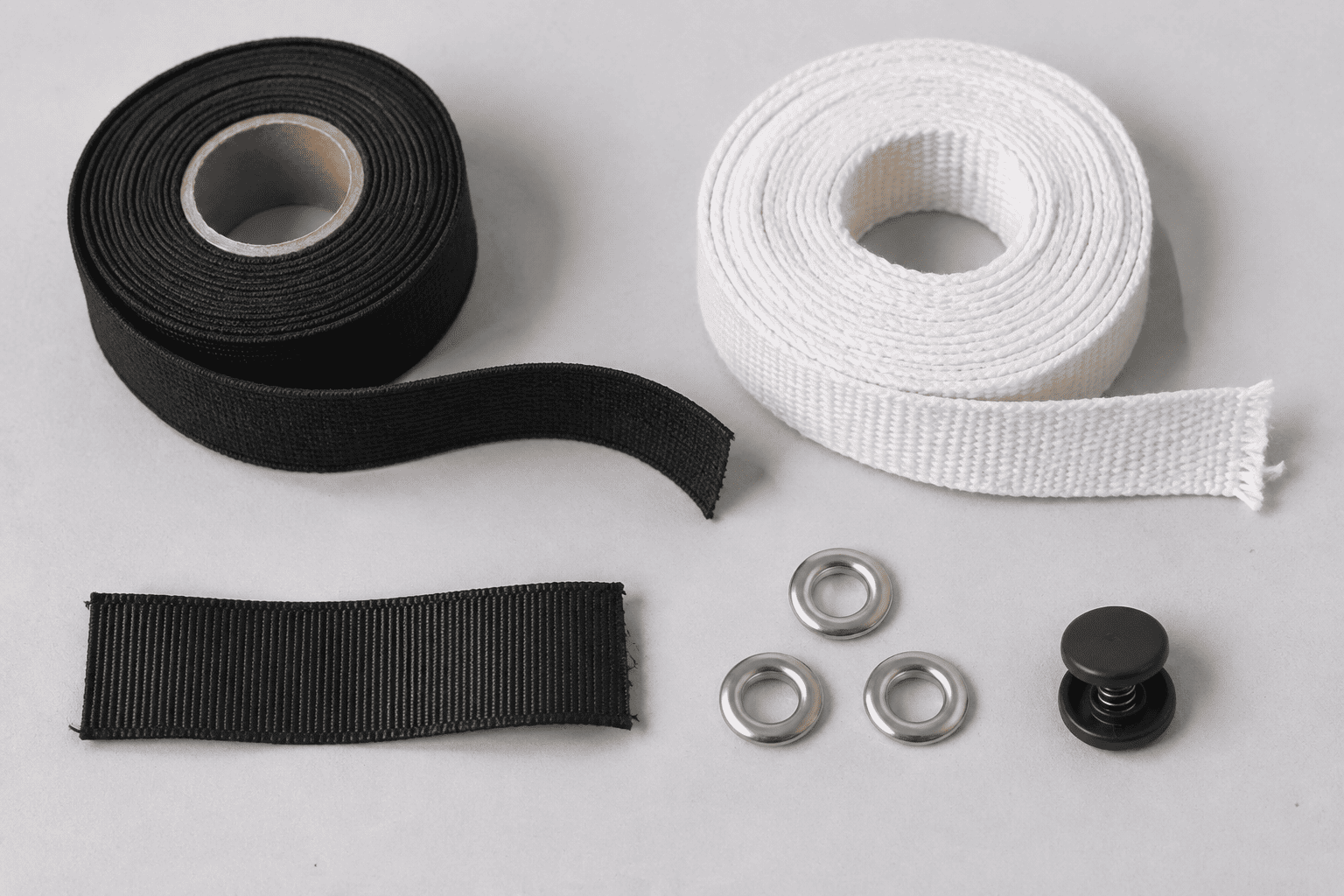
What Are Garment Trims? A Complete Guide to Elastic Bands, Tapes
Garment trims might seem like small details, but choosing the wrong type can unravel an entire production run. I've seen brands confuse elastic bands with woven tapes, pick the cheapest option without testing, and end up with garments that fail after a few washes. The resulting rework, returns, and lost sales hurt far more than the pennies saved on a cheaper trim.
Garment trims are the functional and decorative components—other than the main fabric—that complete a garment. Elastic bands, woven tapes, and binding tapes are among the most critical trim categories because they provide structure, stretch, edge finishing, and reinforcement. Each type uses different materials, weaving methods, and performs differently under stress, washing, and wear. Selecting the right trim requires understanding these functional differences, not just comparing prices or appearances.
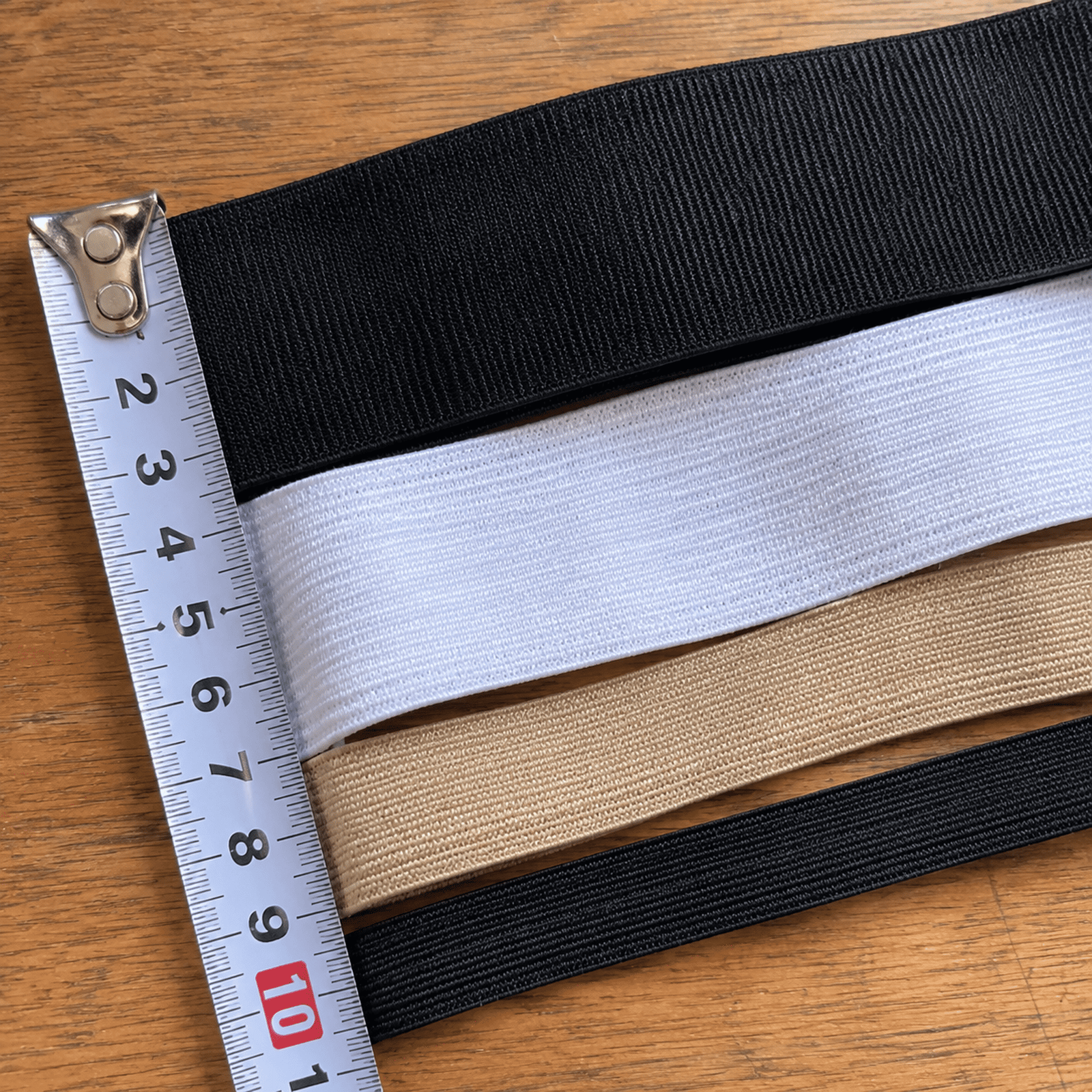
But here's the problem: most sourcing guides treat trims as a flat list—20 types, each with a one-line definition. That approach doesn't help you make buying decisions. In this guide, I'll break down the categories that matter most—elastic bands, woven tapes, and binding tapes—from the perspective of someone who selects raw materials, runs quality control checks, and has fielded the calls when a "cheaper" trim fails in the field.
Why Does Category Clarity Matter for Garment Trims?
A pattern I see with first-time buyers is treating all narrow fabrics as interchangeable. They'll source "something stretchy" or "some kind of tape" without specifying the functional requirement. This leads to mismatched trims that fail under real-world garment use.
Understanding that elastic bands, woven tapes, and binding tapes are functionally distinct product families is the first step toward smarter procurement. Each serves a different structural role in a garment, and confusing them creates problems that no amount of rework can fully fix.
The Three Core Functions
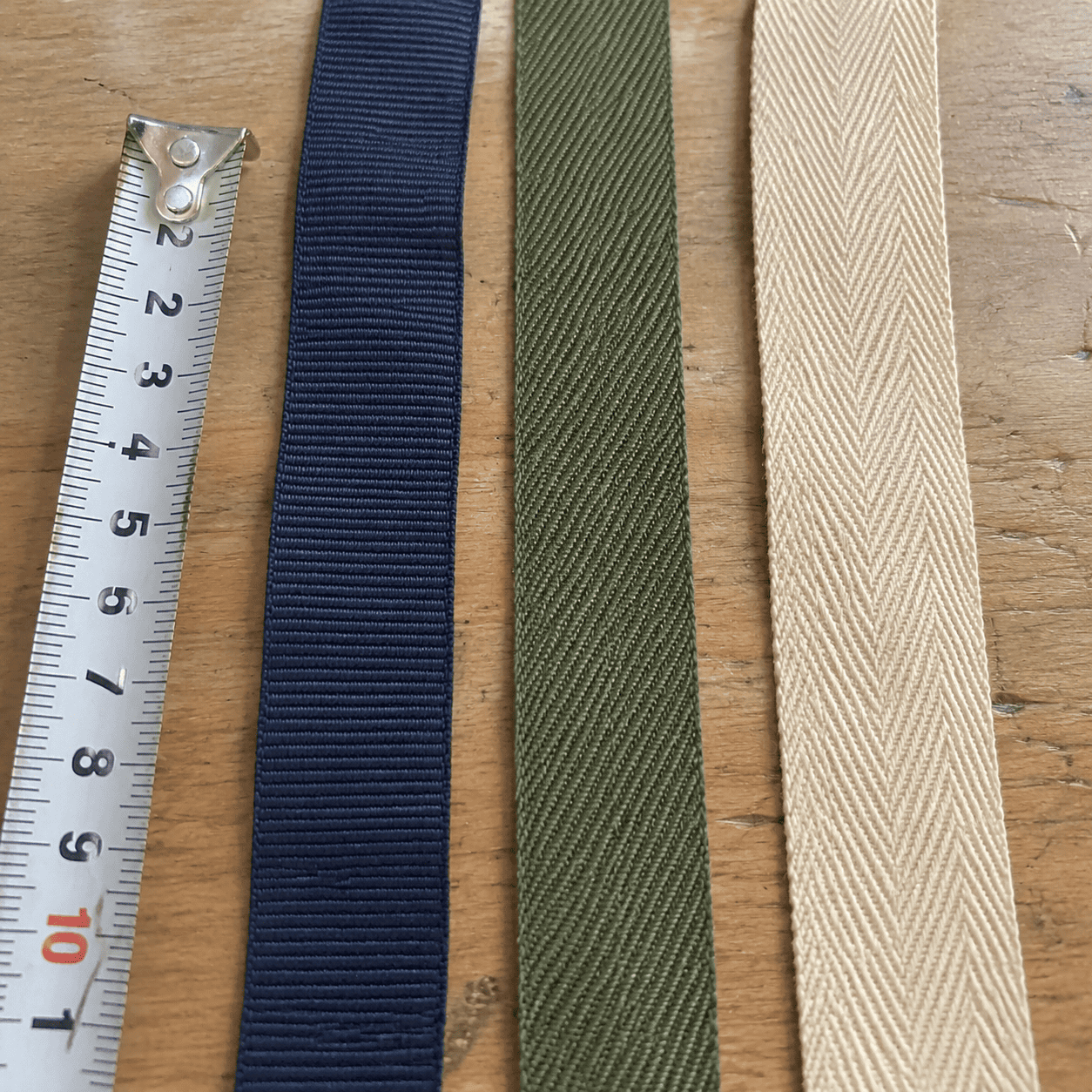
In our production experience, garment trims break down into three primary functional roles:
| Trim Category | Primary Function | Key Performance Variable | Typical Applications |
|---|---|---|---|
| Elastic Bands | Provide stretch and recovery | Elasticity retention after washing | Waistbands, cuffs, leg openings, bra straps |
| Woven Tapes | Reinforce, decorate, or bind seams | Tensile strength, abrasion resistance | Seam reinforcement, drawstring channels, decorative edging |
| Binding Tapes | Encase and finish raw edges | Heat tolerance, fold recovery, drape | Neckline binding, armhole finishing, hem edging |
These three categories overlap visually but diverge sharply in material composition and construction. A woven tape and a binding tape can look nearly identical on a sample card, yet one will fold cleanly around a curved neckline while the other buckles and puckers.
A Real Failure: Confusing Elastic Bands with Woven Tape
I recall a client—a growing DTC brand launching their first activewear line—who submitted a purchase order for "woven tape" to use in their shorts waistbands. What they actually needed was an elastic band. The woven tape they received had zero stretch recovery. When sewn into the waistband, the shorts couldn't hold at the waist. The entire first batch had to be reworked with the correct elastic band, delaying their launch by three weeks and costing them their peak-season window.
This wasn't a quality defect. The tape was perfectly made—it simply wasn't the right product for the job. Category clarity is the first job before any discussion about price, MOQ, or lead time.
What Should Buyers Do First?
Before requesting quotes, I always recommend buyers answer three questions:
- Does this trim need to stretch? If yes, you need an elastic band, not a tape.
- Does this trim need to bear tensile load or resist abrasion? If yes, consider the weave structure and yarn type of your tape.
- Does this trim need to fold around an edge? If yes, you need a binding tape with the right weight and drape for your fabric.
Starting with function—not appearance—eliminates the most common sourcing mistakes I see on our production floor.
What Makes Elastic Bands Perform—And What Makes Them Fail?
Elastic bands are arguably the most performance-sensitive trim in any garment. When they work, nobody notices. When they fail—sagging waistbands, loose cuffs, stretched-out leg openings—every customer notices. And they leave reviews about it.
The critical insight is this: material composition and weaving method determine elasticity lifespan, not the price tier or how the band looks on a sample card. Two elastic bands can feel identically stretchy in hand yet perform completely differently after 20 wash cycles.

Composition: What's Inside the Band?
The stretch in an elastic band comes from its core material—the elastic yarns running through the center of the structure. The outer yarns (typically polyester, nylon, or cotton) provide the surface texture, color, and abrasion resistance. Here are the three most common core types I work with:
| Core Type | Stretch Character | Wash Durability | Typical Use Case | Cost Level |
|---|---|---|---|---|
| Natural rubber | High stretch, strong snap-back | Degrades faster with heat/chlorine | Budget basics, underwear | Low–Medium |
| Synthetic rubber (TPU-based) | Consistent stretch, moderate snap-back | Better heat and chemical resistance | Activewear, swimwear | Medium |
| Latex-free (polyester/spandex core) | Controlled stretch, softer hand feel | Excellent wash durability | Children's wear, sensitive-skin garments, export compliance | Medium–High |
Key point: Rubber content percentage directly affects how stretchy the band is and how long that stretch lasts1. In our QC observation, bands with higher rubber content feel stretchier initially but can lose elasticity faster if the rubber quality is low or the end product is subjected to high-heat drying. Buyers should always ask for the rubber content specification and, ideally, a wash-test reference.
Weaving Method: Knit vs. Woven vs. Braided
Beyond composition, the construction method changes how an elastic band behaves:
- Knitted elastic — Softer, thinner, more flexible. Commonly used for lightweight garments, lingerie, and applications where the elastic sits against skin. It tends to roll less but offers moderate recovery force.
- Woven elastic — Firmer, more structured, higher recovery force. Ideal for waistbands, belts, and applications needing strong holding power. It resists rolling and retains shape better under load.
- Braided elastic — Narrows when stretched (you can see the diagonal weave pattern). Most affordable, suitable for casings where the elastic is enclosed and not directly visible. Less stable for exposed applications.
In our production experience, the most common mismatch is buyers choosing braided elastic (because it's cheapest) for exposed waistband applications where woven elastic is functionally necessary. Braided elastic narrows visibly when stretched2, creating an uneven look in finished garments.
A Real Failure: Cheap Elastic, Expensive Returns
One of our clients—a mid-size Amazon seller—chose the lowest-priced elastic band for a line of men's joggers. The initial samples looked and felt fine. But after just a few wash cycles, the elasticity degraded severely. The waistbands sagged, customers complained, and the product started accumulating negative reviews. The seller had to process a wave of returns, pull the listing temporarily, and reorder with a higher-quality woven elastic at a higher rubber content.
The total cost of that "savings" on elastic? Far more than the price difference would have been if they'd chosen the right band from the start. The cheapest trim is rarely the cheapest total cost.
What Should Buyers Test?
I recommend buyers request or perform these basic checks before committing to a bulk elastic band order:
- Stretch and recovery test — Stretch the band to its rated extension (e.g., 2x length) and release. Does it snap back fully? How many cycles before permanent deformation?
- Wash simulation — Wash a sample at the temperature your end garment will be washed at. Check elasticity retention after 5, 10, and 20 cycles. [verify specific retention rate benchmarks with QC team]
- Width consistency — Measure width at multiple points along the roll. Variation beyond ±0.5mm can cause sewing issues3.
- Rubber content verification — Ask the supplier for the rubber content spec. If they can't provide it, that's a red flag.
What Types of Woven Tapes Should Garment Buyers Know?
Woven tapes don't stretch—and that's exactly the point. They provide structure, reinforcement, and decoration in applications where dimensional stability matters. But "woven tape" is a broad category, and the differences within it affect both aesthetics and durability.
Many buyers default to choosing woven tapes by appearance: "I want a grosgrain ribbon" or "something that looks like twill." The better approach is to start with the functional requirement—tensile strength, surface texture, heat tolerance—and then select the weave structure that delivers it.
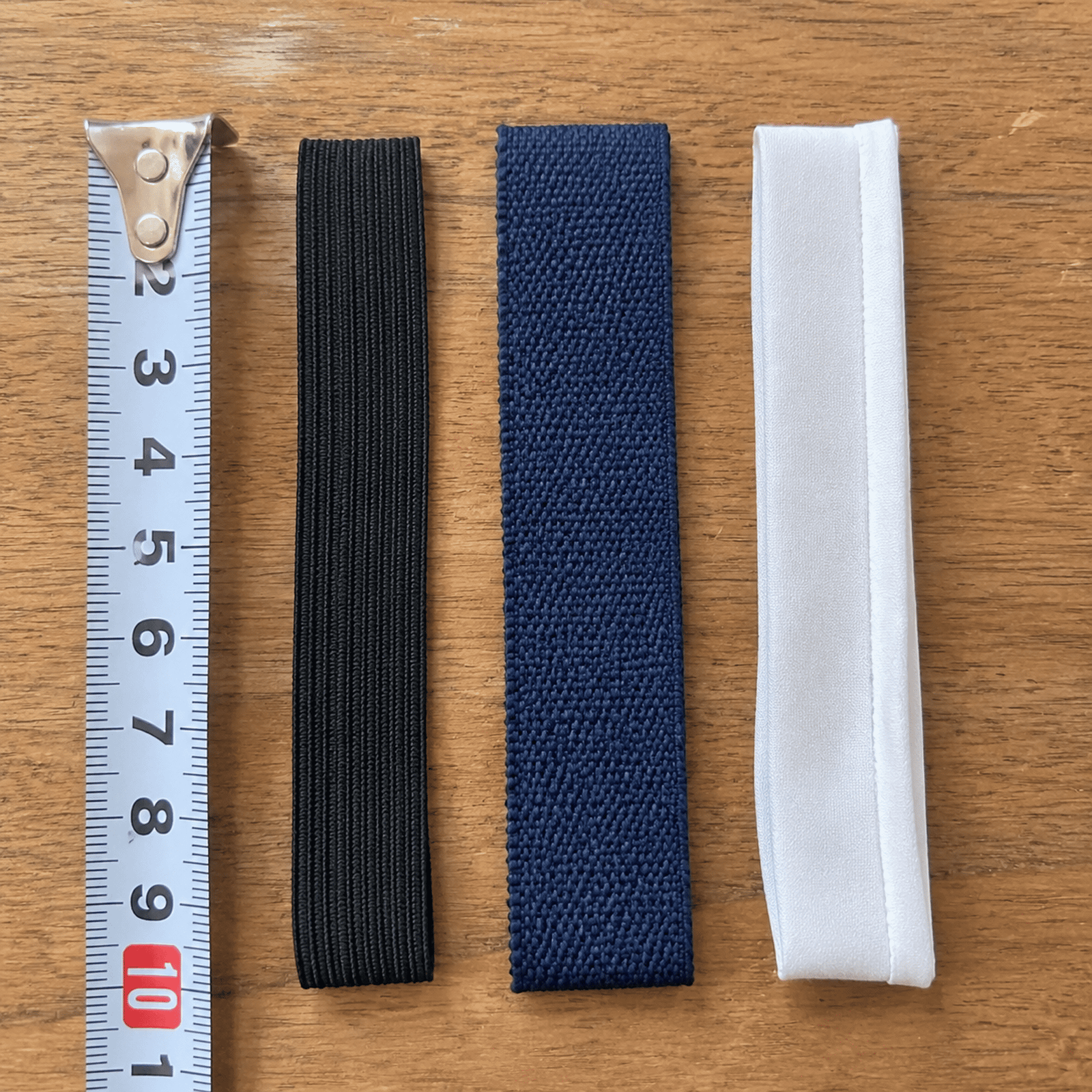
Common Woven Tape Types and Their Functions
| Tape Type | Weave Structure | Key Properties | Typical Applications |
|---|---|---|---|
| Grosgrain tape | Crosswise rib weave | Firm body, distinct ribbed texture, good tensile strength | Waistband interiors, hat bands, decorative trim |
| Twill tape | Diagonal twill weave | Moderate flexibility, excellent abrasion resistance | Seam reinforcement, drawstring channels, hanging loops |
| Herringbone tape | Zigzag twill pattern | Flexible, lies flat, moderate strength | Apron ties, lightweight binding, internal labeling carriers |
| Satin tape | Satin weave (float yarns) | Smooth, lustrous surface, lower abrasion resistance | Decorative edging, lingerie, luxury garment finishing |
| Cotton tape | Plain or twill weave, 100% cotton | Soft, breathable, dyeable, moderate strength | Casual wear ties, organic/natural product lines |
Material Matters Here Too
The yarn composition of a woven tape determines its performance far beyond its visual appeal:
- Polyester tapes offer excellent color fastness, low shrinkage, and resistance to mildew and moisture. They're the workhorse choice for most commercial garment applications.
- Nylon tapes provide superior abrasion resistance and tensile strength per weight. Common in activewear and outdoor apparel where durability under friction is critical.
- Cotton tapes breathe well and accept dye beautifully but shrink more, fade faster, and are less durable under repeated washing. They're best suited for garments marketed on natural fiber credentials.
- Blended tapes (e.g., cotton-polyester) aim to balance hand feel with performance, though buyers should verify the blend ratio—a "cotton tape" that's actually 60% polyester won't have the same drape or breathability as a 100% cotton version.
Failure Mode: Abrasion and Pilling
In our production experience, the most common failure with woven tapes isn't dramatic—it's gradual. A tape used in a high-friction area (like a drawstring channel or a seam that sits under a bag strap) can pill, fray, or thin out over time if the yarn type wasn't selected for abrasion resistance.
I've seen this particularly with satin tapes used in utilitarian applications. A designer chose a satin tape for drawstring channels because of its smooth look. Within a few months of wear, the float yarns in the satin weave snagged and frayed4. Twill tape—less visually luxurious, but structurally far more durable—would have been the correct choice.
Rule of thumb: The smoother and more lustrous a woven tape looks, the more likely its surface yarns are exposed floats—and the more vulnerable it is to snagging and abrasion. Match the weave to the wear conditions, not just the aesthetic.
How Do Binding Tapes Differ from Other Garment Trims?
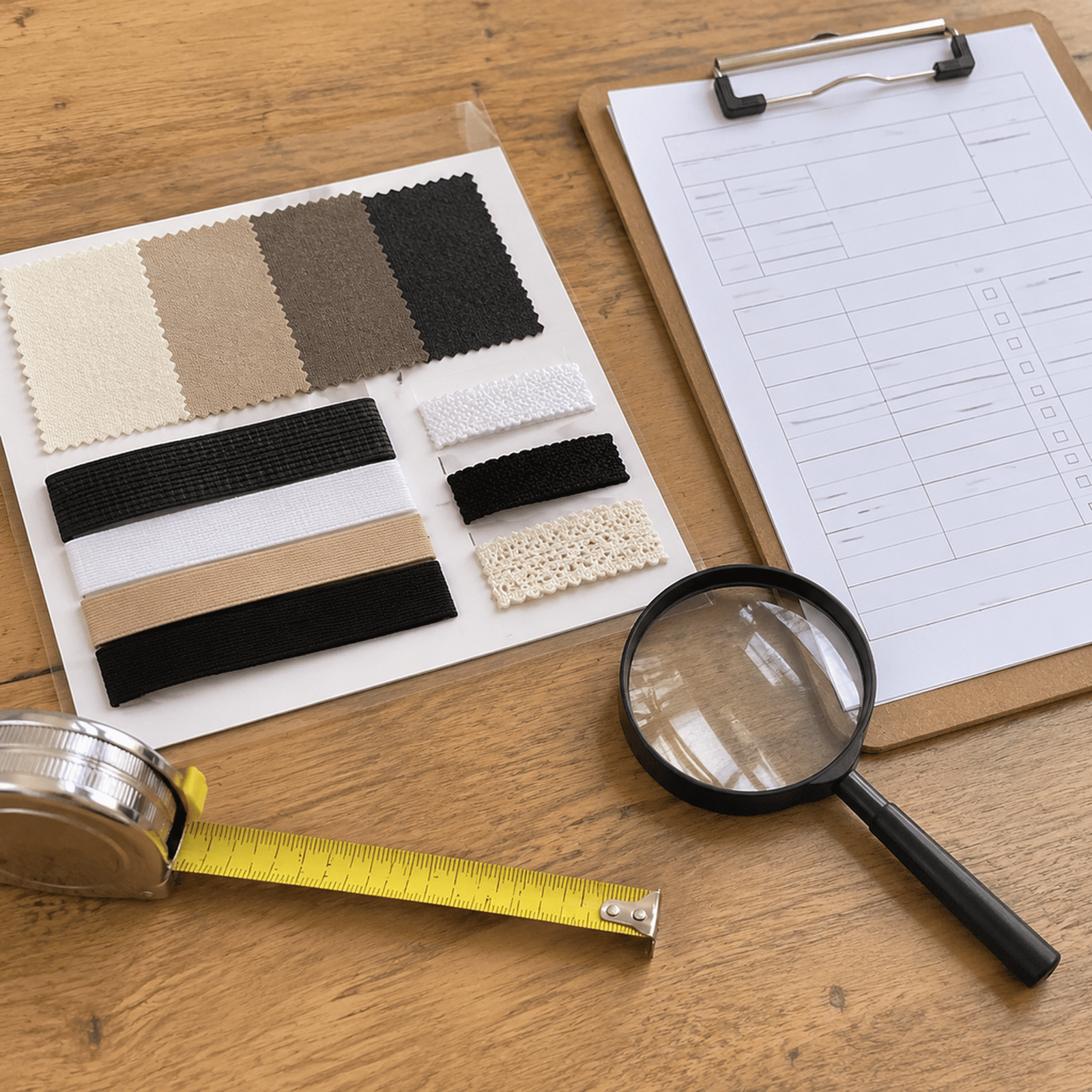
Binding tape is one of the most overlooked trim categories. Many buyers think of it as "just a folded tape," but proper binding tape requires specific properties that general-purpose tapes simply don't have: consistent fold recovery, the right weight-to-drape ratio, and heat tolerance for pressing and fusing.
If you've ever seen a neckline binding that ripples, puckers, or won't lay flat, you've seen what happens when the wrong tape is used as binding.
What Makes a Good Binding Tape?
A binding tape needs to:
- Fold cleanly around a curved or straight edge without memory distortion (i.e., it shouldn't resist being folded or spring back open).
- Match the weight of the garment fabric. A heavy binding on a lightweight jersey creates bulk; a flimsy binding on a structured woven fabric won't hold its shape.
- Withstand heat pressing if the manufacturing process includes fusing or ironing. Some synthetic bindings can melt, shrink, or become glossy under high heat.
- Stretch slightly on the bias (if cut on the bias) to accommodate curves—necklines, armholes, and scalloped hems.
Types of Binding Tape
- Bias binding tape — Cut at a 45° angle to the fabric grain, giving it natural stretch to conform to curves5. Available in woven cotton, poly-cotton blends, and satin. The most versatile binding type.
- Knit binding tape — Made from jersey or rib-knit fabric. Inherently stretchy, so it works well on knit garments without puckering. Common in T-shirts, activewear, and casual wear.
- Fold-over elastic (FOE) — A hybrid: binding tape with elastic properties. Pre-scored down the center for folding over raw edges. Used extensively in lingerie, swimwear, and baby garments.
The Compliance Blind Spot
Here's something many first-time buyers overlook: trims need compliance certifications too—not just your face fabric. A garment destined for the EU or US market may need OEKO-TEX® certification, and that requirement extends to every component that contacts skin, including binding tapes and elastic bands.
I've encountered situations where a buyer's main fabric was fully certified, but their elastic bands and binding tapes were not. This created a compliance gap that could have triggered issues at customs or with retail partners who require full-product certification.
At our facility, our products carry OEKO-TEX® STANDARD 100 certification6, which covers harmful substance testing for trims—but I'd encourage every buyer to verify certification documents independently, regardless of supplier. Certifications can expire, and scope can vary. Ask for the certificate number and check it against the issuing body's database.
How Should Buyers Evaluate Garment Trim Suppliers?
Knowing your trim categories is essential, but it's only half the equation. The other half is evaluating whether a supplier can consistently deliver the trims you need, at the quality you need, when you need them.
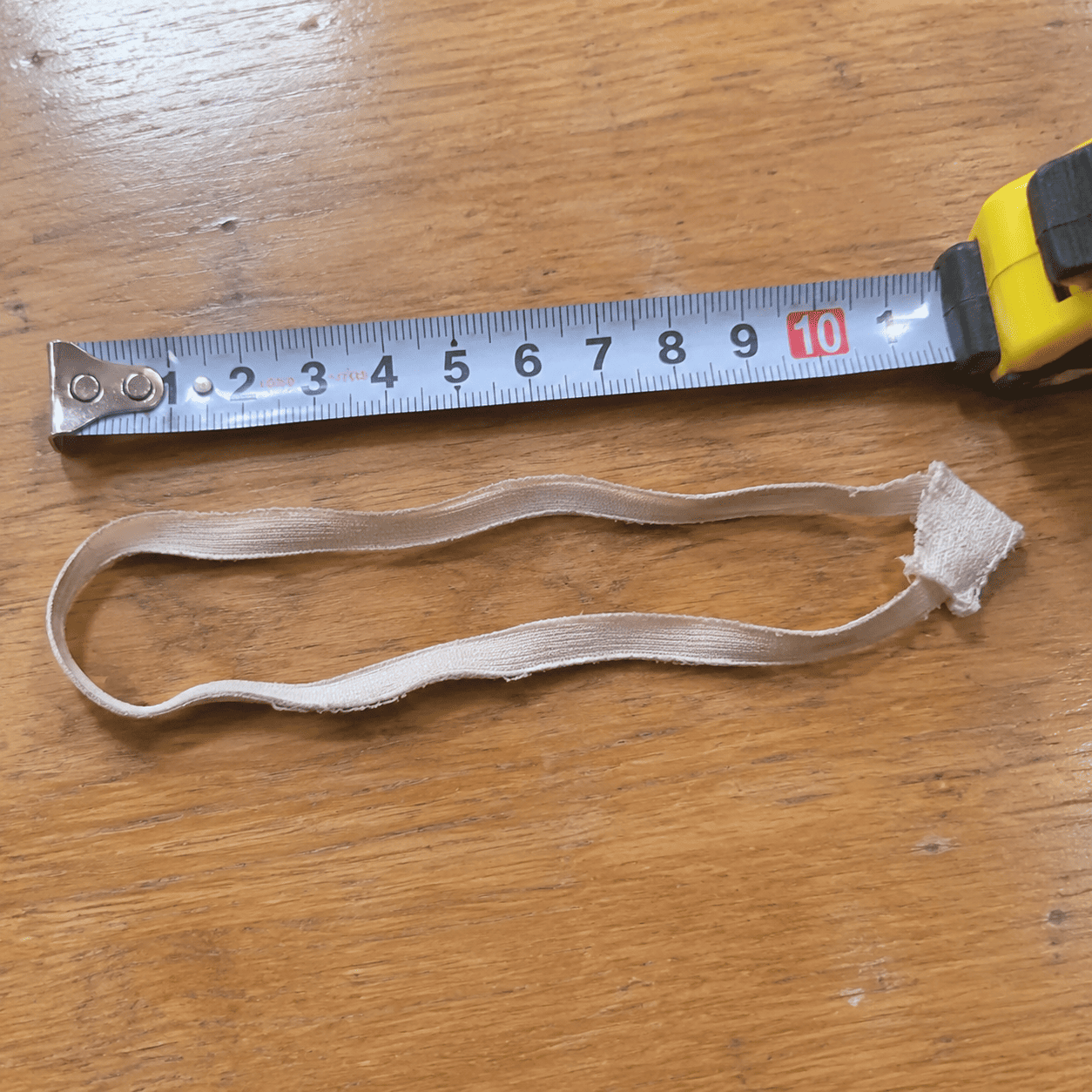
A common frustration I hear from buyers—especially those scaling from small runs to larger volumes—is that their supplier performed well on samples but couldn't maintain consistency in bulk production. Here's the evaluation framework I recommend.
Key Evaluation Criteria
| Criteria | What to Look For | Red Flags |
|---|---|---|
| Material transparency | Supplier can specify yarn type, rubber content, weave method | Vague descriptions like "high quality elastic" with no specs |
| Sample-to-bulk consistency | Supplier has documented QC process for width, color, elasticity | Samples look great but no QC protocol described |
| Certification validity | Current OEKO-TEX®, GOTS, or other relevant certs with verifiable numbers | Certificates with expired dates, no certificate number, or refusal to share |
| MOQ flexibility | Willingness to accommodate smaller runs for testing or new product development | Rigid high MOQs with no sampling option |
| Communication responsiveness | Clear answers within a reasonable timeframe (12–24 hours) | Slow responses, evasive answers about specs or lead times |
| Lead time reliability | Realistic timelines with buffer communication | Promises that sound too good ("3 days for custom elastic") without caveats |
Ask for a Technical Data Sheet
One of the simplest ways to separate serious trim suppliers from order-takers is to request a technical data sheet (TDS) for the specific product you're ordering. A credible supplier should be able to provide:
- Material composition (yarn types, percentages)
- Width and thickness tolerances
- Color fastness rating
- Elasticity specification (for elastic bands): rated stretch percentage and recovery rate
- Applicable certifications
If a supplier can't provide basic technical specifications for their products, proceed with caution. In our facility, we provide free technical parameter sheets with our samples—not because it's unusual, but because it should be standard.
Don't Skip the Wash Test
This is the single most valuable pre-production step that many buyers skip. Order samples and wash them. Wash them repeatedly, at the temperature and method your end consumer will use. Check for:
- Shrinkage (measure before and after)
- Color bleeding or fading
- Elasticity retention (for elastic bands)
- Edge fraying (for woven and binding tapes)
- Surface pilling or texture change
A trim that looks perfect on a sample card but degrades after washing is worse than a trim that looks average but performs consistently. Your customers won't evaluate trims on a card—they'll evaluate them after the 10th wash.
Frequently Asked Questions
What is the difference between elastic bands and woven tapes in garment trims?
Elastic bands contain rubber or spandex cores that provide stretch and recovery, making them essential for waistbands, cuffs, and fitted openings. Woven tapes have no inherent stretch—they provide reinforcement, structure, and decoration. Choosing between them depends entirely on whether the application requires elasticity.
Do garment trims need certifications like OEKO-TEX®?
Yes. For many export markets, certifications like OEKO-TEX® STANDARD 100 apply to all components that contact skin, including elastic bands, binding tapes, and woven tapes—not just the main fabric7. Buyers should verify certification documents directly with the issuing body, as scope and expiry dates vary.
How can I test elastic band quality before placing a bulk order?
Request samples and perform a simple wash test: wash the elastic at your garment's recommended care temperature for 10–20 cycles, then measure stretch recovery, width consistency, and visual degradation. Also ask the supplier for the rubber content specification and a technical data sheet.
What type of binding tape works best for knit garments?
Knit binding tape (jersey or rib-knit) generally performs best on knit garments because its inherent stretch matches the fabric's movement8. Woven bias binding can also work but may pucker on highly stretchy knits if not applied carefully. Fold-over elastic is another option for activewear and lingerie.
Why does cheap elastic lose its stretch after washing?
Low-cost elastic bands often use lower-grade rubber with minimal rubber content percentage. The rubber degrades faster when exposed to heat, detergent chemicals, and mechanical stress9 during washing and drying. Higher-quality elastics use better rubber grades or synthetic alternatives with superior chemical and heat resistance.
Conclusion
Garment trims—elastic bands, woven tapes, and binding tapes—are not interchangeable commodities. Each category serves a distinct structural function, and the variables that matter most are material composition, weaving method, and performance under real-world conditions like repeated washing. Choosing trims by price or appearance alone is a shortcut that consistently leads to production failures, returns, and missed market windows.
The framework is straightforward: start with function, verify composition, test before you commit, and ensure your trims carry the certifications your market requires. If you're sourcing garment trims and want a supplier who can provide technical specifications, free samples, and fast prototyping with low MOQs, reach out to our team at Guangzhou ZhunMing Accessories. We're happy to help you get the trim selection right—before it goes into production.
"Elastic textile-based wearable modulation of musculoskeletal ...", https://pmc.ncbi.nlm.nih.gov/articles/PMC11894418/. Textile engineering studies on narrow elastic fabrics have demonstrated that rubber core content is a primary determinant of both initial elongation and recovery retention after cyclic loading and laundering, with lower rubber content correlating to faster permanent deformation. Evidence role: mechanism; source type: research. Supports: The relationship between rubber core content in elastic narrow fabrics and their stretch-recovery performance over repeated use and laundering cycles.. Scope note: Specific degradation rates vary by rubber grade, manufacturing process, and laundering conditions, so general findings may not map precisely to all commercial elastic band products. ↩
"The Ultimate Guide to Elastic", https://www.seamwork.com/sewing-tutorials/the-ultimate-guide-to-elastic?srsltid=AYCX9vIeFpSAJaG9LwHzq3dk9y0Qb6XZDLhtZw3skhYjPRoe1ivANcyq. Textile reference materials describe braided elastic as a construction in which yarns interlace diagonally; when stretched lengthwise, this diagonal structure causes the band to contract in width, a property that distinguishes it from woven and knitted elastic constructions. Evidence role: mechanism; source type: education. Supports: The structural characteristic of braided elastic that causes it to narrow in width when elongated, due to the diagonal interlacing pattern of its yarns.. Scope note: Most available descriptions are from industry handbooks and educational resources rather than peer-reviewed studies, so the explanation is descriptive rather than experimentally validated. ↩
"A survey of standards for the U.S. Fiber/Textile/Apparel Industry", https://nvlpubs.nist.gov/nistpubs/Legacy/IR/nistir5823.pdf. Narrow fabric industry quality standards typically specify width tolerances for elastic bands, with common commercial tolerances ranging from ±0.5mm to ±1.0mm depending on the product width and application; deviations beyond specified tolerances can cause inconsistent feeding through sewing guides and uneven finished garment dimensions. Evidence role: general_support; source type: institution. Supports: That narrow fabric and elastic band manufacturing quality standards specify width tolerances, and that excessive width variation causes feeding and alignment problems during garment sewing.. Scope note: The ±0.5mm figure cited in the article may represent a stricter tolerance than some industry standards require; acceptable tolerances vary by product width, end use, and buyer specification. ↩
"Weave structures of polyester fabric affect the tensile strength ...", https://pmc.ncbi.nlm.nih.gov/articles/PMC11756394/. Textile construction principles establish that satin weave fabrics, which feature extended warp or weft floats with minimal interlacing points, present a smooth lustrous surface but are more prone to snagging, yarn displacement, and surface abrasion compared to plain and twill weaves with higher interlacing frequency. Evidence role: mechanism; source type: education. Supports: That the satin weave structure, characterized by long yarn floats on the fabric surface, is inherently more susceptible to snagging and abrasion damage than plain or twill weave structures.. ↩
"Bias (textile) - Simple English Wikipedia, the free ...", https://simple.wikipedia.org/wiki/Bias_(textile). In textile construction, fabric cut on the true bias—at 45° to the selvedge—exhibits greater extensibility than fabric cut on the straight grain, because the diagonal orientation allows yarns to shift relative to one another under tension, enabling the material to conform to curves. Evidence role: definition; source type: encyclopedia. Supports: The principle that cutting woven fabric at a 45° angle to the warp and weft (on the bias) allows the fabric to stretch and drape more freely due to the diagonal orientation of the yarns.. ↩
"Oeko-Tex", https://en.wikipedia.org/wiki/Oeko-Tex. According to the OEKO-TEX® Association, STANDARD 100 certification requires that all components of a textile article—including threads, buttons, zippers, elastic bands, and other trims—are tested for harmful substances, with testing criteria varying by product class based on the degree of skin contact. Evidence role: general_support; source type: institution. Supports: That OEKO-TEX® STANDARD 100 certification applies to all components of a textile product, including trims, accessories, and non-textile elements, with testing for harmful substances based on product class and skin contact level.. ↩
"Highlights of Apparel and Textile Requirements in the ...", https://www.cpsc.gov/s3fs-public/pdfs/blk_pdf_TextilesandApparel.pdf. Under the EU REACH regulation and the US Consumer Product Safety Improvement Act (CPSIA), chemical safety requirements apply to all materials in a finished textile product, including trims, elastic components, and accessories that may come into contact with the wearer's skin. Evidence role: general_support; source type: government. Supports: That EU and US textile safety regulations (such as REACH and CPSIA) require all components of a garment, including trims and accessories, to meet chemical safety standards, not only the main fabric.. Scope note: Specific testing requirements and restricted substance lists differ between jurisdictions and product categories (e.g., children's wear has stricter limits), so buyers should consult the applicable regulation for their target market. ↩
"Knit Necklines, Part II: Bias-bound", https://www.made-by-rae.com/blog/2014/02/knit-necklines-part-ii-bias-bound. Garment construction guidelines recommend that binding and finishing trims applied to knit fabrics should possess stretch characteristics compatible with the base fabric's extensibility, as rigid or low-stretch bindings can cause puckering, restrict fabric movement, and lead to seam failure during wear. Evidence role: expert_consensus; source type: education. Supports: That binding tapes used on knit garments should have comparable stretch properties to the base fabric to prevent puckering, distortion, or seam failure.. Scope note: This is a widely accepted industry practice rather than a finding from controlled experimental research, and specific stretch-matching ratios may vary by garment type and application method. ↩
"Study on Degradation of Natural Rubber Latex Using ... - PMC", https://pmc.ncbi.nlm.nih.gov/articles/PMC9961476/. Polymer science research has established that natural rubber (cis-1,4-polyisoprene) is susceptible to thermo-oxidative degradation and chemical attack from alkaline and oxidizing agents commonly found in laundry detergents, with repeated mechanical cycling further accelerating chain scission and permanent set. Evidence role: mechanism; source type: paper. Supports: That natural rubber undergoes accelerated degradation when exposed to elevated temperatures, alkaline detergents, and repeated mechanical deformation, leading to loss of elasticity.. Scope note: Most degradation studies focus on bulk rubber rather than rubber yarns within elastic band constructions, so the rate and severity of degradation in finished trims may differ. ↩

0 Comments
Ask a question or share your garment accessories sourcing experience.