

A complete guide to labels and trims in the Fashion Industry
Choosing labels and trims in the fashion industry is one of the most consequential — and most underestimated — decisions a new brand makes. Get it wrong, and you face compliance violations, production delays, or a finished garment that undermines the brand image you spent months building. The right trims do far more than look good: they communicate your positioning, meet legal requirements, and survive the life your customer puts the product through.
Labels and trims encompass every component attached to a garment beyond the fabric itself — from woven brand labels and care labels to hang tags, buttons, zippers, patches, and drawcords. They serve three distinct functions: legal compliance, brand communication, and product functionality. Selecting the right combination requires matching each trim to your product's end-use, target market regulations, brand positioning, and production budget.
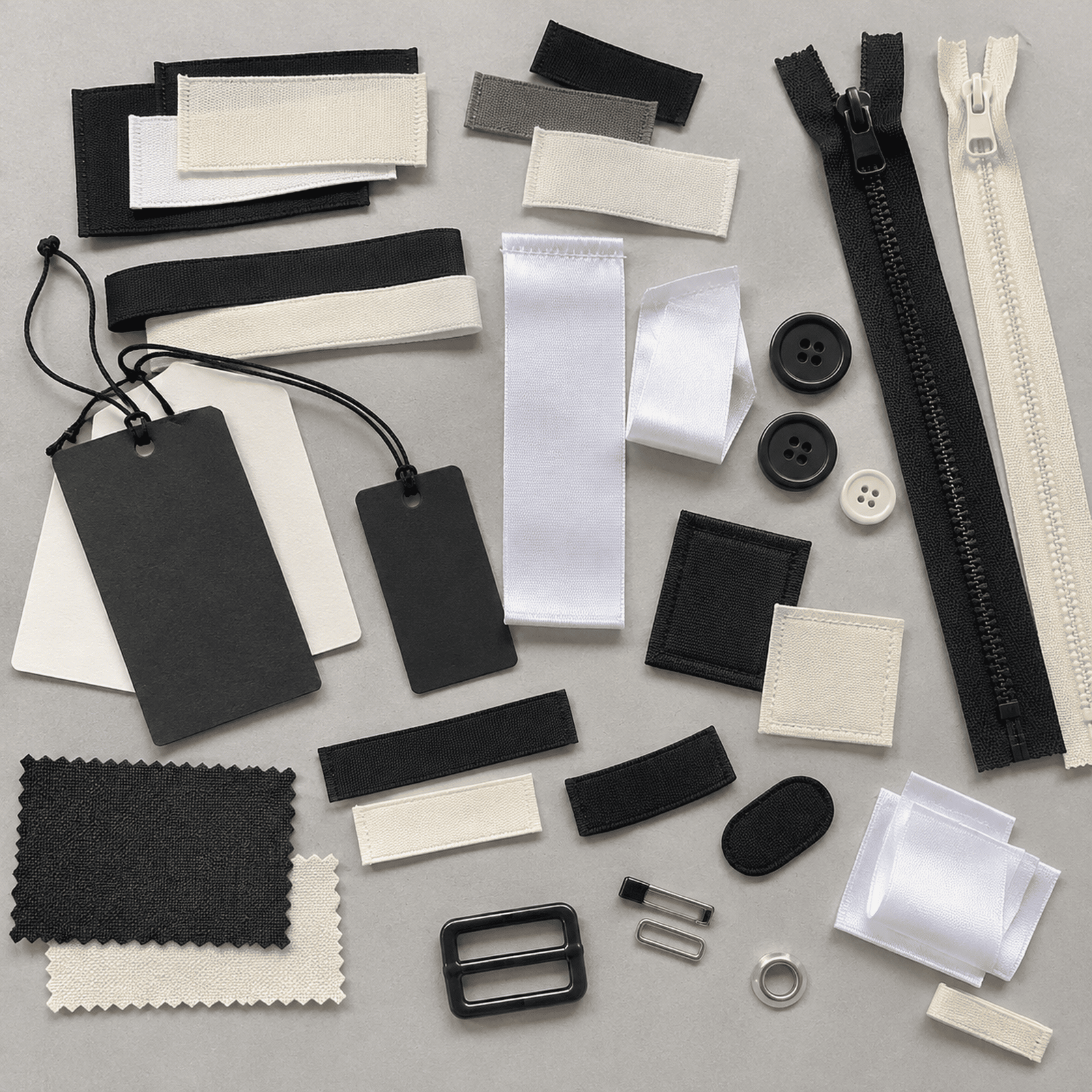
But here is the problem: most online resources treat trims as a vocabulary lesson — "here are ten types of labels" — without helping you decide which ones your specific project actually needs. In this guide, I will walk you through the full landscape from a production-side perspective, help you separate compliance requirements from branding decisions, and give you the practical parameters that determine whether your trims perform or fail.
Why Do Labels and Trims Matter More Than Most Brands Realize?
New brand founders often leave trim selection to the final week before production. It feels like a small detail — until a missing care label holds up a shipment, or a cheap woven label pills after three washes and triggers customer complaints.
Labels and trims matter because they sit at the intersection of three critical functions: regulatory compliance, brand identity, and product durability. Neglecting any one of these creates measurable business risk — from customs rejections to customer returns to a brand perception that feels "off."
Compliance Trims vs. Branding Trims: The Most Important Distinction
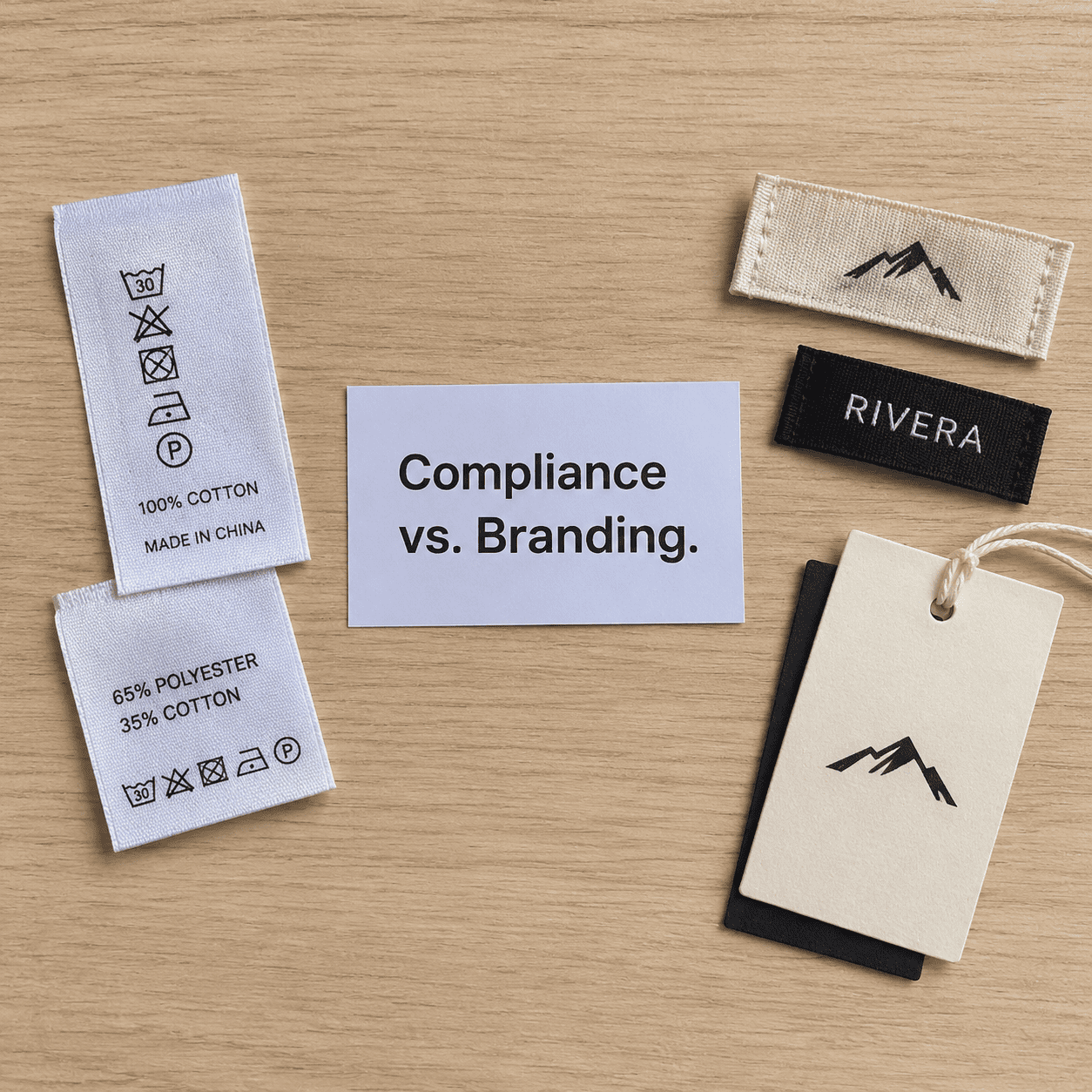
In our experience developing trim packages for DTC brands and Amazon sellers, the single biggest conceptual mistake first-time buyers make is treating all labels as branding elements. They are not. There are two fundamentally different categories:
| Category | Purpose | Examples | Consequence of Getting Wrong |
|---|---|---|---|
| Compliance trims | Meet legal requirements for your target market | Care labels, fiber content labels, country of origin labels | Customs holds, fines, forced relabeling, marketplace listing removal |
| Branding trims | Communicate brand identity and perceived value | Woven brand labels, hang tags, leather patches, custom zippers | Weak brand perception, inconsistency, customer disappointment |
Compliance trims are non-negotiable. In the United States, the FTC requires fiber content disclosure, care instructions, and country of origin on most textile products1 [verify current requirements for your specific product category]. The European Union enforces textile fiber labeling under Regulation (EU) No 1007/20112 [verify current requirements]. Other markets — Canada, Australia, Japan — have their own rules.
I am not a compliance attorney, and I strongly recommend you consult one for your specific market. My role is to flag that these requirements exist, because a surprising number of first-time brand owners discover them only after production is complete.
The Cost of Treating Trims as an Afterthought
A common pattern we see: a brand finalizes fabric, cut, and sew — then rushes trim selection in the last few days. The result?
- Wrong lead times. They spec custom metal buttons that require 25–30 days, but need delivery in 14.
- Wrong materials. They choose a satin-weave woven label for an activewear piece that gets washed three times a week — the label frays within a month.
- Wrong budget allocation. They spend heavily on hang tags (which customers discard immediately) and skimp on the brand label sewn inside the neckline (which the customer sees every time they put the garment on).
Trims should be specified during the design phase, not after. They are part of the product, not accessories added to it.
What Are the Core Types of Labels in the Fashion Industry?
With dozens of label types available, it is easy to feel overwhelmed. The real question is not "what labels exist" but "which label type matches my product's wash requirements, brand positioning, and price point?"
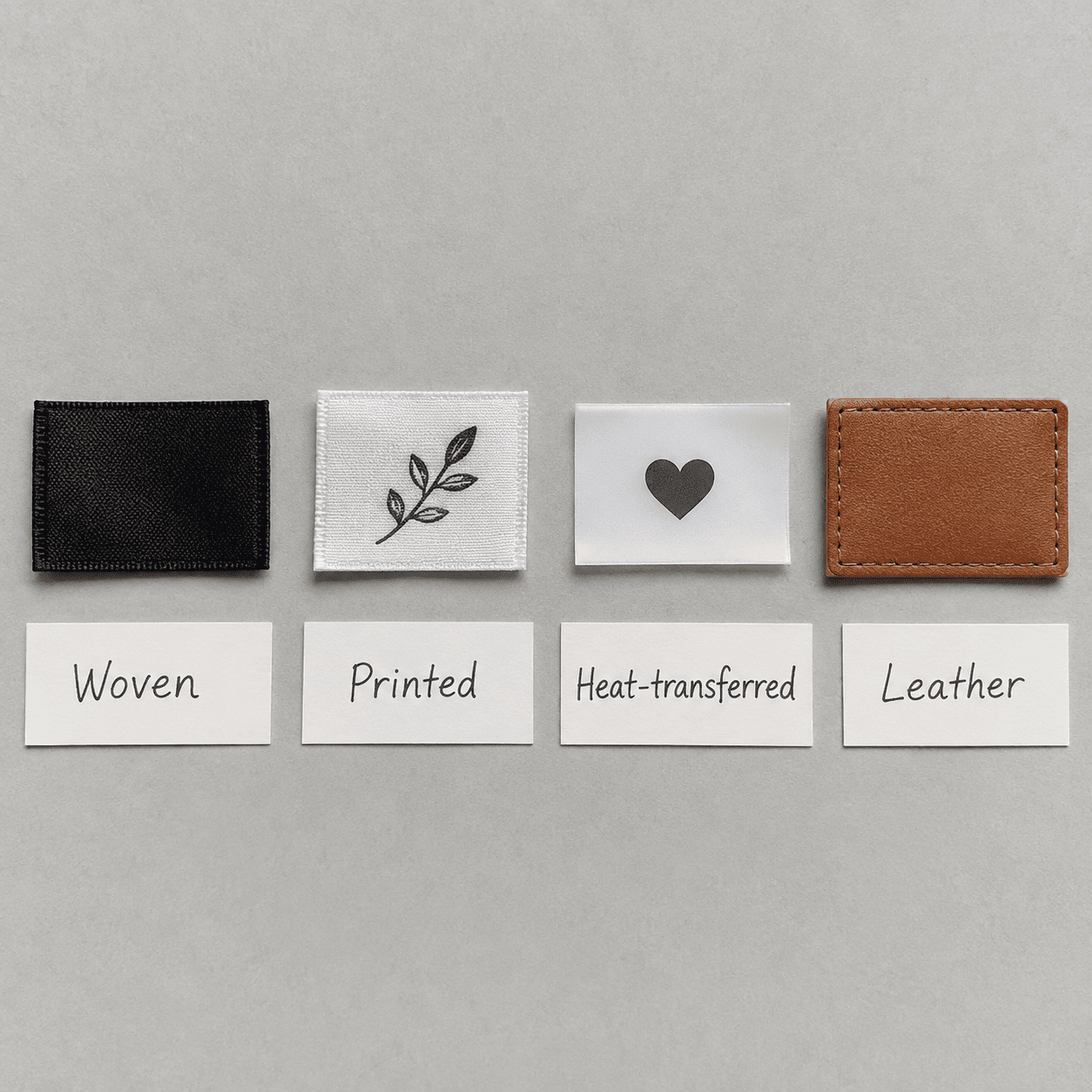
The core label types in the fashion industry fall into five main categories: woven labels, printed labels, heat transfer labels, leather/PU labels, and rubber/PVC labels. Each has distinct characteristics in terms of durability, tactile feel, visual expression, cost, and minimum order quantity.
Woven Labels
Woven labels are the most traditional and widely used label type. The design is woven directly into the fabric of the label using yarns, which gives them excellent durability and a premium tactile quality.
What most buyers don't know: Not all woven labels are equal. The two parameters that matter most are weave type and density.
| Weave Type | Characteristics | Best For | Relative Cost |
|---|---|---|---|
| Damask | High thread count, smooth surface, fine detail reproduction | Luxury and premium brands, intricate logos | Higher |
| Satin | Shiny, smooth finish, slightly less detail capacity | Mid-range brands, text-heavy labels | Moderate |
| Taffeta | Rougher texture, basic detail reproduction | Care labels, budget-conscious production | Lower |
HD (High Definition) woven labels use significantly higher thread density — often 80–100+ threads per centimeter compared to standard 50–603. The practical difference? An HD woven label reproduces small text, gradient effects, and complex logos clearly, while a standard-density label may blur fine details.
Selection decision: If your logo has fine lines, small text, or multiple colors, request an HD damask sample. If your logo is bold and simple, standard satin may deliver the look you need at a lower unit cost.
A common mistake we correct during sampling: clients specify satin-weave labels for garments that will endure frequent high-temperature washing (workwear, activewear, children's clothing). Satin weave is beautiful, but the longer float threads that create its sheen are more vulnerable to abrasion. For high-wash applications, damask or taffeta weaves typically perform better.
Typical MOQ: 100–300 pieces (varies by supplier). Lead time: 7–15 days for production after design approval.
Heat Transfer Labels
Heat transfer labels (also called tagless labels) are printed graphics applied directly to the fabric using heat and pressure. No stitching is involved — the label essentially becomes part of the garment surface.
The primary advantage is comfort. There is no sewn edge, no folded fabric — just a smooth print. This is why major basics brands shifted to heat transfer for neckline labels4. It eliminates the "itchy tag" complaint entirely.
Key technical parameter: wash durability. Heat transfer labels vary enormously in longevity depending on the ink system, transfer film, and application temperature. A quality heat transfer label should survive 50+ home washes without significant cracking or fading. Low-quality transfers can begin peeling after 5–10 washes.
Selection decision: Heat transfers are ideal for products where skin contact matters (underwear, children's wear, activewear) and where a "tagless" aesthetic fits the brand. They are less suitable when you need a premium tactile element that the customer consciously notices and associates with quality.
Typical MOQ: 500–1,000 pieces. Lead time: 5–10 days.
Leather and PU Labels
Leather labels and synthetic PU (polyurethane) leather labels serve as prominent visual brand markers, most commonly seen on denim waistbands, outerwear, and premium accessories. They communicate craftsmanship and durability.
Genuine leather vs. PU leather is not purely a quality distinction — it is a positioning and compliance decision:
- Genuine leather has natural texture variations, ages distinctively, and signals premium positioning. It also carries higher cost and requires accurate material declaration on your content label.
- PU leather offers more consistent appearance, lower cost, broader color options, and can be marketed as a vegan/animal-free option.
A practical note from our production experience: leather labels require debossing or hot stamping for text and logos, which limits the level of detail compared to printing. If your logo has very fine lines or multi-color elements, leather may not reproduce it well. We always recommend requesting a physical sample before committing to production — the digital mockup often looks quite different from the finished product.
Typical MOQ: 300–500 pieces. Lead time: 7–12 days.
Rubber and PVC Labels
Rubber (silicone) and PVC labels are molded, three-dimensional labels that offer a bold, tactile, modern aesthetic. They are especially popular in streetwear, sportswear, and outdoor apparel.
| Feature | Silicone/Rubber | PVC |
|---|---|---|
| Feel | Soft, flexible | Semi-rigid, glossy |
| Durability | Excellent — resistant to washing, UV, chemicals | Good, but can crack at extreme cold |
| Brand signal | Technical, sporty, contemporary | Bold, youthful, graphic |
| Eco perception | Increasingly accepted | Less favorable in eco-conscious markets |
| Typical colors | Custom Pantone matching available | Wide range, including metallic effects |
Selection decision: If your brand targets outdoor or activewear markets, rubber patches communicate technical credibility. If you are building a streetwear label with bold graphic identity, PVC offers strong visual impact. For luxury or heritage positioning, neither may be appropriate — woven labels or leather labels will better match the expectation.
Typical MOQ: 500–1,000 pieces (due to custom mold costs). Lead time: 10–18 days (mold creation adds time to first orders; reorders are faster).
What Trims Beyond Labels Should Every Brand Consider?
Labels get most of the attention, but the broader trims category — hang tags, patches, zippers, buttons, drawcords, and elastic bands — collectively define how a garment feels, functions, and presents itself.
Beyond labels, essential trims in the fashion industry include hang tags, embroidered patches, zippers and zipper pulls, buttons and snaps, elastic bands, and drawcords. Each trim category has different MOQ structures, lead times, and brand signaling effects that must be planned during the design phase.
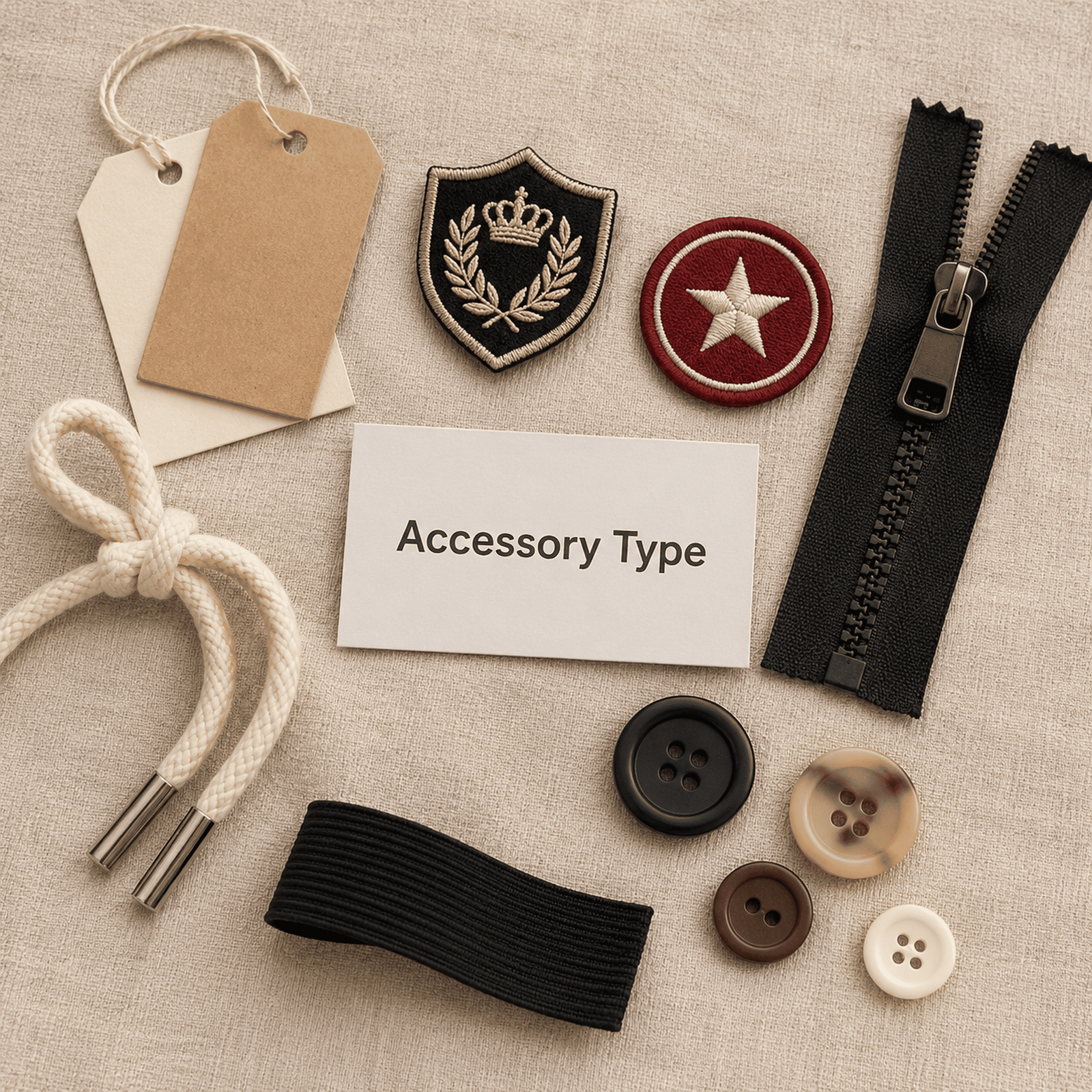
Hang Tags
Hang tags are arguably the most visible trim at the point of purchase — especially for retail and e-commerce photography. They are also the one trim the customer intentionally removes and discards, which creates an important strategic trade-off.
Should you invest heavily in hang tags? It depends on your sales channel.
- Retail and wholesale: Hang tags carry pricing, barcodes, and product information. They are functional necessities and brand impression drivers. Investing in quality card stock, specialty finishes (spot UV, foil stamping, embossing), and thoughtful design pays off here.
- E-commerce DTC: The customer sees the hang tag in product photography and unboxing. A well-designed hang tag adds to the unboxing experience but needs to earn its cost relative to labels and packaging that stay with the product permanently.
Material and finish selection for hang tags:
| Material | Feel & Signal | Best For | Cost Level |
|---|---|---|---|
| 350gsm coated card | Smooth, professional, versatile | Most brands, clean designs | Budget-friendly |
| Cotton paper / textured stock | Artisanal, tactile, premium | Heritage, luxury, sustainable brands | Moderate–High |
| Kraft paper | Eco-friendly, natural, approachable | Organic, sustainable, casual brands | Budget-friendly |
| Specialty (wood, fabric, metal) | Unique, statement-making | Premium limited editions, luxury | High |
A pattern we see frequently: first-time brands over-invest in hang tag finishes and under-invest in the hang tag's informational content. Your hang tag is an opportunity to communicate care instructions, brand story, sustainability practices, or even a QR code linking to digital experiences. Use that real estate strategically.
Typical MOQ: 200–500 pieces. Lead time: 5–10 days.
Embroidered Patches
Embroidered patches offer a rich, textured brand element that communicates craft and heritage. They are commonly used on outerwear, caps, workwear, and streetwear — anywhere a bold, dimensional brand mark is appropriate.
Key technical parameters:
- Embroidery coverage: The percentage of the patch surface covered by thread (vs. the base fabric showing through). Higher coverage (70–100%) creates a denser, more premium look but increases cost and production time.
- Thread type: Polyester thread is standard for durability and colorfastness. Metallic threads create visual impact but are less durable and harder to produce cleanly.
- Backing type: Iron-on (heat-seal), sew-on, or velcro. Iron-on backings are convenient but may not hold permanently on all fabrics — especially performance fabrics or heavy canvas. For production garments, sew-on application is generally more reliable.
Selection decision: Embroidered patches work best when your brand identity includes bold, relatively simple graphics with limited color gradients. If your logo relies on photographic detail or subtle color transitions, a woven label or printed patch may reproduce it more faithfully.
Typical MOQ: 100–300 pieces. Lead time: 7–14 days.
Zippers, Buttons, and Functional Hardware
Functional trims — zippers, buttons, snaps, rivets, drawcord ends — are the trims your customer physically interacts with every time they wear the garment. A zipper that sticks, a button that pops off, or a grommet that oxidizes will damage brand perception far more than a slightly imperfect label.
Zippers: The two dominant manufacturers in the global market are YKK and SBS5, but there are many quality alternatives depending on your positioning and budget. Key decisions include:
- Material: Metal teeth (brass, aluminum, nickel) vs. coil (nylon) vs. molded plastic (Vislon/Delrin). Metal zippers signal premium and durability. Coil zippers are lighter, more flexible, and less expensive. Molded plastic zippers are common in sportswear and outerwear.
- Custom pulls: Custom-molded or engraved zipper pulls are a powerful but often overlooked branding opportunity. They add tactile brand contact every time the customer opens or closes the garment.
Buttons: Material choice (corozo/nut, horn, metal, polyester, shell) communicates brand level instantly. A genuine corozo button on a blazer signals heritage craftsmanship6. A custom-debossed metal button on denim signals brand investment.
| Trim Type | Typical MOQ | Lead Time | Key Cost Driver |
|---|---|---|---|
| Standard zippers (stock colors) | 100–500 pcs | 5–10 days | Length and material |
| Custom zipper pulls | 500–1,000 pcs | 15–25 days | Mold creation |
| Stock buttons | 100–500 pcs | 3–7 days | Material type |
| Custom-debossed metal buttons | 500–1,000 pcs | 15–25 days | Mold + plating |
| Elastic bands (custom woven) | 500–1,000 yards | 10–15 days | Width and design complexity |
| Drawcords (custom tipped) | 300–500 pcs | 7–12 days | Material + tip style |
Critical note on lead times: Metal hardware and custom molds consistently have the longest lead times in the trim category. If your design includes custom zipper pulls, branded rivets, or custom metal buttons, these must be specified and ordered before other trims to avoid becoming the bottleneck in your production timeline.
How Do You Match Labels and Trims to Your Brand Positioning?
Choosing trims is not just a technical exercise — it is a brand strategy decision. The same t-shirt blank will feel like three different products depending on whether it carries a heat transfer label, a woven damask label, or a rubber patch.
Matching labels and trims to your brand positioning requires mapping each trim decision against your brand archetype, target customer expectations, and the product category's norms. A luxury brand, a streetwear label, and an activewear line should make fundamentally different trim choices — even at similar price points.
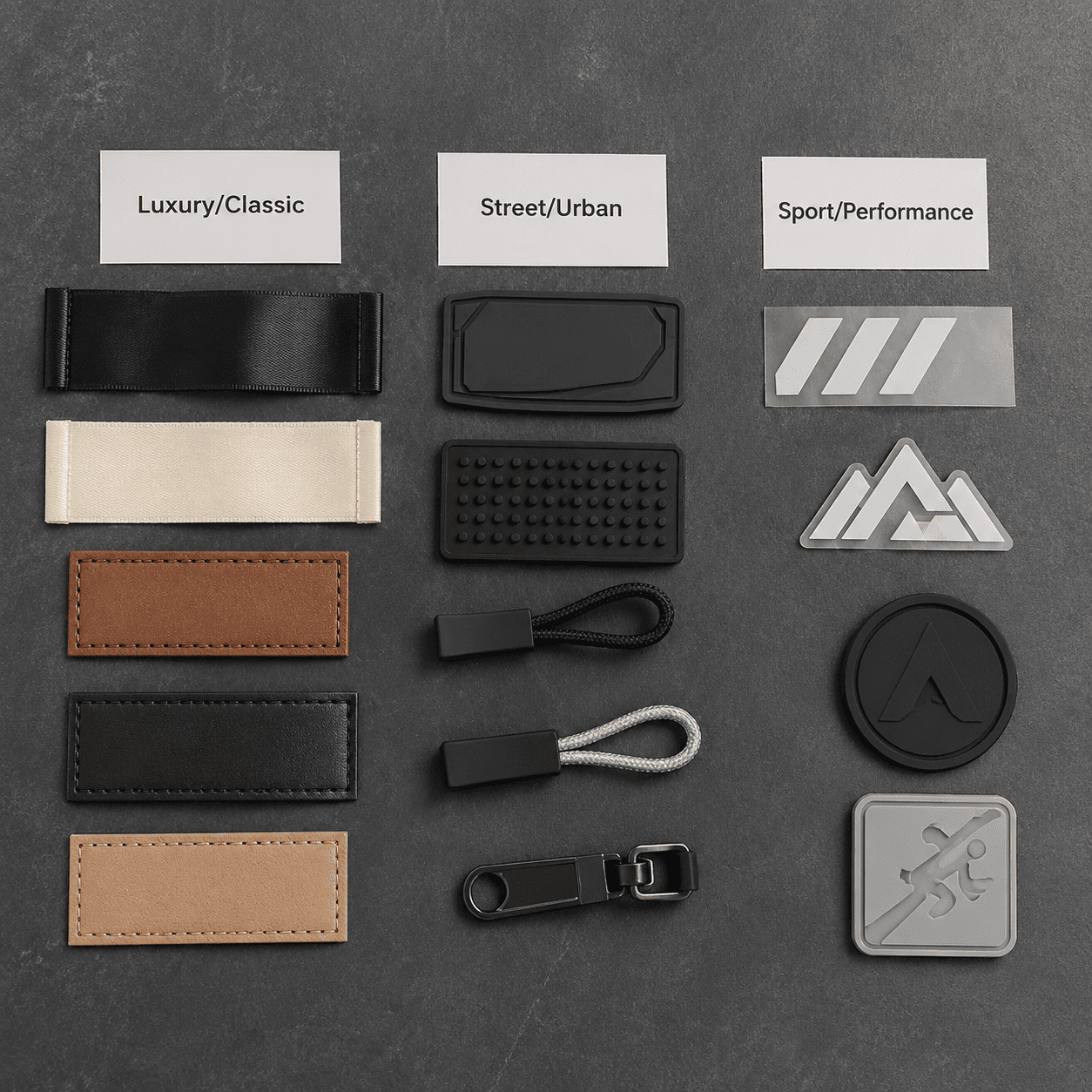
Trim Selection by Brand Archetype
| Brand Archetype | Recommended Label Type | Recommended Accent Trims | Materials to Consider | Materials to Avoid |
|---|---|---|---|---|
| Luxury / Heritage | HD damask woven labels, genuine leather patches | Corozo buttons, metal hardware, woven hang tags | Natural fibers, genuine leather, brass | PVC, cheap polyester, plastic buttons |
| Streetwear / Urban | Woven satin labels, rubber/PVC patches | Custom zipper pulls, embroidered patches, woven elastic bands | Silicone, bold-color threads, custom mold hardware | Understated minimalism, delicate finishes |
| Activewear / Performance | Heat transfer labels, silicone patches | Reflective trims, custom cord locks, technical zippers | Moisture-wicking compatible materials, silicone, coil zippers | Genuine leather, metal that corrodes with sweat |
| Sustainable / Eco | Organic cotton woven labels, recycled content labels | Kraft hang tags, natural fiber drawcords, recycled buttons | Organic cotton, recycled polyester, biodegradable materials | PVC, non-certified metals, virgin plastic |
| Basics / Essentials | Heat transfer labels (tagless), simple woven labels | Minimal hang tags, standard coil zippers | Cost-effective quality materials, clean finishes | Over-designed trims that inflate unit cost |
The "Touch Test" Framework
Here is a practical framework I use when advising brands on trim selection. I call it the Touch Test — because trims are one of the few brand elements customers physically interact with.
Ask these three questions for every trim on your garment:
- Will the customer touch this trim intentionally? (Zipper pulls, buttons, drawcords → invest in quality feel and branded detail)
- Will the customer see this trim repeatedly? (Neckline labels, waistband labels → invest in appearance durability and comfort)
- Will the customer discard this trim immediately? (Hang tags, packaging wraps → balance visual impact against cost)
This framework prevents the common mistake of distributing trim budget evenly across all components. Your budget should weight the trims that create the most repeated brand contact.
What Quality Parameters Should Buyers Verify Before Production?
Specifying the right trim type is only half the job. The technical parameters within each category determine whether that trim actually performs over the product's lifespan. A "woven label" can mean a label that lasts 100 washes or one that frays after 5 — and the price difference may be marginal.
Key quality parameters buyers should verify include color fastness ratings, thread density, material composition, wash durability testing, and dimensional stability. Requesting test reports or conducting pre-production wash testing is the most reliable way to prevent post-production quality failures.
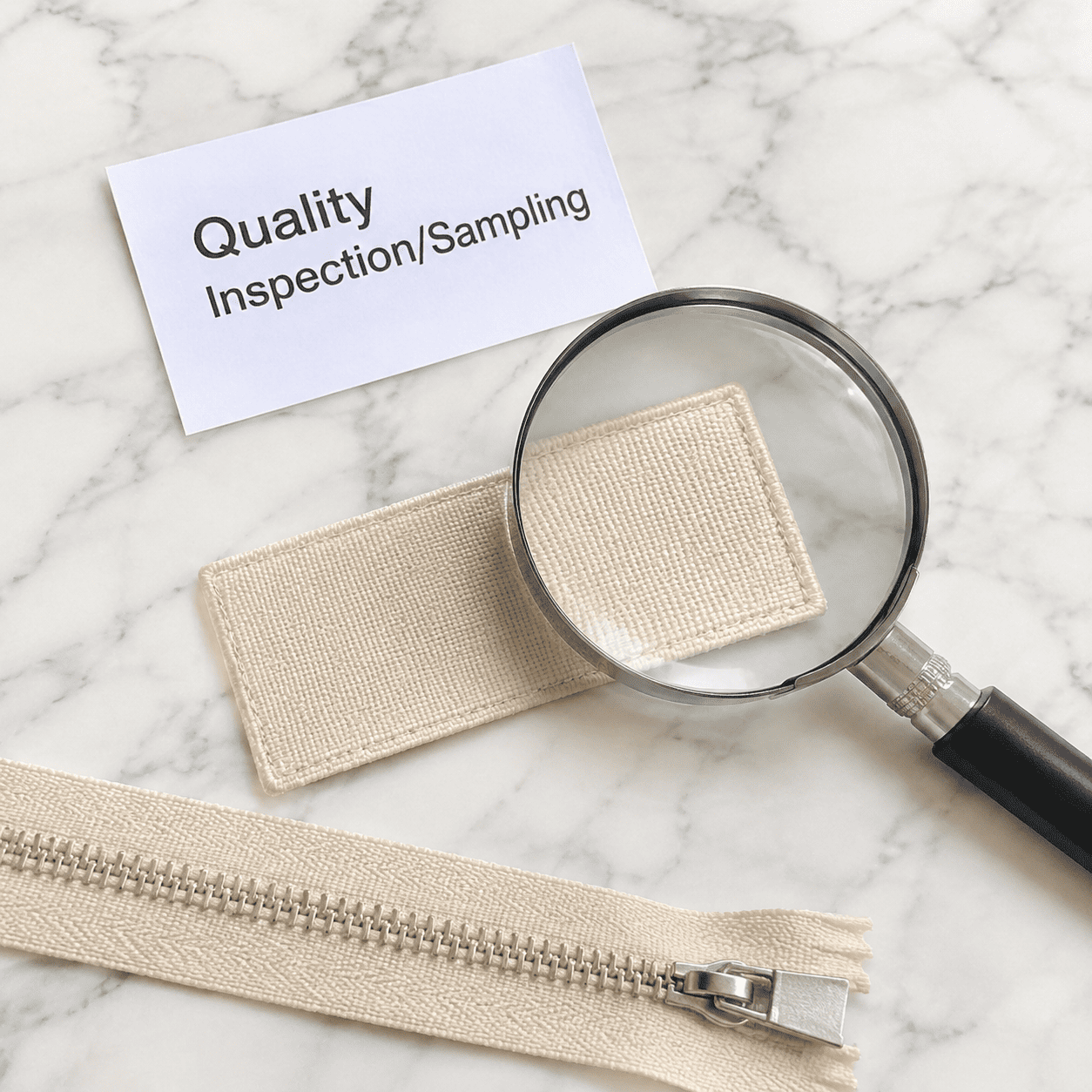
Critical Parameters by Trim Type
For woven labels:
- Color fastness to washing (ISO 105-C06): Look for ratings of 4 or above on a 1–5 scale. Anything below 3 risks visible color change after repeated washing.
- Color fastness to rubbing (ISO 105-X12): Especially important for labels in high-friction positions (waistband, collar).
- Thread density: Request the threads-per-centimeter specification. Higher density = sharper detail and smoother surface.
- Edge finish: Ultrasonic cut, heat cut, or woven selvedge edges. Ultrasonic and woven selvedge edges prevent fraying far better than simple heat cut.
For heat transfer labels:
- Wash cycle durability: Request the number of tested wash cycles. Quality transfers should survive 50+ cycles at the wash temperature specified on your care label.
- Crack resistance: After repeated washing, does the print crack or peel? Request a wash-tested sample before committing to production.
- Fabric compatibility: Not all transfer systems adhere equally to all fabrics. Polyester, cotton, and blended fabrics may require different transfer temperatures and pressures.
For functional hardware (zippers, buttons, snaps):
- Tensile strength: How much force does the zipper or snap withstand before failure? This is especially critical for children's wear, where safety standards are strict7.
- Corrosion resistance: Metal trims that contact sweat (activewear) or moisture (outerwear) must be tested for corrosion resistance. Nickel-free plating is also increasingly required by regulations in the EU and other markets8 [verify current requirements].
- Cycle testing: How many open/close cycles can the zipper handle? Quality zippers are tested to thousands of cycles.
The Sample Stage Is Non-Negotiable
I cannot overstate this: always request physical samples before committing to bulk production. Digital mockups, Pantone swatches, and specification sheets are essential planning tools, but they cannot replicate how a label feels between your fingers, how a zipper pull sits in the hand, or how a hang tag's finish catches light.
In our production workflow, we build 3–7 days for sampling into every project timeline. This is not a delay — it is insurance against a far more expensive problem: receiving 10,000 units of a trim that does not match your expectations.
When evaluating samples, test them in context:
- Sew the label into the garment position where it will be used.
- Wash the garment at least 3–5 times at the care-label temperature.
- Check color, texture, adhesion, and readability after washing.
- Compare the trim against your other brand materials — packaging, website, business cards — for color and finish consistency.
Conclusion
Labels and trims in the fashion industry are functional brand assets that demand the same strategic attention you give to fabric selection, design, and marketing. The most important takeaway from this guide is the distinction between compliance trims (legally mandated, non-negotiable) and branding trims (strategically chosen to match your positioning). Beyond that, every trim decision should be guided by your product's end-use, your target market's regulatory landscape, your brand archetype, and the practical realities of MOQ and lead time.
Start with compliance. Build your brand expression on top of it. Sample everything before committing to production. And budget your trim investment based on where customers will actually interact with it.
If you need help selecting the right labels and trims combination for your project — or if you want to talk through material and craft options for your specific product category — our team is available to walk you through the process from sampling to delivery.
"Threading Your Way Through the Labeling Requirements ...", https://www.ftc.gov/business-guidance/resources/threading-your-way-through-labeling-requirements-under-textile-wool-acts. The U.S. Federal Trade Commission enforces the Textile Fiber Products Identification Act (15 U.S.C. §70) and the Care Labeling Rule (16 CFR Part 423), which mandate disclosure of fiber content, care instructions, and country of origin for most textile products sold in the United States. See FTC, 'Threading Your Way Through the Labeling Requirements Under the Textile and Wool Acts.' Evidence role: general_support; source type: government. Supports: The FTC enforces the Textile Fiber Products Identification Act and the Care Labeling Rule, requiring fiber content, care instructions, and country of origin on textile products.. Scope note: Specific requirements vary by product category; certain items such as footwear and headwear may have different or additional labeling obligations. ↩
"Factsheet - 32011R1007 | European Free Trade Association", https://www.efta.int/eea-lex/32011r1007. Regulation (EU) No 1007/2011 on textile fibre names and related labelling and marking of the fibre composition of textile products was adopted on 27 September 2011 and establishes rules for labelling textile products placed on the EU market, including fibre composition disclosure requirements. See EUR-Lex, Document 32011R1007. Evidence role: general_support; source type: government. Supports: Regulation (EU) No 1007/2011 of the European Parliament and of the Council governs textile fibre names and related labelling and marking of fibre composition of textile products.. ↩
"Units of textile measurement", https://en.wikipedia.org/wiki/Units_of_textile_measurement. Textile weaving references indicate that jacquard-woven label density is a primary determinant of image resolution and surface smoothness, with high-definition labels employing significantly greater warp and weft thread counts per unit area than standard weaves. See general textile engineering literature on jacquard weaving parameters. Evidence role: mechanism; source type: research. Supports: Higher thread density in woven labels (measured in threads per centimeter) enables finer detail reproduction and smoother surface texture.. Scope note: Exact thread density ranges may vary by manufacturer and equipment; the specific figures cited (80–100+ vs. 50–60 threads/cm) reflect common industry practice rather than a single standardized specification. ↩
"Union Label Timeline", https://ilgwu.ilr.cornell.edu/timeline/union-label-timeline.html. Hanesbrands Inc. introduced its 'tagless' heat-transfer label technology for undershirts and underwear beginning around 2002, marketing the elimination of scratchy sewn-in tags as a key consumer benefit. The innovation was widely adopted across the basics and underwear segments of the apparel industry in subsequent years. See contemporary press coverage of the Hanes tagless label launch. Evidence role: historical_context; source type: other. Supports: Major apparel brands, notably Hanes, pioneered the shift to heat-transfer 'tagless' labels in the early 2000s, driven by consumer complaints about irritation from sewn-in labels.. Scope note: The specific timeline and adoption rate varied by brand and product category; the claim of an industry-wide shift is broadly accurate but not uniformly applicable to all market segments. ↩
"YKK", https://en.wikipedia.org/wiki/YKK. YKK Group, headquartered in Japan, is the world's largest zipper manufacturer, reportedly holding approximately 40–45% of global market share. SBS Zipper, based in Fujian, China, is among the largest competitors, with significant market presence in Asia and growing international distribution. See industry analyses of the global zipper market. Evidence role: general_support; source type: research. Supports: YKK is widely recognized as the world's largest zipper manufacturer, with SBS (Fujian SBS Zipper Science & Technology) being a major competitor, particularly in the Chinese and global mass-market segments.. Scope note: Exact market share figures vary by source and year; characterizing both as the 'two dominant' manufacturers may understate the presence of other significant players such as RIRI and Lampo in premium segments. ↩
"A Natural History of the Corozo Button - Kerrin", https://kerrin.co/blogs/journey/a-natural-history-of-the-corozo-button?srsltid=AYCX9vL6qn5807TmAD3iamUjWaedEylvGOTvQEAyaTaB7QMAdAhN2uCJ. Corozo buttons are derived from the seed of the tagua palm (Phytelephas), also known as vegetable ivory. Used in European garment manufacturing since the mid-19th century, tagua buttons are valued for their dense, ivory-like texture, natural color variation, and durability. See Wikipedia, 'Phytelephas,' and historical accounts of button manufacturing materials. Evidence role: historical_context; source type: encyclopedia. Supports: Corozo buttons are made from the tagua nut (vegetable ivory) and have been used in garment manufacturing since the 19th century as a natural, durable alternative to animal ivory and plastic.. ↩
"Highlights of Apparel and Textile Requirements in the ...", https://www.cpsc.gov/s3fs-public/pdfs/blk_pdf_TextilesandApparel.pdf. In the United States, the Consumer Product Safety Improvement Act (CPSIA) imposes strict requirements on children's products, including testing for small parts (16 CFR 1501) and lead content. The EU standard EN 14682 regulates cords and drawstrings on children's clothing. ASTM F1816 addresses drawstrings specifically. These standards collectively impose rigorous requirements on trim attachment strength and design for children's garments. See U.S. Consumer Product Safety Commission and European Committee for Standardization. Evidence role: general_support; source type: government. Supports: Children's clothing is subject to stringent safety regulations regarding small parts, drawstrings, and hardware attachment strength in major markets including the US (CPSIA, ASTM F1816) and EU (EN 14682).. Scope note: Requirements vary significantly by age group and market; the article's general reference to 'strict standards' does not capture the specificity of age-graded requirements. ↩
"Nickel allergy following European Union regulation in ...", https://pubmed.ncbi.nlm.nih.gov/23909687/. Under REACH Regulation (EC) No 1907/2006, Annex XVII, Entry 27, the European Union restricts the use of nickel in articles intended for direct and prolonged contact with skin, setting a maximum nickel release rate of 0.5 µg/cm²/week. This applies to metal components in garments such as buttons, rivets, and zippers. See European Chemicals Agency (ECHA), Annex XVII to REACH. Evidence role: general_support; source type: government. Supports: The EU restricts nickel release from articles intended for prolonged skin contact, including garment hardware, under REACH Regulation (EC) No 1907/2006, Annex XVII, Entry 27.. Scope note: The regulation limits nickel release rate rather than mandating entirely nickel-free materials; compliance can be achieved through plating or alloy selection that meets the release threshold. ↩

0 Comments
Ask a question or share your garment accessories sourcing experience.