
Essential Types of Garment Trims and Their Functions in Apparel Manufacturing
Choosing the right types of garment trims can feel overwhelming when you're launching a new apparel line — especially when every supplier seems to offer the same generic list without context. Pick the wrong trim for a premium hoodie, and you've quietly undermined months of design work. The right trims, matched to your product's positioning and use case, protect quality, reinforce brand identity, and prevent costly returns.
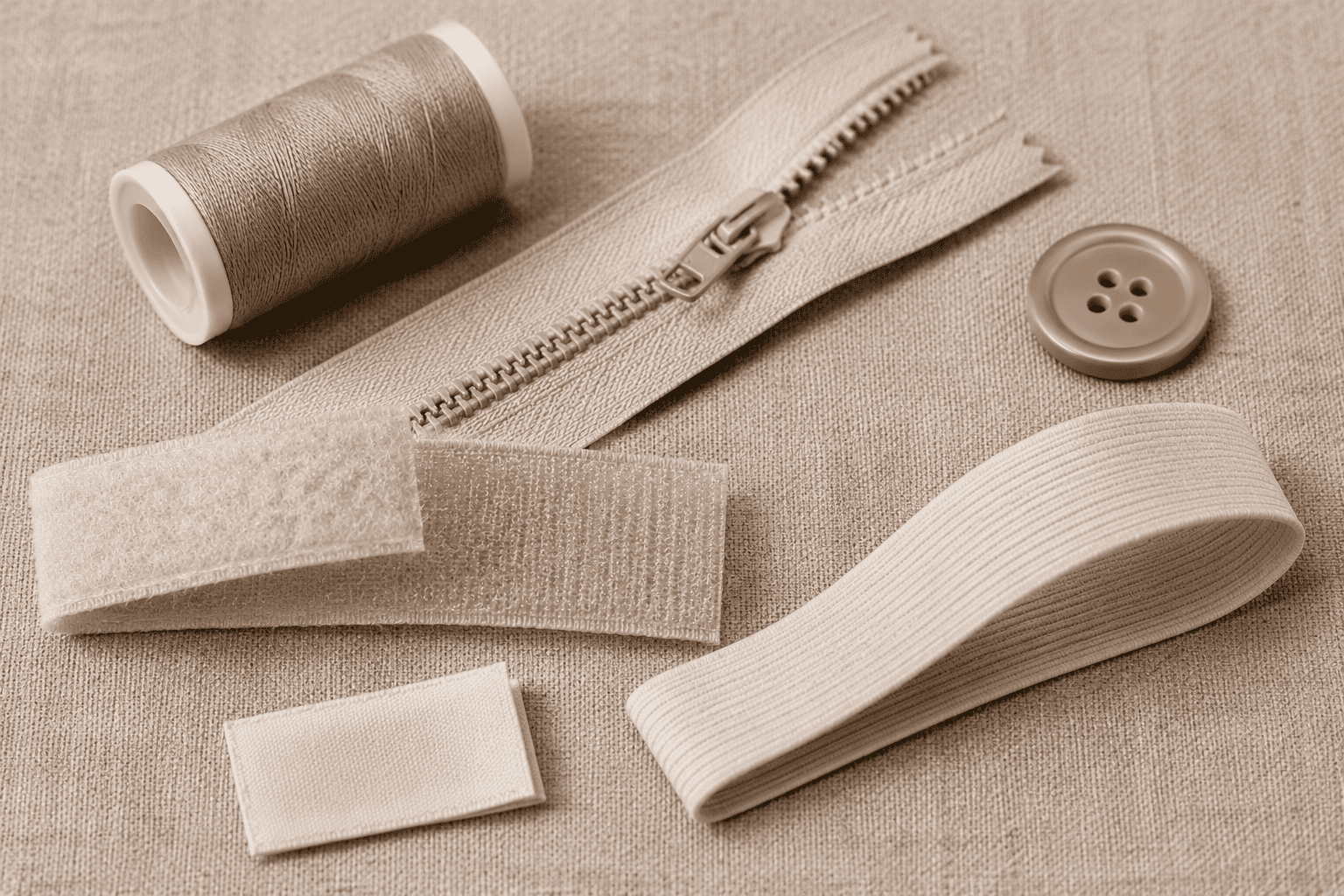
Garment trims are the functional and branding components attached to or integrated into a finished garment — including woven labels, hang tags, zippers, buttons, elastic bands, drawcords, patches, and care labels. Each trim type serves a specific purpose: branding, function, decoration, or regulatory compliance. Selecting trims based on your product's price tier, end-use, and brand identity — rather than copying competitors — is the single most important decision that separates professional-grade apparel from amateur products.
Below, I break down the major categories of garment trims, explain what each one actually does beyond appearance, share the failure patterns I see regularly in production, and give you a practical decision framework. Whether you're a DTC founder placing your first order or a procurement manager building a systematic reference, this guide will help you avoid the mistakes that quietly erode product quality.
What are the main categories of garment trims and why does the taxonomy matter?
Most newcomers to apparel manufacturing treat trims as a single undifferentiated bucket — "just the extras." This confusion leads to mismatched selections, wasted budgets, and products that feel incoherent. Understanding the functional taxonomy is the first step toward making deliberate, strategic trim decisions.
Every garment trim falls into one of four functional categories: branding trims, functional trims, decorative trims, and informational/compliance trims. Each category serves a distinct purpose, and confusing them — like using a decorative patch where a branding label belongs — creates a disjointed product experience that consumers notice even if they can't articulate why.
The four-category framework
Here's the taxonomy I use daily when advising clients on trim packages:
| Category | Primary Purpose | Examples | What Goes Wrong When Misused |
|---|---|---|---|
| Branding trims | Identify the brand and position the product | Woven labels, leather/PU labels, branded zipper pulls, metal logos | Brand dilution, perceived cheapness, inconsistent identity |
| Functional trims | Enable garment construction and wearability | Zippers, buttons, elastic bands, drawcords, snaps, hooks | Garment failure, returns, comfort complaints |
| Decorative trims | Add aesthetic value and visual differentiation | Embroidered patches, PVC/rubber patches, appliqués, printed graphics | Overdesign, cost bloat, durability issues after washing |
| Informational/compliance trims | Communicate care instructions, sizing, fiber content, legal data | Care labels, size labels, content tags, country-of-origin labels | Legal non-compliance, marketplace suspensions, consumer distrust |
Why this matters for your purchasing decisions
In our production facility, I regularly see clients who send a single order mixing all four categories without prioritizing. They'll obsess over the main woven label but treat the care label as an afterthought — then get flagged by Amazon for missing compliance information1. Or they'll invest in beautiful embroidered patches but pair them with the cheapest generic zipper, creating a jarring quality mismatch that undermines the entire garment.
The key insight is this: each category has a different cost-quality sensitivity. Branding trims have the highest brand-impact-per-dollar ratio. Functional trims have the highest failure-risk if you go cheap. Informational trims carry legal consequences. Decorative trims are optional but powerful when done right.
When I sit down with a new client — whether it's a DTC brand founder in the U.S. or a garment factory procurement manager in Southeast Asia — the first question I ask is: "What's the retail price of your finished garment?" That single data point tells me which category deserves the most investment and which trim processes are appropriate. A $15 fast-fashion tee needs minimal but correct informational trims and a clean, cost-effective branding label. A $90 premium hoodie needs a coordinated system across all four categories.
Rule of thumb: If you can only invest extra budget in one trim category, invest in branding trims. They touch the customer every time the garment is worn and are the last thing seen before purchase.
Which branding trims define your apparel identity — and how do you choose between them?
Your branding trims are the silent ambassadors of your label. Get them wrong, and even a beautifully constructed garment feels anonymous or cheap. The challenge is that multiple trim types can carry your brand — woven labels, printed labels, heat-transfer labels, leather labels, metal logos — and each one sends a very different signal.
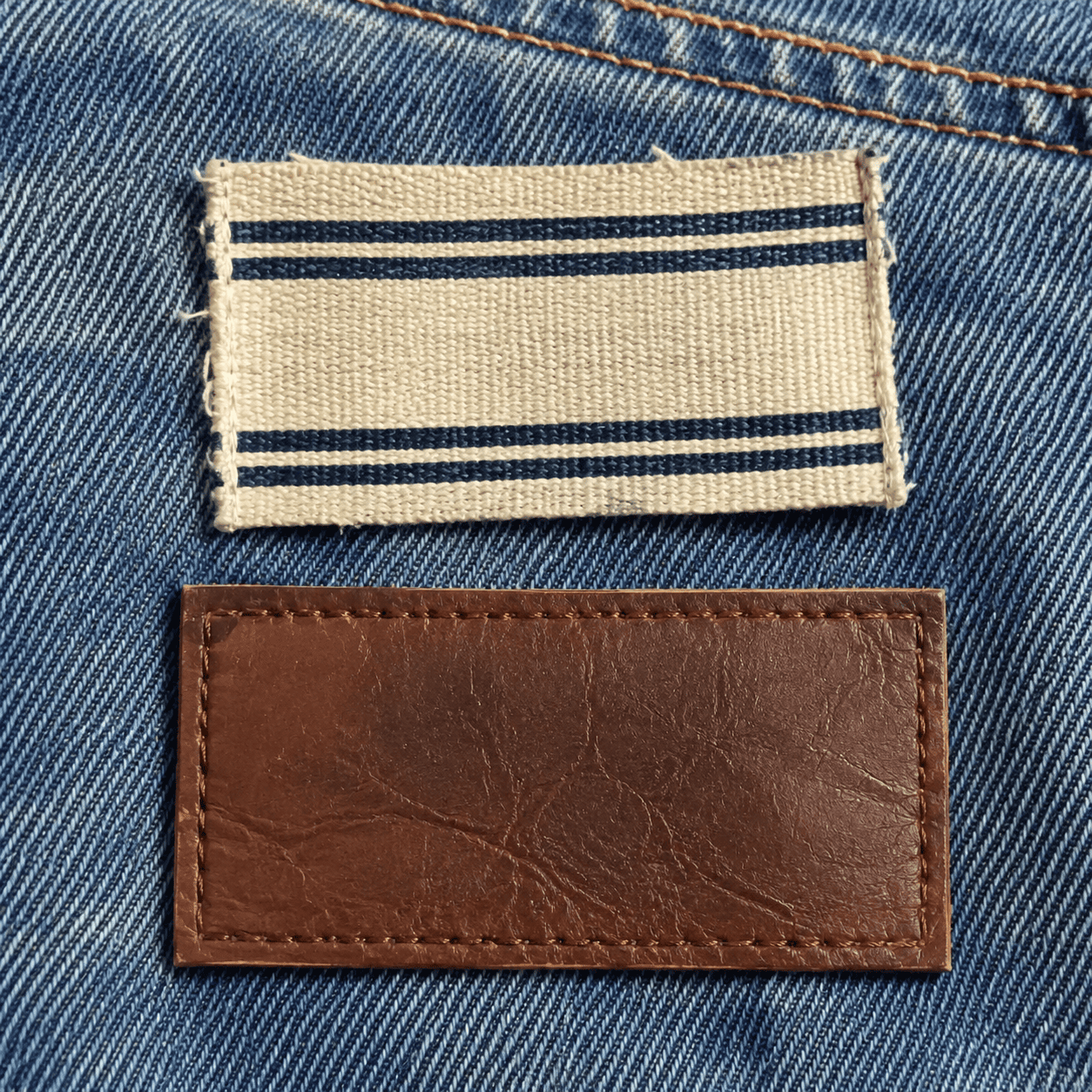
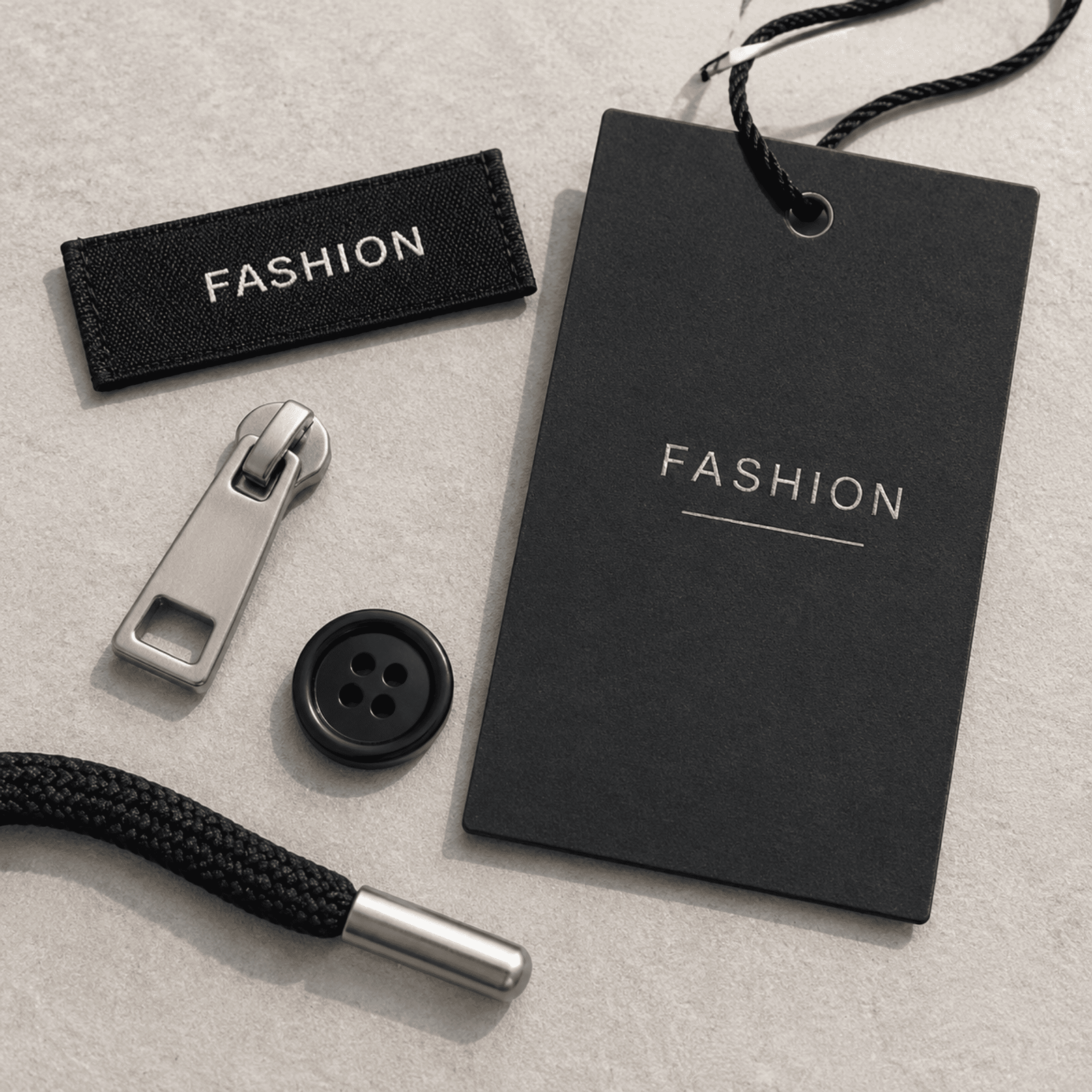
Branding trims include woven labels, heat-transfer labels, printed satin labels, leather or PU labels, and branded hardware (zipper pulls, metal tags). Your choice should be driven by garment positioning: woven labels for mid-to-premium tiers, heat-transfer labels for performance and athleisure wear where tagless comfort matters, and leather labels for denim, outerwear, and premium casualwear. Choosing based on appearance alone — without considering wash durability, hand-feel, and garment context — is the most common mistake I see.
Woven labels: the backbone of garment branding
Woven labels remain the most versatile and widely used branding trim in the industry. They're produced on Jacquard or satin weave looms, with the design woven directly into the fabric rather than printed on top.
Here's what most people don't realize: weaving density directly affects label quality. A standard-density woven label (about 40–50 threads per centimeter in the weft) works fine for bold logos and simple text. But if your brand mark has fine serif lettering or detailed artwork, you need high-density weaving (60+ threads per centimeter) — and that costs more. When clients send us artwork with intricate details and request "standard" labels to save cost, I always flag this. The result of forcing fine artwork onto low-density weaving is blurred text and muddy logos that look like a production defect.
Common failure pattern: I've seen brands approve label samples that look perfect — then receive bulk production where the logo is slightly soft or fuzzy. This usually happens because the sample was produced on a different loom setting than the bulk run. Always request a pre-production sample from the actual bulk loom setup, not just a strike-off.
Heat-transfer labels: when "tagless" is the goal
Heat-transfer labels (also called tagless labels) are printed designs applied to the garment using heat and pressure — typically at 150–180°C for 8–15 seconds2, depending on the fabric. They eliminate the physical label entirely, which consumers increasingly prefer for comfort, especially in athleisure, underwear, and children's clothing.
The critical variable most buyers overlook is adhesion compatibility with the base fabric. Heat-transfer labels adhere differently to cotton, polyester, blends, and technical fabrics. A transfer formulated for 100% cotton may peel after 10 washes on a poly-blend. In our production, we always ask clients for the exact fabric composition before recommending a transfer type. This one question prevents the most common heat-transfer failure: label wash-out.
| Label Type | Best For | Wash Durability | Cost Range | Feel on Skin |
|---|---|---|---|---|
| Damask woven | Premium apparel, structured garments | 50+ washes | Medium–High | Smooth, slightly stiff |
| Satin woven | Mid-range basics, casual wear | 40+ washes | Low–Medium | Soft, flexible |
| Heat-transfer | Athleisure, underwear, children's wear | 20–40 washes (varies) | Low | Seamless |
| Printed satin | Budget basics, fast fashion | 15–25 washes | Lowest | Soft but ink can crack |
| Leather/PU | Denim, outerwear, premium casual | N/A (exterior) | Medium–High | Tactile, premium |
Leather and PU labels: positioning through texture
Leather labels (genuine or PU synthetic) instantly signal a higher product tier. They're most commonly found on denim waistbands, outerwear collars, and bag flaps. The decision between genuine leather and PU comes down to price tier and brand values — PU is cruelty-free and more consistent in color, while genuine leather develops a patina that premium denim brands prize.
What goes wrong: Brands sometimes apply leather labels to lightweight garments where the trim's weight distorts the fabric. I always recommend leather labels only on fabrics with enough body to support them — 8 oz denim and above, structured canvas, or heavyweight sweatshirt fleece.
Functional trims are the workhorses of your garment. They hold it together, allow the wearer to put it on and take it off, and enable adjustability. When branding trims fail, you lose brand perception. When functional trims fail, you lose the customer entirely — through returns, complaints, and negative reviews.
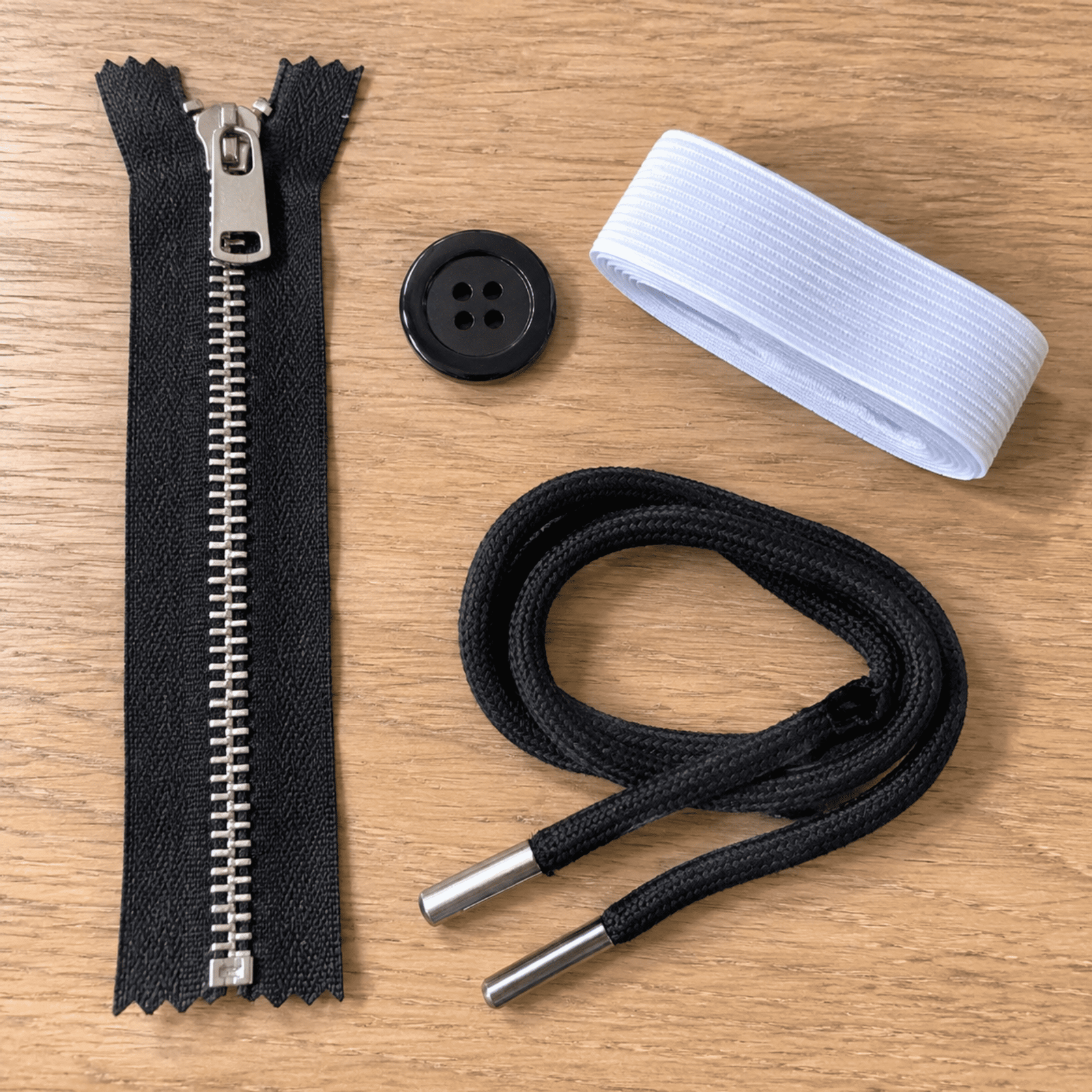
Functional garment trims — zippers, buttons, snaps, elastic bands, drawcords, and hooks — directly determine garment durability, comfort, and user experience. The most impactful quality decision in this category is zipper selection: a cheap plastic zipper on a premium outerwear piece is the fastest way to destroy perceived value. Match your functional trim quality to your garment's price tier and intended use.

Zippers: the trim with the highest failure visibility
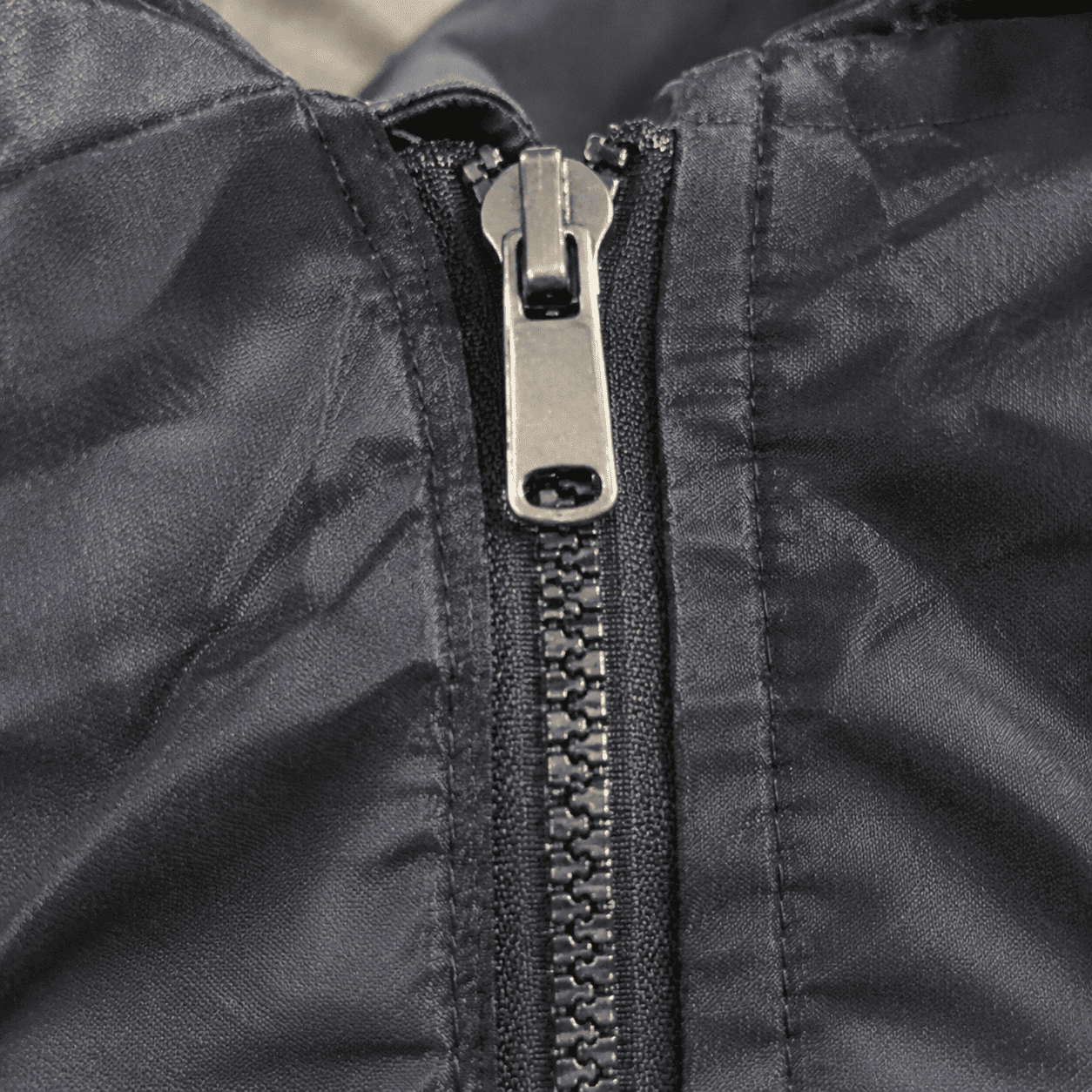
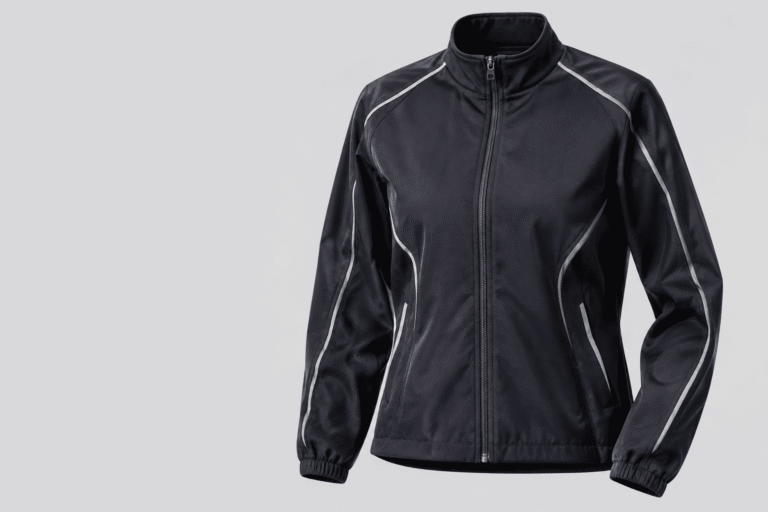
Zippers are the single most visible functional trim on most garments. A stuck, misaligned, or broken zipper is the #1 complaint that triggers returns in outerwear, bags, and jackets3. Here's the selection framework I use:
- Molded plastic zippers: Best for sportswear, bags, and casual jackets. Lightweight and corrosion-resistant. Suitable for $15–$40 garments.
- Coil (nylon) zippers: Flexible and smooth. Ideal for dresses, lightweight jackets, and technical fabrics. Available in very fine gauges for delicate applications.
- Metal zippers: Premium look and feel. Best for denim, leather goods, and structured outerwear. Significantly heavier. Appropriate for $50+ garments.
- Vislon (plastic molded teeth on tape): Popular in activewear and mid-range outerwear. Smoother than standard plastic, lighter than metal.
Common failure pattern: One recurring issue I see is brands selecting a lightweight #3 coil zipper for a heavy outerwear jacket to save $0.15 per unit. The zipper then separates under stress within a few months of wear. The repair or return cost dwarfs the initial savings many times over. Always match zipper gauge to garment weight and stress.
Elastic bands and drawcords: comfort and adjustability
Elastic bands and drawcords seem simple, but they're among the most technically nuanced trims we produce. Key variables include:
- Elastic width and recovery rate: A narrow elastic (15mm) with poor recovery will lose tension after 20 washes, causing waistband sag. We recommend testing elastic samples through at least 30 wash cycles before approving bulk orders.
- Drawcord material: Cotton drawcords look natural but can shrink. Polyester cords maintain length but feel plasticky4. Blended cords offer the best of both worlds for most applications.
- Drawcord tips (aglets): Often overlooked, but metal aglets signal premium quality, while heat-sealed tips are functional but basic. Branded aglets — with your logo engraved or printed — add a surprising amount of perceived value for minimal additional cost.
Production tip: When specifying elastic bands, always provide both the relaxed width and the intended stretch percentage. "25mm elastic" means nothing without knowing if you need 100% stretch (doubles in length) or 200% stretch (triples). This single specification gap causes more reorders than any other elastic-related issue in our facility.
Buttons and snaps: small details with outsized impact
Buttons are one of the oldest garment trims, and the range of materials — metal, plastic, shell, wood, horn, coconut — means they can serve both functional and decorative roles simultaneously. The selection principle is straightforward: button material should match garment fabric weight and care requirements.
| Button Material | Best Garment Application | Can It Be Machine Washed? | Price Tier Signal |
|---|---|---|---|
| Plastic/resin | Basics, casual shirts, children's wear | Yes | Budget–Mid |
| Metal (alloy) | Denim, outerwear, military-inspired | Yes (check plating) | Mid–Premium |
| Shell (mother of pearl) | Dress shirts, luxury casual | Hand wash recommended | Premium–Luxury |
| Wood/coconut | Eco-brands, resort wear, casual | Handle with care | Mid–Premium (niche) |
| Horn | Suiting, luxury outerwear | Dry clean | Luxury |
What goes wrong: Metal buttons with poor plating corrode after a few washes, leaving rust stains on the fabric. I've seen this ruin entire production runs. Always request plating test reports — typically salt spray test results — when evaluating metal button suppliers5. A qualified professional evaluation of plating quality is worth the small upfront cost.
Why do decorative trims like embroidered patches and PVC labels require careful material matching?
Decorative trims are where brands express creativity — and where cost overruns and quality failures hide most easily. The temptation is to add patches, appliqués, and embellishments without considering how they'll perform after the customer takes the garment home and washes it.
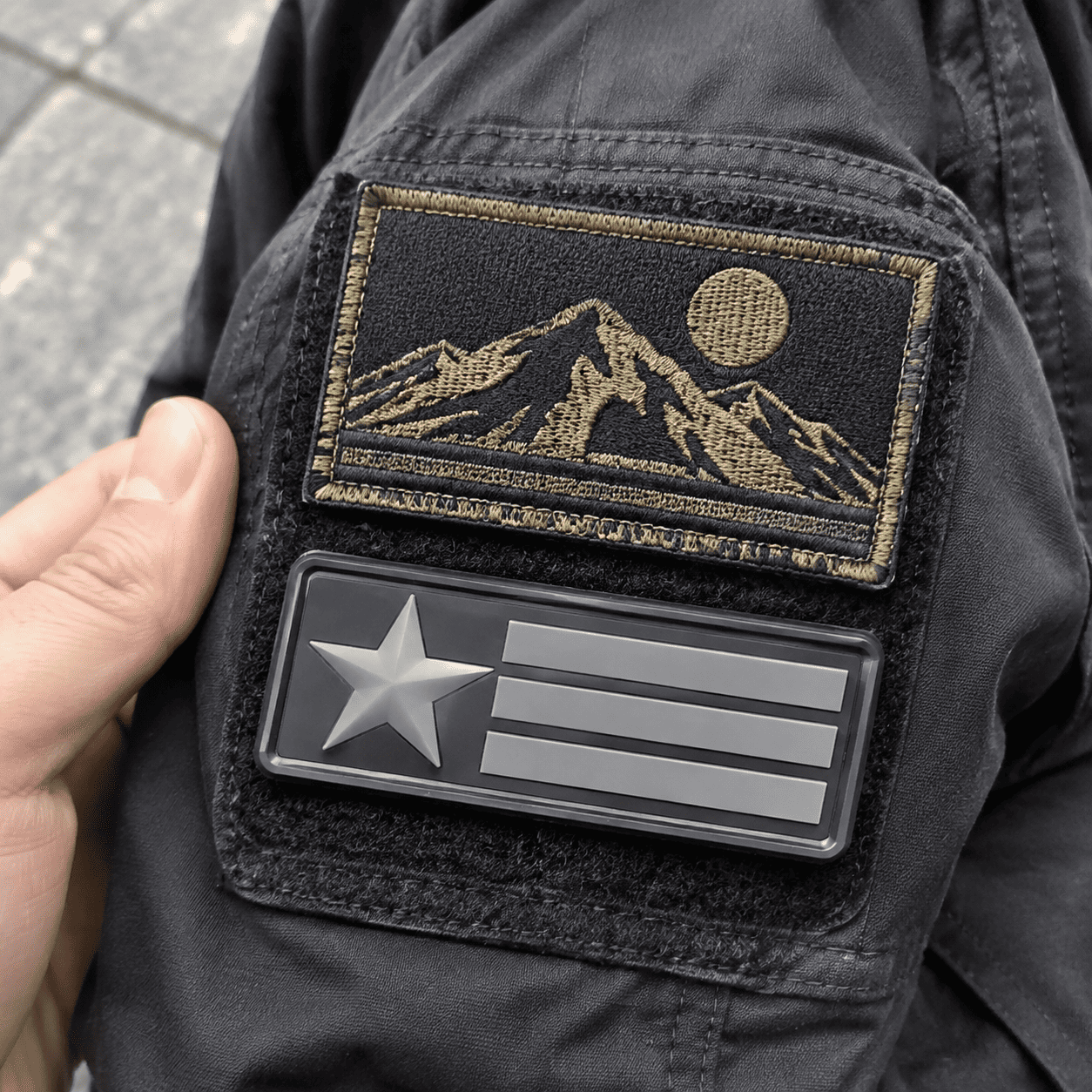
Decorative garment trims — embroidered patches, PVC/rubber patches, appliqués, and specialty hardware — must be matched to the base fabric's weight, stretch, and care requirements. The most common failure is applying rigid embroidered patches to stretchy knit fabrics, which causes puckering, distortion, and premature detachment after washing.
Embroidered patches: base fabric is everything
When clients send us artwork for embroidered patches, the first thing we check is the base fabric (backing) specification, not the design. Here's why: an embroidered patch is essentially a dense thread structure built on a substrate. If the backing is too thin, the embroidery puckers and the patch curls. If the backing is too thick, the patch becomes stiff and uncomfortable.
Common backing options include:
- Twill backing: The most versatile. Works for jackets, caps, bags. Medium stiffness.
- Felt backing: Softer feel, slightly vintage aesthetic. Good for casual and streetwear applications.
- Canvas backing: Heavy-duty. Best for workwear and military-style applications.
Critical decision: sew-on vs. iron-on vs. heat-seal. Iron-on patches use a heat-activated adhesive backing. They're convenient but have lower long-term durability than sew-on patches, especially on fabrics that stretch or undergo frequent washing. In our experience, iron-on adhesion starts failing visibly around the 15th–20th wash on cotton garments6. For any garment priced above $40, I recommend either sew-on attachment or heat-seal plus sew for maximum security.
Thread density and stitch count also matter more than most buyers realize. A higher stitch count per square centimeter produces a smoother, more photo-realistic design but increases production time and cost. For text-heavy patches, 80,000–100,000 stitches typically suffice. For detailed graphic designs, you may need 150,000+ stitches. Under-specifying stitch count to save cost produces patches that look thin and unfinished — a problem that's obvious to consumers even at a glance.
PVC and rubber patches: the modern alternative
PVC (polyvinyl chloride) and silicone rubber patches have grown rapidly in popularity, especially in streetwear, activewear, and outdoor brands7. They're waterproof, extremely durable, and can reproduce fine 3D details that embroidery cannot.
Key considerations:
- 2D vs. 3D design: 2D PVC patches are flat with recessed or raised areas defined by layers. 3D patches have sculpted surfaces. 3D molds cost more upfront but create a tactile premium feel.
- Color matching: PVC patches are produced from liquid PVC dispensed into molds. Pantone color matching is precise, making PVC superior to embroidery for brand-critical color accuracy8.
- Attachment: PVC patches are typically attached via sewing, Velcro backing, or heat seal. Velcro is popular for workwear and tactical applications but adds bulk.
What goes wrong: PVC patches can crack in extreme cold if the formulation uses cheap plasticizers9. For outerwear intended for cold-climate markets, always specify cold-resistant PVC formulations and verify this with your supplier. Similarly, some lower-cost rubber patches contain materials that may not pass certain consumer safety standards — verify certifications such as OEKO-TEX® documentation before committing to bulk production10.
How should you coordinate garment trims as a system rather than choosing them in isolation?
Here's where most emerging brands falter. They design a beautiful woven main label, then source hang tags from one supplier, zippers from another, and buttons from a third — with no coordination on color, texture, finish, or brand voice. The result is a garment that feels assembled rather than designed.
Garment trims work as an integrated system. Your main label, care label, hang tag, zipper pull, button finish, drawcord tips, and any patches should share a cohesive visual language — consistent color palette, matching finish (matte or gloss), aligned typography, and compatible tactile quality. Brands that coordinate their trim system create a stronger perceived value than brands that invest more money in a single premium trim while neglecting the rest.
Building a trim system: the decision framework
I recommend a reverse-engineering approach to trim selection. Start from the finished product and work backward:
- Define your garment's retail price and positioning. Is this a $20 everyday basic or a $120 premium piece?
- Identify your brand's visual identity constraints. What colors, fonts, and finishes define your brand?
- Map every trim touchpoint on the garment. Main label, care label, size label, hang tag, zipper, buttons, drawcord, aglets, patches — list them all.
- Assign a quality tier to each touchpoint. Every trim should match or exceed the perceived quality of the garment fabric itself.
- Ensure finish consistency. If your main label uses matte gold foil on black, your hang tag should use the same gold and black, and your zipper pull should have a matte gold finish — not shiny brass.
The "weakest link" principle
In our production experience across hundreds of brand clients, we've observed a consistent pattern: consumers judge overall garment quality by the lowest-quality trim, not the highest11. A garment with a stunning woven label but a flimsy, generic hang tag creates a cognitive mismatch. The customer subconsciously registers the mismatch and downgrades their quality perception of the entire product.
This principle is particularly relevant for DTC brands selling online. When a customer unboxes your product, the hang tag is often the first trim they see and touch. If it feels thin, poorly printed, or generic, you've already undermined the unboxing experience before they've even tried the garment on.
Practical coordination tips
- Source from as few suppliers as possible. Consolidated sourcing reduces color-matching variance across trim types. Working with a supplier that can produce labels, hang tags, patches, and elastic trims under one roof — the way we operate — simplifies coordination significantly.
- Create a trim specification sheet listing every trim with its Pantone colors, material, dimensions, finish, and attachment method. Share this single document across all suppliers.
- Request physical mock-ups of all trims together before approving production. Lay them on a garment sample and photograph them. Digital proofs cannot capture how finishes interact in real light.
Frequently Asked Questions
What types of garment trims are most important for a new DTC clothing brand?
For a new DTC brand, prioritize branding trims (a quality woven main label and professional hang tag) and compliance trims (care labels with accurate content). These two categories cover brand identity and legal requirements — the non-negotiables. Add decorative trims only after your core system is solid.
How do I decide between woven labels and heat-transfer labels for my apparel line?
Choose based on garment type and customer comfort expectations. Woven labels work best for structured garments, casual wear, and mid-to-premium products. Heat-transfer labels suit athleisure, underwear, and children's clothing where "tagless" comfort matters. Always verify heat-transfer adhesion compatibility with your specific fabric blend.
Can I order small quantities of custom garment trims as a startup?
Yes, many manufacturers now offer flexible minimum order quantities (MOQs) for custom trims. In our case, we support low MOQs with 3–7 day sampling timelines, making it feasible for startups and small-batch brands to access custom branding trims without committing to massive production volumes.
What happens if I use cheap zippers on premium garments?
Cheap zippers on premium garments create immediate quality dissonance. Customers feel the difference — rough slider action, lightweight teeth, flimsy tape — and associate it with the overall garment quality. More critically, low-quality zippers fail mechanically, leading to returns, negative reviews, and long-term brand damage that far exceeds the per-unit savings.
Should all my garment trims come from the same supplier?
Not necessarily, but sourcing multiple trim types from a single supplier dramatically improves color consistency, lead time coordination, and communication efficiency. If your current setup involves three or four trim suppliers, consider whether a one-stop sourcing approach might reduce the coordination burden and quality variance across your trim package.
Conclusion
Understanding the essential types of garment trims — and how they function as an integrated system — is foundational knowledge for anyone serious about apparel manufacturing. Trims are not afterthoughts. They're the touchpoints where your brand meets the customer's hands, eyes, and trust. Branding trims define identity. Functional trims determine durability. Decorative trims add differentiation. Compliance trims keep you legal.
The most important takeaway? Match every trim decision to your garment's price tier and brand positioning, and coordinate them as a system. A well-chosen, cohesive trim package elevates even simple garments, while mismatched trims quietly degrade products your team worked hard to design.
If you're planning your first trim order — or looking to upgrade your current trim system — feel free to reach out to our team for a consultation. We offer free samples, fast prototyping (3–7 days), and the kind of material-specific guidance that prevents costly mistakes before they reach your customers.
"Threading Your Way Through the Labeling Requirements ...", https://www.ftc.gov/business-guidance/resources/threading-your-way-through-labeling-requirements-under-textile-wool-acts. The U.S. Federal Trade Commission's Care Labeling Rule (16 CFR Part 423) requires care instructions on most textile garments, and major online marketplaces including Amazon enforce compliance with applicable labeling laws as a condition of listing. Evidence role: general_support; source type: government. Supports: That online marketplaces including Amazon require apparel listings to comply with textile labeling regulations, and non-compliant listings may face enforcement actions. Scope note: Amazon's specific enforcement mechanisms and thresholds for suspension are not fully public and may change over time. ↩
"Application Tips for Heat Transfer Products", https://www.averydennison.com/na/en/industries/apparel/application-tips-ntp. Textile finishing references indicate that heat-transfer label application typically requires temperatures between 140–190°C and dwell times of 5–20 seconds, with exact parameters varying by substrate composition and adhesive formulation. Evidence role: mechanism; source type: research. Supports: The standard temperature and dwell-time ranges used in heat-transfer label application for garments. Scope note: Exact parameters vary by equipment manufacturer and adhesive chemistry, so the cited ranges are general industry guidance rather than universal specifications. ↩
"How to Fix a Jacket Zipper", https://www.hellyhansen.com/en_us/guides/how-to-fix-a-zipper?srsltid=AYCX9vJuzdtngCtp9nLIoKVtOhHw-ntKMm7xoVAZVNqjYaTk3urvnxdh. Industry quality audits and consumer complaint analyses consistently identify zipper malfunction—including slider jamming, teeth separation, and tape failure—as one of the most frequently cited defects in outerwear returns. Evidence role: statistic; source type: research. Supports: That zipper-related defects are among the leading causes of consumer returns and complaints for outerwear and jacket categories. Scope note: Publicly available return-reason data is limited, and rankings may vary by brand, price tier, and market segment. ↩
"Particle Shedding from Cotton and Cotton-Polyester Fabrics in ...", https://pmc.ncbi.nlm.nih.gov/articles/PMC10421144/. Textile science literature confirms that cotton, as a cellulosic fiber, is susceptible to progressive shrinkage during laundering (typically 3–5% in untreated forms), whereas polyester's thermoplastic structure provides superior dimensional stability with negligible shrinkage under normal wash conditions (Kadolph, Textiles, 11th ed.). Evidence role: mechanism; source type: education. Supports: That cotton fibers are prone to shrinkage when laundered due to relaxation and swelling of cellulose fibers, while polyester fibers exhibit high dimensional stability. Scope note: Actual shrinkage depends on yarn construction, cord braiding, and any pre-shrinkage treatments applied during manufacturing. ↩
"Salt spray test", https://en.wikipedia.org/wiki/Salt_spray_test. ASTM B117 (Standard Practice for Operating Salt Spray Apparatus) and ISO 9227 define accelerated corrosion testing procedures widely used to evaluate the protective quality of metallic coatings on hardware, including garment buttons and fasteners. Evidence role: definition; source type: institution. Supports: That salt spray testing (e.g., ASTM B117 or ISO 9227) is a standard method for evaluating the corrosion resistance of metal plating on hardware components. Scope note: Salt spray testing provides comparative corrosion resistance data under accelerated conditions and may not perfectly predict real-world performance across all environments. ↩
"Do Iron-On Patches Survive the Wash? (Durability & Care ...", https://www.pinprosplus.com/post/do-iron-on-patches-survive-the-wash. Textile adhesion studies suggest that thermally bonded patches on cotton substrates show measurable peel-strength degradation after 15–25 home laundering cycles, depending on adhesive type and wash temperature. Evidence role: statistic; source type: research. Supports: The approximate number of wash cycles before iron-on adhesive patches begin to delaminate from cotton substrates. Scope note: Wash durability varies significantly with adhesive formulation, wash temperature, and detergent type, so specific cycle counts are indicative rather than definitive. ↩
"PVC Garment Patches 2026 Trends", https://www.accio.com/business/pvc-garment-patches. Industry trend analyses note growing adoption of PVC and silicone rubber patches in contemporary apparel, driven by their durability, waterproof properties, and ability to reproduce detailed 3D branding elements favored by streetwear and outdoor brands. Evidence role: general_support; source type: research. Supports: That PVC and silicone rubber patches have seen increasing adoption in streetwear, activewear, and outdoor apparel segments. Scope note: Quantitative market growth data specific to PVC/rubber patches as a trim subcategory is limited in publicly available sources. ↩
"Embroidered vs PVC Patches: Complete Comparison Guide", https://newyorkcustomlabels.com/blog/post/custom-embroidered-vs-pvc-patches-pros-and-cons. PVC patches are produced by dispensing pigmented liquid PVC into molds, allowing custom color formulation to precise Pantone specifications, whereas embroidery color matching is limited by the finite range of available thread colors and the optical blending effects of thread texture. Evidence role: mechanism; source type: research. Supports: That PVC patch production allows more precise Pantone color matching than embroidery, which is constrained by available thread color ranges. Scope note: Color perception also depends on surface finish (matte vs. gloss) and lighting conditions, so 'precision' is relative to viewing context. ↩
"Review of Recent Developments of Glass Transition in PVC ...", https://pmc.ncbi.nlm.nih.gov/articles/PMC8708294/. Polymer science literature confirms that PVC flexibility at low temperatures is directly dependent on plasticizer type and concentration; inadequate or low-quality plasticizers raise the glass transition temperature, causing the material to become brittle and crack under cold conditions (see, e.g., Wypych, PVC Degradation and Stabilization). Evidence role: mechanism; source type: encyclopedia. Supports: That PVC formulations with lower-quality or insufficient plasticizers exhibit increased brittleness and cracking at low temperatures due to elevated glass transition temperatures. ↩
"Oeko-Tex", https://en.wikipedia.org/wiki/Oeko-Tex. OEKO-TEX Standard 100 is an independent testing and certification system for textile products at all stages of production, including accessories and trims, verifying that tested articles are free from harmful levels of regulated substances (OEKO-TEX Association, oeko-tex.com). Evidence role: definition; source type: institution. Supports: That OEKO-TEX Standard 100 certification tests textiles and accessories—including trims—for harmful substances to ensure consumer safety. ↩
"Halo effect", https://en.wikipedia.org/wiki/Halo_effect. Research in consumer psychology suggests that product quality evaluations are disproportionately influenced by the lowest-performing attribute, consistent with negativity bias in multi-attribute judgment (see, e.g., Herr et al., 1991, on diagnostic information in quality inference). Evidence role: mechanism; source type: paper. Supports: The psychological tendency for consumers to anchor overall product quality judgments on the weakest or most discrepant component. Scope note: Most studies examine general product evaluation rather than garment trims specifically, so the application to apparel trim systems is an extrapolation. ↩

0 Comments
Ask a question or share your garment accessories sourcing experience.